Mair
AsylumMair is the wife of Trevor Williams, who owns Plas Mold and shares the divided house with her. She has no children and is introduced through the work of carrying laundry into the wind; later, she sits with Stella Raphael over tea and accompanies her to collect Charlie from school. Her place in Stella’s life is modest but consequential: as Stella grows detached from her family and begins an affair with Trevor, Mair is close enough to recognize the change, yet remains largely silent about it.
Identity and Introduction
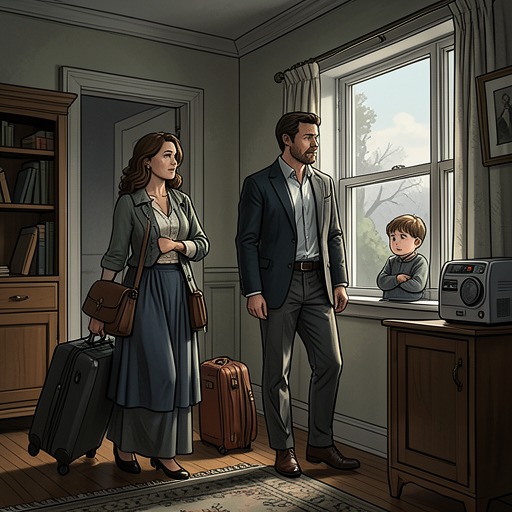
Mair appears when the Raphaels arrive at Plas Mold. Trevor shows Stella and Max Raphael around the house, whose arrangement makes clear that the two couples occupy opposite sides of the same dwelling. Stella realizes that she and Max will have to share a bedroom, a prospect she does not want to confront in front of Trevor. The household’s physical closeness establishes the setting for Mair’s later presence: she is not a distant acquaintance but a neighbor just beyond the back door.
Stella first sees Mair coming from her end of the house with a basket of damp laundry. She hangs clothes on a line across the patch of grass beside the house, moving with clothespins in her teeth while the laundry snaps in the wind. The details place her in a routine of domestic labor rather than social display. When the removal men carry the bed through the back door, Mair and Stella stand in the weather and speak briefly. Mair asks whether the Raphaels came from London; Stella says they came from somewhere not far away. Mair does not appear to know of the scandal associated with the family.
Appearance and Characterization
Mair is described as lean, like her husband, but without the furtive energy Stella thinks she sees in Trevor. Her pale blue eyes and the suggestion that her skin was once soft accompany Stella’s impression that Mair, probably thirty-five or thirty-six, has been worn down into an appearance of agelessness. This portrait is explicitly filtered through Stella’s perception: she reads Mair’s face as marked by work, disappointment, and childlessness. It reveals as much about Stella’s gaze as it does about Mair, whose own thoughts and private history are not disclosed.
The scene also gives Mair a small, practical competence. When Stella offers her a cigarette, Mair sets down the laundry and knows how to light it in the wind. The gesture is unceremonious, like her greeting and conversation. She asks whether Trevor has shown Stella where everything is, but the exchange does not develop into confidences. Mair is present and observant without becoming openly intimate.
Life at Plas Mold and Relationship with Stella
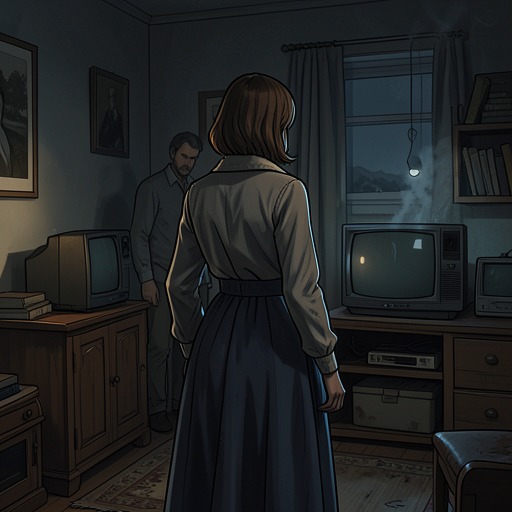
As Stella’s marriage deteriorates, Max stops trying to do what he believes his moral duty requires and turns toward his own needs. He avoids looking at or speaking to Stella, and she feels as if she and the other people around her have become insubstantial to one another. In this numbed state, Trevor’s visits and sexual relationship briefly calm her. Mair understands enough about her husband to recognize that an unhappy woman living under the same roof is unlikely to remain separate from him for long. She appears not to care, but the account offers no explanation of her response and does not establish what she feels privately.
Mair continues to come over, and she and Stella sit together drinking tea while saying very little. Stella finds that the company relieves the numbness for a while, whether the visitor is Mair or someone else. Their connection is therefore less a friendship of shared confidences than a repeated, quiet companionship. Mair’s presence gives Stella contact with another person without requiring her to explain herself; at the same time, Mair’s silence leaves the affair unspoken between them.
Charlie’s Illness and Mair’s Role
One morning, while Mair is sitting with Stella in the kitchen, the school telephones to say that Charlie is unwell and asks Stella to take him home. Max has left the car, so Stella agrees. Mair offers to go with her. Her offer is a concrete act of assistance at a moment when Stella must deal with her son while already withdrawn from the family around her.
The drive back is quiet. Mair sits beside Stella in the front seat, staring straight ahead, while Stella tries to ask Charlie whether he is unhappy. Charlie shrugs and looks out of the window; once home, he goes upstairs without speaking. Mair does not intervene in the exchange, and the journey ends without reconciliation or explanation. After she declines Stella’s offer of tea, Stella sits alone in the kitchen and recognizes that she has begun to see Charlie as an extension of Max and therefore as part of a conspiracy against her. Mair’s presence frames the encounter, but the account does not suggest that she knows the full force of Stella’s alienation. Her role remains one of restrained companionship: she accompanies Stella, witnesses the silence, and then leaves her to face it.