John Archer
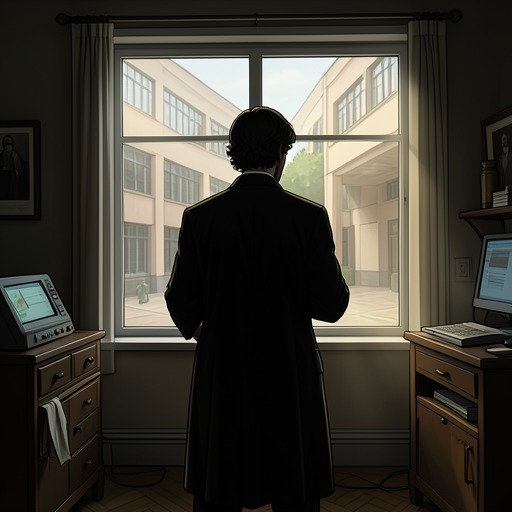
AsylumJohn Archer is a senior attendant at the Maximum-security hospital and grounds whose position gives him a close view of the patients’ work and movements. He becomes important to Stella Raphael and Edgar Stark’s story not through a dramatic confrontation, but through the ordinary acts of supervision, observation, and reporting on which the hospital’s authority depends. His alertness helps make their private attachment visible to the institution; his presence also frames the contrast between the patient’s restricted freedom and the staff’s power to monitor it.
Identity and Work
In the summer of 1959, parole patients left the grounds each morning in supervised work parties to maintain the estate. They wore baggy yellow corduroy trousers and blue shirts, with white canvas jackets slung over their shoulders. Edgar Stark was assigned to work on the garden of the Deputy superintendent’s house, where Stella lived with her husband, Max Raphael, and their son, Charlie Raphael. Archer, described as a senior man, was the attendant associated with the party. When Stella went out to pick flowers or vegetables, she sometimes found Edgar without Archer in sight and stopped to talk with him.
That arrangement put Archer at a significant boundary. The work took patients beyond their wards and into the grounds, but it remained supervised, and their freedom depended on the institution’s confidence in them. Edgar’s parole allowed him to work outside the wards; it did not erase his status as a patient or the attendant’s responsibility to watch over him. Archer’s intermittent absence from Stella’s view created opportunities for her to meet Edgar, while his later attention to their conduct made the limits of that apparent privacy clear.
Encounters in the Garden
One morning, Stella entered the Vegetable garden and saw Archer sitting on a bench in the shade, in his shirtsleeves, rolling a cigarette. She did not want to speak with him, but, having come down the path, she greeted him formally. He stood as soon as he heard her. Further along, Edgar was working at the base of the Conservatory, chipping away at crumbling mortar. Stella and Edgar exchanged no words in Archer’s presence. She understood the social difference between them: as a doctor’s wife she was owed deference, while Edgar, as a patient, occupied a lower position in the hospital’s hierarchy. Their silent exchange nevertheless carried a meaning Archer could potentially observe.
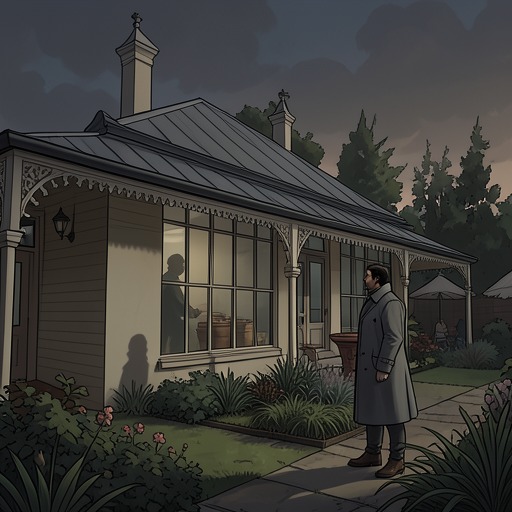
On another occasion, Stella returned along the garden path with flowers in her basket and made a deliberate effort to behave naturally when Archer approached. She complimented the tomatoes he was supplying for summer salads. His steady gaze unsettled her, although she could not tell whether it signified anything beyond her own guilty conscience. The scene establishes Archer as a watchful presence without showing him openly accusing or challenging her. The pressure comes from his capacity to notice and from Stella’s awareness that her conduct might be read by someone who serves the hospital.
Reporting and Institutional Authority
Archer did, in fact, report the developing friendship to the narrating psychiatrist, to whom he was accountable. The narrator characterizes him as sharp-eyed and devious, comparing his deviousness to Edgar’s, and says that Archer soon disclosed what he had observed. That judgment belongs to the narrator; the scenes themselves show Archer watching, receiving information, and occupying a position from which he could report what occurred. The distinction matters: Archer’s practical influence comes less from any stated personal plan than from the institutional value of what he sees and tells.
His report brings Stella and Edgar’s connection into a system where suspicion can have material consequences. Stella recognizes that hospital officials can restrict a patient’s opportunities on suspicion alone: Edgar might be removed from the outside work party, lose parole status, and have his possible discharge delayed. The decision-making power rests with the hospital’s senior authorities, not Archer, but an attendant’s observations can enter the chain of knowledge on which those authorities act. In this way, the staff’s routine oversight helps turn a private relationship into an institutional matter, while Stella’s position as a doctor’s wife does not give her the same authority to speak for Edgar as the officials who control his status.
Edgar’s Disappearance
Archer also appears in the account of Edgar’s escape. After lunch, Edgar told him that he was wanted in the chaplain’s garden, then went off alone. The account presents this as what staff later thought must have happened, rather than as a directly witnessed escape. Edgar retrieved Max’s clothes from a hiding place in the woods at the end of the Raphaels’ garden and used them to get away from the estate. When the work parties were due to return, Archer discovered that his patient was missing. The alarm followed only after a delay, during which Max Raphael had been trying to determine what had happened without first establishing Edgar’s whereabouts.
The episode gives Archer a different relation to the hospital’s surveillance system. Earlier, his observations helped bring Edgar and Stella’s intimacy to staff attention; during the escape, the missing patient becomes apparent to him only after Edgar has left. The gap reveals the practical limits of supervision across outdoor work sites. Archer is neither the decision-maker who controls Edgar’s future nor the person who ultimately prevents his departure. He is, instead, one of the attendants through whom the institution keeps track of patients—and through whom a failure of that tracking becomes known.
Narrative Role
Archer’s importance lies in this double function. He helps expose the fragility of Stella and Edgar’s attempt to treat their meetings as private, yet the later escape demonstrates that institutional oversight is not all-seeing. His steady presence on the garden path, his report to the psychiatrist, and his discovery of Edgar’s absence connect domestic space, parole work, and hospital authority. The story gives him few personal details beyond his senior role and the narrator’s assessment of his watchfulness; within those limits, he represents the human observer through whom institutional power gathers information, while remaining distinct from the officials who decide how to use it.