Stella Raphael
AsylumStella Raphael’s life is shaped by a collision between private longing and the roles that appear to contain it: wife, mother, doctor’s dependent, lover, and patient. Her affair with Edgar Stark carries her out of her family home and into fugitive life, but the freedom she imagines there does not survive the consequences of her choices. After Charlie Raphael drowns while she stands by, smoking and dissociated, Stella is returned to the hospital, where guilt, the institution’s routines, and her continuing attachment to Edgar converge in her fatal overdose. Her story is also filtered through Peter Cleave, whose clinical interpretations and acknowledged gaps make her both the subject of his inquiry and someone who repeatedly escapes his understanding.
Identity and Background
Stella is the daughter of a diplomat disgraced in a scandal years before the events of the story; both her parents are dead. She married Max Raphael while barely out of her teens, and their son, Charlie, is ten when the events unfold. Max is a forensic psychiatrist: reserved and melancholy, a competent administrator in Peter Cleave’s assessment, but weak and without imagination. Peter considers the mismatch between Max and Stella apparent from their first meeting, though this is his judgment rather than Stella’s own explanation of her marriage.
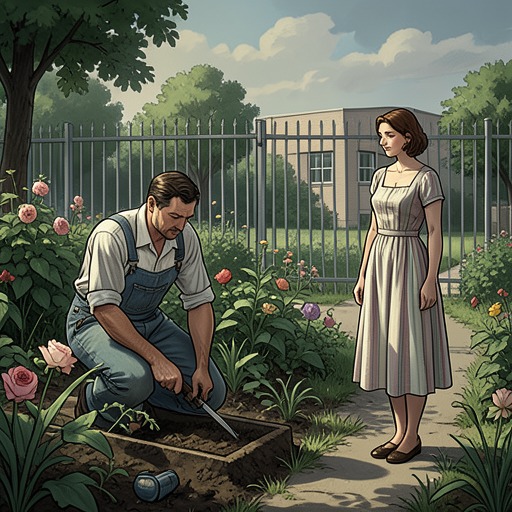
In the summer of 1959, shortly after the Mental Health Act became law, Max accepts the deputy superintendent’s position at the hospital and the family moves there from London. Their large, initially neglected house stands near the Main Gate. Max takes an interest in restoring its garden, while Stella’s encounters with a patient working there draw her toward a life that the orderly domestic arrangement cannot contain. Peter describes her as deeply frustrated and romantic, prone to transforming experience into melodrama. That description helps explain his account of her, but it also marks the limits of the perspective through which readers first see her: he is her psychiatrist, and he later admits that she withheld the truth from him.
The Affair and the Flight to London
Edgar is among the parole patients assigned to work in the deputy superintendent’s garden. Each morning, supervised groups maintain the estate grounds; when Stella goes out to pick vegetables or flowers and the attendant John Archer is absent, she sits and talks with Edgar. She recognizes her attraction early and tries to dismiss it by telling herself that befriending a patient can do no harm. The repeated, ordinary opportunity to meet him gives the attraction a place to grow, even as she attempts to treat it as harmless.
Their first sexual encounter takes place in the conservatory. Stella crosses a meadow and waits in an arched opening in the garden wall near the building, uncertain whether she can bear to remain there. When Edgar appears, she draws him inside and kisses him; afterward she returns to the house and stays in the bath for an hour. The encounter is followed not by a clear decision but by an effort not to acknowledge what she has done. Beneath that attempted denial, however, is the expectation that she will do it again. The affair therefore begins in a private space inside the family estate, close to the domestic life it will eventually rupture.
Edgar later escapes from the hospital wearing Max’s clothes, which he has hidden in the woods at the end of the Raphaels’ garden. After he reaches London, Stella faces the choice of staying with her family or joining him at the Horsey Street warehouse loft. She considers Charlie and almost changes her mind, but pushes the thought away. She calls a car, stops at the bank to withdraw the few hundred pounds in the joint account, and travels to Victoria Station with a suitcase. In the station cafeteria she experiences herself as detached, watching herself behave like an ordinary middle-class visitor; once she has committed to the journey, that detachment gives way to exhilaration. At the loft she confirms that she is with Edgar, and they embrace.
For Stella, the first night there feels like stolen happiness. Nick, who has helped them, provides food, drink, and shelter; she imagines a future in which their precarious life will improve. But Edgar’s urgency soon redirects the reunion toward his artistic ambitions. He sketches Stella’s head while she watches his gaze and pencil at work. The drawing’s smudged outlines and cross-hatching seem to contain her only indistinctly; rather than reassuring her, the image leaves her bewildered and feeling that she does not know Edgar. The scene unsettles the romantic unity she has brought to the affair: he is looking at her, but his art does not give her the clear, idealized image she expects.
Return, Marriage, and Estrangement
Stella’s fugitive life ends when she returns to the loft and finds men inside. Edgar is gone, and the police recognize her and take her back upstairs. They do not immediately question her after establishing that she does not know where he is. At the police station, a woman in uniform gives her tea; later Max arrives. He initially approaches her as a victim who has been manipulated and abandoned, and Stella collapses into his arms, clinging to him. In that moment she needs the comfort he can offer as a doctor. The distinction between doctor and husband does not hold: as the doctor recedes and the husband advances, a different crisis begins.
Back in the family household, the appearance of domestic order persists without restoring intimacy. Max sleeps in the spare bed in Charlie’s room, but the arrangement creates practical frictions: there is insufficient cupboard space, he must keep suits in Stella’s room, and he has to remove in advance the clothes he will need so that he will not wake her. His work is also disrupted when he tries to spread papers in the sitting room. These details make their separation part of daily life rather than a single declaration.
Max’s concern narrows increasingly to Charlie, and Stella understands that her remaining security may end: Max could leave and take their son. The family’s outward form is now the structure protecting her, even though it no longer has substance for her. She cannot make herself pretend to feel anything but indifference toward Max. He, in turn, grows weary and avoids speaking to her; she feels herself becoming invisible to him. In this fog of detachment, Trevor Williams’s visits briefly make her feel more alive. Their sexual relationship calms her and temporarily relieves her anxiety, but does not repair the family or give her a lasting alternative to it.
Charlie’s Death and Readmission
During a family outing at Cledwyn Heath, Stella follows Charlie away from the picnic group to a pool. As he plays in the shallows, a dissociative episode descends: she perceives black waves and a haze like graphite dust, while the pool and her son seem distant. She lights a cigarette. When Charlie loses his balance and struggles in deeper water, she rises but does not call for help or go to him. She watches him disappear beneath the surface, repeatedly bringing the cigarette to her lips with movements she experiences as tight, separate, and controlled.
Hugh Griffin later insists that Charlie was screaming and that Stella stood smoking without trying to help. Whether a warning from the hill could have saved the boy is disputed, but the public response turns on her stillness. People who had sympathized with her now call her unnatural, evil, a monster, or mad. She is charged with manslaughter, remanded, and questioned repeatedly. Numb and detached, she watches herself being moved from room to room, as though from a barricaded place within her own psyche and also from a point above and beside herself. Peter’s visit brings the first faint stir of emotion she has felt for days, and she begins to cry.
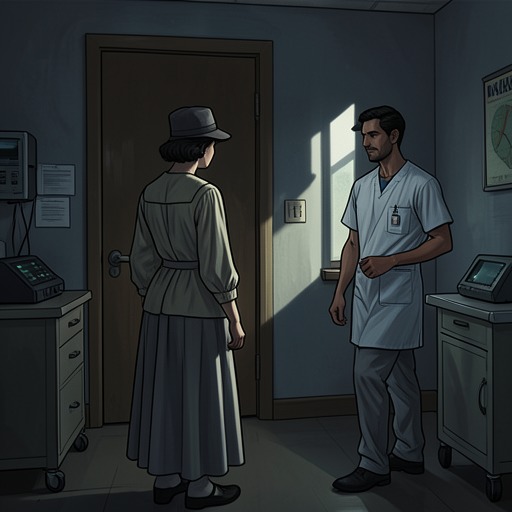
The next day Stella is driven back to the hospital and admitted through the gate of the female wing rather than the Main Gate. She brings three suitcases, saying she needs only essentials, though Peter notices that she has packed most of her evening clothes, including her black silk dress. After a formal interview, a physical examination, and a bath, she is taken to a barred room on the admissions ward. The return turns the hospital into both a place of confinement and the setting in which Peter can resume treating her. It also marks the reversal of her earlier departure: the woman who left with a suitcase for Edgar is brought back under police supervision, carrying clothes whose significance she does not explain.
Guilt, Ending, and Narrative Role
Peter regards Stella’s relationship with Edgar as more clinically intriguing than the circumstances of Charlie’s death. He interprets her response at the pool through the language of maternal filicide and the Medea complex, suggesting that hostility toward Max had been projected onto Charlie. He further concludes that, in extremis, Stella saw Edgar in the water rather than her son or her husband. These are Peter’s clinical readings, not facts Stella clearly explains. Their force is accompanied by his desire to strip away her defenses and examine her psyche, a desire that makes his care inseparable from professional authority.
Stella tells Peter that the affair ended when Charlie died. Yet her grief does not arrive as a simple confession or a settled account. In a recurring dream, Charlie looks at her and asks, “Mummy, can’t you see I’m drowning?” The voice follows her into the morning routines of the ward, where she washes, dresses, and walks to the dining room while trying to maintain an outward composure. In the dream she answers that she will help him, but there is no one there to hear her. The words keep the drowning present not as a completed event but as an accusation she cannot answer away.
The narrative never grants Stella an uninterrupted account of herself. Peter first interprets her, then loses sight of her during her time in London, and must rely on memories she offers tentatively and disjointedly. Her dissociation at the pool and at the police station compounds that distance: she is present in the events but experiences herself as elsewhere. This form reflects a central contradiction in her story. Stella acts decisively when she leaves for Edgar, yet her most devastating action is narrated through paralysis, numbness, and the failure to act.
Stella dies in the hospital after taking a fatal dose of sedatives. Staff spend the night trying to save her, but she does not regain consciousness and dies shortly before dawn. Peter says that her face, as she relaxed and let go of deception and repression, became pale and beautiful again; his description returns to the aesthetic gaze that also shaped his account of her earlier life. She is buried in the hospital cemetery outside the Wall three days later. Max and his mother attend, along with staff; Peter notes that Max has grown thin and stooped, and that he has not told his mother of the marriage plans Peter had made with Stella. Her death closes the affair’s material course, but not its interpretive uncertainty: Peter’s effort to understand her remains bound to the story she could not, or would not, tell him.