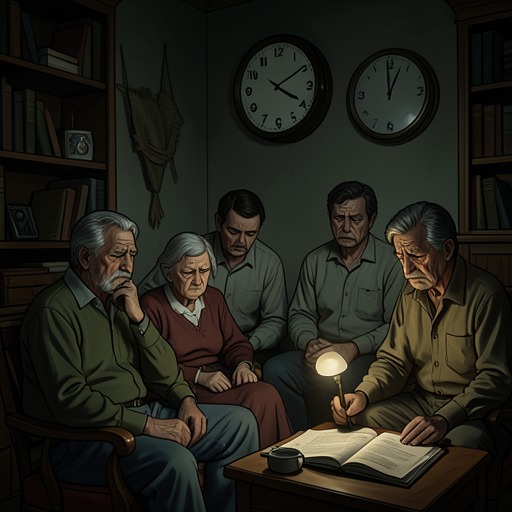
Hugh Griffin
AsylumHugh Griffin, Charlie Raphael’s teacher, enters the story as an observant schoolmaster who notices the unhappiness Stella Raphael has not recognized in her son. His attempt to understand Charlie leads him to invite Stella on a class outing; there, when Charlie struggles in the water, Griffin runs past her and tries to save him. The contrast between his immediate action and Stella’s controlled stillness makes him a pivotal witness to the crisis and, afterward, a source of accusation.
Identity and First Encounter
Griffin is introduced at Charlie’s school, a large Victorian brick building Stella has never visited. When she is called to meet him, he comes into the staff room, clears textbooks from a couch, and asks her to sit. He is tall and young, with thick waves of blond hair, a long pointed nose, and chalk dust on the lapels of his green tweed jacket. The physical details place him firmly in the school setting, but the encounter quickly turns from routine to personal: Griffin asks why Charlie is so unhappy.
Stella has not expected the question. Griffin explains that Charlie is clever but does not make an effort, and that anxiety may be preventing him from telling his teacher what is wrong. His attention to the boy reaches beyond schoolwork to a distress he cannot yet name. Stella, meanwhile, is surprised and unsettled by the concern. The scene establishes a difference between them: Griffin is trying to make room for Charlie’s unspoken difficulty, while Stella is unprepared to see it as a problem requiring attention.
Contact with Stella and Charlie
The meeting does not produce an easy exchange. Stella becomes angry, rises, and searches her bag for a cigarette; when Griffin asks her to sit, she says she has no time. She turns away to stare at the notice board, smoking in short, rapid puffs. Griffin seems reluctant to let her leave and is about to say more, but two women enter the staff room. He then stands and offers to fetch Charlie. On the drive home, Stella tells her son that his teacher thinks he is not working hard enough; Charlie says nothing. Griffin’s concern has reached the family, but the conversation does not open into a discussion between mother and child.
The narration also describes an attraction Griffin feels toward Stella, and his unease about it: she is the mother of one of his pupils and differs from the farmers’ wives and schoolteachers familiar to him. Stella notices his fluster and watches him with amusement. This element complicates their contact without changing its immediate purpose. Griffin’s first substantial intervention is about Charlie’s anxiety, yet the encounter is coloured by an attraction he appears uncomfortable acknowledging.
A few days later, Griffin writes again. Stella nearly discards the letter, expecting another appeal for greater kindness toward her child or a request to talk. Remembering Griffin’s earnest manner at their meeting, she opens it. Instead of asking for an appointment, he invites her to join the class outing to Cledwyn Heath, where the pupils will study local flora and fauna. Stella’s initial response is negative, but, over tea in the kitchen, she considers going if the others are kind to her. At supper she tells the family she may attend. Charlie is excited, having evidently doubted that a parent would come; Max Raphael also takes heart at her decision. Griffin’s invitation thus brings Stella into the setting where his concern for Charlie will become an urgent physical response.
The Outing and Charlie’s Crisis
At Cledwyn Heath, Charlie struggles in the water as Stella stands nearby. She experiences the numbness that follows her distress and watches him flail and shout. Her movements remain tight and controlled: she turns away, brings a cigarette to her lips, and inhales. She does not see Griffin appear over the brow of the hill or hear him shout when he sees her beside the water. His first awareness to her is physical: he bounds past her through the rain and crashes into the water, still shouting.
Griffin comes out carrying Charlie and lays him on the ground, trying to revive him. The scene gives his concern for the boy a decisive form. At school he had recognized anxiety and tried to elicit an explanation; at the water he responds without delay to immediate danger. Stella, by contrast, has remained still and turned repeatedly to her cigarette. The contrast is not simply between a teacher and a mother in the abstract: Griffin has already tried to make Stella attend to Charlie’s unhappiness, and now his intervention exposes the gulf between his response and hers.
The aftermath is confused. Other adults and children gather; the children are taken back to the bus, the police are called, and Stella is treated as being in shock. Griffin’s rescue is therefore followed by a collective emergency in which Stella is largely overlooked. The police later take her and Max to the station, and Max brings her home. The episode shifts Griffin from concerned teacher to direct witness to a crisis with consequences for Stella and her family.
Witness, Accusation, and Narrative Role
Afterward, Max tells Stella that she did not make a sound or open her mouth. He also reports that Griffin is saying it was her fault. The accusation gives Griffin’s perspective a continuing presence even though the available account does not give his own explanation of it. What is established is the basis for his judgment: he saw Stella beside the water while Charlie struggled, and he was the one who ran in to help. His earlier efforts to understand the boy now stand beside a scene in which Charlie’s need is unmistakable and Stella does not act.
Griffin’s role is consequently both practical and evidentiary. He identifies a problem Stella has not recognized, tries to involve her through a school outing, and intervenes when Charlie is in danger. The sequence also limits what can be said about him: the narrative supplies his conduct and Max’s report of his blame, not a full account of his thoughts after the rescue. That partial perspective sharpens his importance. Griffin is the person whose action interrupts Stella’s stillness, and the witness whose accusation makes that stillness impossible for the family to treat as unseen.