Peter Cleave
AsylumPeter Cleave is a psychiatrist at the hospital who becomes its superintendent after Jack Straffen retires. He is both clinician and narrator, and his account of Stella Raphael and Edgar Stark is shaped by a tension he eventually recognizes: he wants to understand and treat them, but also becomes personally invested in their lives. His clinical authority gives him unusual access to their private histories; his attraction to Stella and his wish to manage Edgar make that access a source of compromised judgment as well as insight.
Identity and Clinical Method
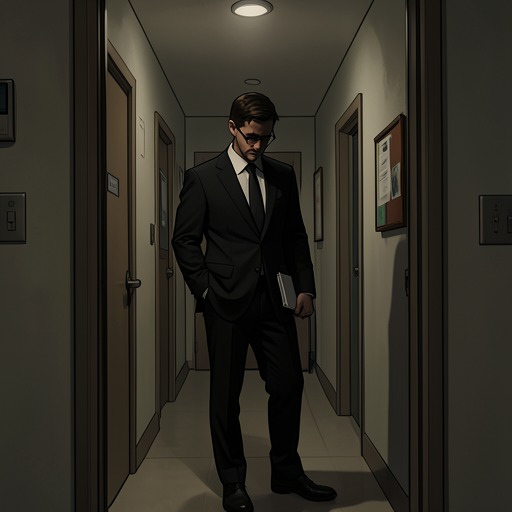
Cleave describes himself as having worked at the hospital longer than its custodial staff. In the evening he returns to his office to reflect on the day, keeping alcohol locked in his desk and looking out toward the country beyond the Wall. His interactions with attendants are deliberately courteous and hierarchical: he believes they value structure, and he has made a manner of patrician affability part of his dealings with them. The stillness of the office and the routines of the institution frame his self-image as an experienced observer, accustomed to interpreting people and events.
That authority is not presented as neutral. Cleave is fascinated by artistic personality because he considers creative impulse important in psychiatry, and he is drawn to patients who challenge his understanding. Yet he also knows that his interest can become entanglement. His account repeatedly distinguishes what he observed from what he inferred, and, at its most consequential, he admits that private concerns clouded his clinical judgment. The narrative thus makes his interpretive skill inseparable from the question of whether he can see beyond his own desires.
Edgar Stark and the Limits of Control
Edgar Stark is one of Cleave’s patients. When Edgar first arrives, Cleave sees a confused, unsteady man who shuffles into the hospital, hunched on a bench with his head in his hands. Once Cleave has settled him and got him talking, he discovers a forceful individual with an original mind and considerable charm when he chooses to use it. The two develop what Cleave calls a warmly combative relationship. Cleave encourages a sense of special connection between doctor and patient, believing it will help Edgar feel that he has a particular relationship with his physician.
At the same time, Cleave regards Edgar as restless, devious, quick to understand how the hospital works, and alert to opportunities for his own advantage. The doctor’s interest is therefore mixed with wariness: he wants to cultivate the relationship, but expects Edgar to exploit situations. In a session some months after Edgar’s admission, Cleave recognizes that Edgar is beginning to disclose the extent of his delusions and to abandon his earlier presentation of the murder as impulsive. That disclosure deepens the doctor’s knowledge of Edgar without resolving the danger Cleave associates with him.
Cleave sees Edgar with Stella only once, at a hospital dance in the Central Hall. The event temporarily loosens the hospital’s usual distinctions of rank: parole patients from the male and female wings attend alongside staff, with the room arranged for dancing, food, and music. Cleave’s single observation of the pair takes place about a year after the Raphaels arrived and roughly three weeks after Edgar began working for Max Raphael in the garden, around the beginning of June. The limitedness of this direct encounter matters: much of Cleave’s later understanding of their relationship comes through disclosures, reports, and his own interpretation rather than sustained observation of them together.
Stella Raphael: Warning, Disclosure, and Return
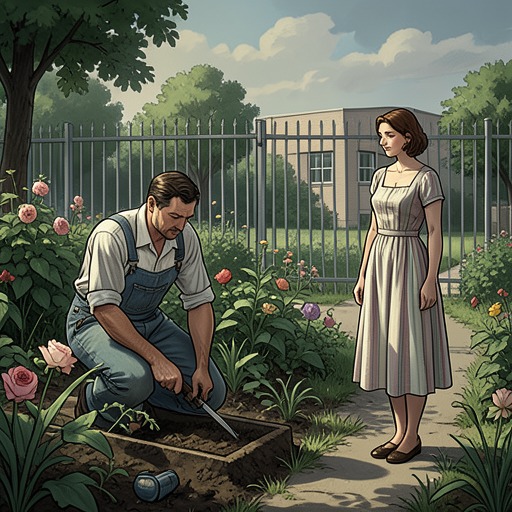
Cleave confronts Stella about whether she is still seeing Edgar. She responds with a composed denial, which he reads as a deliberate attempt to protect herself from his knowledge. Later, in the kitchen, he follows her from the vegetable garden and warns her emphatically that Edgar is dangerous. She is coring cooking apples when he enters, and the ordinary task becomes part of their tense exchange: Cleave takes the knife from her and puts it in his pocket as he turns her to face him. His manner is protective, but the gesture also makes visible the power he exercises in the encounter.
Cleave has already been trying to establish what has happened between Stella and his patient. He spends an hour with Bridie before Jack joins them, bringing them up to date on the little he knows about the relationship. Jack’s confirmation that it is true gives Cleave a firmer basis for understanding the affair, though not a complete account of Stella’s experience. When she describes her time away from the hospital, she often went to Southwark Cathedral, sitting in shadow on a stone bench or walking past tombs and chapels in sunglasses and a tightly tied headscarf. Cleave calls her in his mind the sad woman in the cathedral, but acknowledges that the farther her life moves from the hospital, the harder it is for him to reconstruct it into a shape he recognizes. His sympathetic image of her is also a reminder of the limits of his knowledge.
After Charlie Raphael drowns, Stella is remanded and questioned repeatedly. Cleave visits unexpectedly; she feels the first faint stirring of emotion she has experienced for days, and his expression of sympathy brings her to tears. She is numb and detached from the interviews and proceedings around her, but his visit becomes the central event of her day. Cleave accompanies her through further interviews and a court appearance, trying to minimize her distress. She leaves the management of what is happening to him, and when he asks whether she wants him to continue looking after her, she reacts with alarm at the possibility that he might leave.
Cleave tells Stella that she has been ill and that he wants to treat her in a hospital. She agrees to go to his hospital. By then Jack Straffen has retired, and Cleave has reluctantly agreed to take over the position; he tells Stella informally that he is now the doctor in charge. Her last thought before falling asleep is of Max Raphael and his former expectation that the job would be his. The appointment therefore connects Cleave’s personal relationship with Stella to a decisive institutional role: he is not merely visiting her as a familiar doctor, but is now in a position to direct her care.
Treatment, Transference, and Proposal
As Stella’s treatment proceeds, Cleave becomes increasingly convinced that the transference is developing as he wants it to: he believes she is shifting her dependence onto him. He admits that the thought gives him a peculiar, complicated satisfaction, which he regrets failing to analyze at the time. The candid admission unsettles the image of the detached physician. Cleave is not simply observing Stella’s attachment; he welcomes its movement toward himself, even while his professional position requires him to assess it.
Stella’s progress also involves managing how she appears inside the hospital. With medication reduced, boredom becomes difficult to tolerate, and she understands that an outburst could undo weeks of self-control. She tries to present a calm, amiable, composed manner without appearing either hysterical or depressed, while remaining unsure how long this performance must continue or whether staff recognize how carefully she is sustaining it. The possibility of growing old on the admissions ward weighs on her. After a few days, Cleave moves her to a downstairs ward. Her progression through the hospital is thus tied not only to her condition but also to the behavior the institution can observe.
Cleave’s involvement becomes explicit when he considers asking Stella to live with him after she leaves the hospital. He is past sixty and expects to retire soon; he does not want to spend his remaining years alone. He imagines that Stella, whom he sees as cultured and beautiful, would be suited to his quiet home and to the interests they share: art, travel, gardening, and books. He pictures her bringing light and grace to his rooms, and imagines that living together would allow him to know her and understand her affair with Edgar. He also believes she would find comfort, safety, and asylum with him. The proposal reveals how readily he recasts treatment and care as the basis for a private future he wants for himself.
Recognition, Death, and Aftermath
Cleave’s recognition comes when he sees Stella again in the Central Hall wearing the black silk dress associated with the night Edgar took her in his arms. At first he had treated the dress as a possible gesture of pride or defiance toward the hospital community. He then realizes that he has misread it: in his interpretation, Stella wore it for Edgar, as a wedding dress marking the night she became wedded to him. He understands that the affair is not dead and that he has allowed private concerns to cloud his judgment. He names the distortion as classic countertransference. His recognition is not a triumphant recovery of professional neutrality; it is an acknowledgment that his desire to make Stella’s attachment available to himself helped shape what he thought he saw.
Cleave telephones the female wing to check on Stella. An attendant looks into her room, finds her in bed breathing deeply, and reports back. The reassurance does not remove his unease. He reviews the preceding weeks and considers how his earlier suggestion that Edgar might be at the hospital could have revived Stella’s hope, even after he clarified that the possibility was hypothetical. Cleave imagines that she returned to her room and kept that small flame alive. His account makes the recognition belated: he can reconstruct the emotional consequences of his words only after acknowledging how much his own interpretation had been compromised.
Stella is dead by the time of the later aftermath. Max Raphael attends, looking thin, stooped, and markedly older than when Cleave last saw him; Brenda Raphael accompanies him. Cleave notes that Max does not reveal whether he feels the irony of being in the superintendent’s office, a position he once thought would be his. Brenda hopes Stella is at peace, a remark Cleave finds vulgar, and he observes that Max has not told her of his plans to marry Stella. The scene confirms how much of Cleave’s imagined future remained private and unrealized.
Cleave does not retire as planned. Edgar remains hostile and uncooperative on the top ward in the Refractory Block, and Cleave expects him to weaken because he believes he is all Edgar has now. He has not told Edgar that Stella is dead, wanting first to hear Edgar’s account. He also notes that Max still suspects Stella gave Edgar Max’s clothes and knew he intended to escape, rather than having the clothes taken on impulse. These unresolved questions keep Cleave in his institutional role and leave him managing not only treatment but also the timing and circulation of information.
In reflecting on Edgar and Stella, Cleave sees Edgar as having idealized her beauty and then struggled against the chaos of his passions when the image he had made could no longer be sustained. He connects that struggle to Edgar’s last sculpture, while recognizing the gap between Edgar’s stated artistic aims and Cleave’s own interpretation of them. He sees the pair as disordered people trapped in private suffering, each longing for the other, and places their affair among the destructive relationships he has witnessed. His conclusion carries a double edge: he can identify the pattern of idealization and ruin in them, but his own involvement has shown how readily a physician who interprets others can become captive to an image of his own.