Trevor Williams
AsylumTrevor Williams is the owner and resident landlord at Plas Mold whose closeness to the Raphaels becomes consequential in Stella’s life. Initially a silent, watchful neighbor, he later has sex with Stella while her marriage is disintegrating; the same household that confines her also places him within reach, making him part of the fragile routines and compromises by which she gets through her days.
Identity and Arrival at Plas Mold
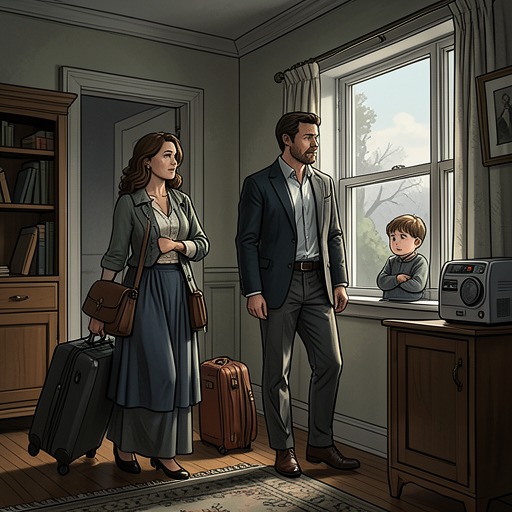
When the Raphaels move into Plas Mold, Trevor owns the house and occupies its other side with his wife, Mair. They have no children. He shows the family around, but his silence gives Stella the distinct impression that he would prefer as little contact with them as possible. His manner establishes a wary distance before any intimacy develops.
The house itself makes that separation incomplete. Its kitchen is a long ground-floor room, with a sitting room of matching dimensions one floor above; the top floor contains two bedrooms and a bathroom off the landing. Stella realizes that she and Max will have to share a bedroom, a fact Max has not mentioned. She keeps her reaction to herself while Trevor watches her. In the blustery weather, the house creaks and bangs like a ship, while the shared building places the two households close enough for their lives to overlap.
Stella meets Mair when she comes out carrying damp laundry to hang beside the house. The women exchange a few words in the wind as the removal men carry the Raphaels’ double bed inside. Stella’s first impressions of the couple remain sharply unequal: she regards Trevor as silent and watchful, whereas Mair’s life appears to her defined by work and disappointment. Later, Stella’s account also associates the local men she encounters with suspicion of the Raphaels as English newcomers. These impressions belong to Stella’s perspective; at this point Trevor has shown the family around, but their relationship has not yet moved beyond the cautious proximity of landlord and tenant.
The Affair Begins
The relationship changes in mid-November, when Mair leaves to spend several days with her mother. Stella is alone at the kitchen table, turning the pages of a magazine over tea, still wearing her dressing gown, when Trevor knocks at the back door. He asks to come in, then crosses the kitchen and stands staring out of the window across the valley. The stillness of the countryside already unsettles Stella: she describes such days as menacing, filled with an unnamed dread. In this quiet, enclosed domestic space, Trevor approaches her without first declaring an intention, and the encounter begins on terms she has not sought.
Trevor holds her gaze and strokes her between hip and belly; Stella responds by parting her legs slightly, but the narrative stresses her passivity and reluctance. She thinks she may as well let him have what he wants: she has felt sexually alive only rarely for a long time, stopping him would be difficult, and she fears he might rape her. Her decision is therefore presented not as a clearly initiated affair but as a yielding shaped by sexual deprivation, inertia, and apprehension. When she invites him upstairs, his smile seems to her the look of someone who has tricked her, sharpening the imbalance she has already perceived in the encounter.
In the bedroom, Stella kneels holding the headboard, closes her eyes, and empties her mind while moving against Trevor. She speaks only to prevent him from ejaculating inside her; she has not used her contraceptive cap for weeks because, as she explains, there had been no point. Afterward, while he dresses, she asks whether he still has sex with Mair. His answer—that it happens less often—makes the affair legible as an intrusion into an existing marriage, not a new partnership. The scene leaves intimacy entangled with absence: Stella’s estrangement from Max, Mair’s brief departure, and Trevor’s access to the house converge, but the encounter offers no evidence of a mutual emotional bond.
Intimacy, Insecurity, and the Household
When Trevor returns several days after their first encounter, Stella is still sunk in a fog in which the people around her seem spectral and insubstantial. Her marriage has narrowed into silence: Max no longer appears to regard caring for her as a moral duty, and she fears that one day he will leave with Charlie. She cannot rouse herself to alter this course. Trevor’s presence offers a temporary bodily counterpoint to that numbness; with him, she comes partly to life, and sex leaves her calm and sleepy, easing her anxiety for a while. The relief is brief and practical rather than evidence of a deeper attachment.
Mair understands that something is happening between her husband and Stella. She knows Trevor well enough to expect that an unhappy woman living under the same roof would not long escape his attention, yet she does not appear to care. She continues to visit Stella for tea, and the two women sit together with little conversation. For Stella, either visitor can momentarily interrupt the numbness that makes the world colorless. The affair therefore develops inside a household where its participants share space and routines, but where knowledge of it does not produce an open confrontation.
Trevor also becomes a source of practical security at a time when Stella fears losing her place in the house. Each time she goes out, she half expects to return and find the locks changed. When she raises this fear with him, a strange glint comes into his eye; he tells her that nobody can change the locks except him. Because he owns Plas Mold, his assurance carries the force of property as well as personal reassurance. It calms her to some extent, while underlining how precarious her position is: her continued shelter depends partly on the landlord whose sexual access to her has already become part of her life there.
The arrangement is not a stable refuge. After drinking heavily one night, Stella makes a final trip outside and hammers on the Williamses’ door, shouting for Trevor. She does not tell him what she wants, and the next morning she has to apologize to Max for her behavior. The episode leaves Trevor’s response unstated, but shows how the affair has entered the disorder of Stella’s days: he is someone she seeks out in a drunken crisis, while the house around her remains divided by silence, resentment, and the routines she struggles to maintain.
Narrative Role and Limits
Trevor’s place in Stella’s life remains bounded by the contrast between bodily relief and emotional longing. On her solitary walks through the wet lanes and up the hill, she imagines Edgar still somewhere beyond her, drawing closer; Trevor’s return can quiet her anxiety for a while, but the account gives no sign that he displaces that imagined reunion. Nor does it establish a lasting attachment between them. His importance lies instead in the way his presence joins sexual vulnerability to the practical security of a shared house: he is both the man Stella yields to and the owner able to reassure her about the locks. The narrative presents this entanglement through Stella’s experience, while leaving Trevor’s motives and feelings largely unelaborated.