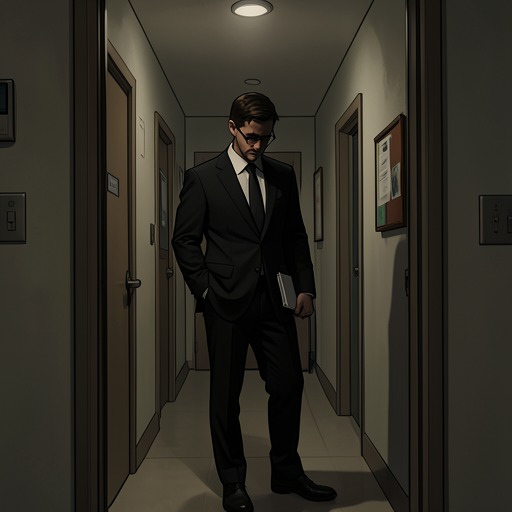
Jack Straffen
AsylumJack Straffen is the superintendent of Maximum-security hospital and grounds when Max Raphael and his family arrive in the summer of 1959. He helps bring Max into the institution’s senior administration, then confronts the consequences when Edgar Stark escapes from the hospital. Through these decisions, Jack appears as a practical institutional leader whose authority is exercised amid uncertain clinical judgments, public scrutiny, and competition over who will succeed him.
Identity and Institutional Position
Jack Straffen oversees a high-security institution organized around strict physical boundaries and controlled movement. The hospital’s perimeter, barred windows, outward-opening doors, and supervised grounds work details make security an everyday administrative concern, not simply a matter of responding to a crisis. Jack’s role places him at the center of decisions about staffing, patient risk, and the institution’s public exposure.
The period of his superintendency coincides with the summer of 1959, when the Mental Health Act has just passed into law. The novel situates him within an institution whose authority includes both treatment and confinement: patients may work in the grounds under supervision, while decisions about whether they remain inside depend on assessments of their condition and risk. Jack is not shown as a theorist of these arrangements, but his position gives his decisions practical force.
Appointment of Max Raphael
When Max Raphael applies for the deputy superintendent’s position, he travels from London for an interview. The board is impressed by him, and Jack is more impressed still. The narrator advises against offering him the job, but Jack does so; the Raphaels arrive at the hospital a few weeks later. The account gives no detailed explanation for Jack’s disagreement with the narrator, making the appointment a concise early instance of his willingness to exercise his own professional judgment.
The appointment later acquires a sharper institutional consequence. Max is widely assumed to be the obvious successor when Jack leaves, a prospect Peter Cleave says everyone had expected. Yet Max does not take over. After the scandal surrounding Stella Raphael and the damage to Max’s standing, the narrator judges that Jack was right to let him go: the hospital is too sensitive an institution for Max to occupy a senior post. Jack expresses sympathy to Max at their parting, but the farewell’s formal civility does not erase the professional judgment behind the departure.
Judgment and Institutional Risk
Jack’s manner can seem weary when a problem appears to be routine. When the hospital learns that alcohol has been brought in, he treats it initially as one of the irritating complications of institutional work rather than an immediate emergency, while identifying Edgar as a possible source. The episode shows how a seemingly minor breach can matter in a place where patient supervision and rules governing the grounds are bound up with security.
His caution is tested by Edgar’s escape. Edgar uses Max’s hidden clothes as a disguise and leaves the estate; the hospital does not immediately sound the siren. Jack and the narrator choose first to organize a search of the grounds, reluctant to alert the surrounding countryside before trying to find him nearby. Attendants search the farm, marsh, and part of the forest for two hours. When Edgar remains missing, the police are informed. The decision reflects a conflict between limiting public alarm and acting quickly enough to prevent a fugitive from gaining distance.
The delay also exposes a failure in communication. Max spends close to three hours investigating the missing clothes and does not promptly establish that Edgar is absent. Jack and the narrator are disturbed by the interval: had Max checked the chaplain’s garden earlier and raised the alarm, Edgar might have been found sooner. Jack’s authority cannot undo the lost time; the episode instead shows how institutional response depends on information reaching the right people without delay.
Secrecy and the Stella Raphael Scandal
After Edgar’s escape, Jack tells Max and Stella that he had previously withheld rumors because he saw no reason to distress them with them, but that the new circumstances require him to bring the matter into the open. His announcement is deliberately grave, although the account at this point leaves the rumors themselves unspecified. The scene makes his management of information part of his job: he has judged that discretion is appropriate until events make continued silence untenable.
The later treatment of Max’s departure shows the same pressure between private loyalties and institutional reputation. Stella’s actions have damaged Max’s prospects, while the hospital’s sensitivity makes confidence in its senior staff especially important. Jack offers sympathy at the farewell, and the narrator supports the decision to let Max go despite acknowledging the personal cost. Jack’s part is presented less as public punishment than as a personnel judgment made under the shadow of scandal.
Retirement and Succession
Jack eventually retires. His departure opens the way for Peter Cleave, who says that he was initially treated as a stopgap while the hospital looked for someone to take the position permanently. Peter had expected Max to be Jack’s successor; instead, after time in the interim role, he decides he has served long enough and reflects that remaining could make his anxiety chronic. Jack’s retirement therefore changes the institution’s leadership beyond simply vacating a post: it redirects the expected succession from Max to Peter.
Jack is absent from Stella’s funeral because his health is poor; the Straffens send their regrets. His absence is a final, brief measure of his changed position in the story. By then he is no longer the superintendent shaping the hospital’s response to crisis, and Peter occupies the office. Jack’s legacy remains attached to the decisions made during his tenure: appointing Max, managing the response to Edgar’s escape, and leaving an institution whose next leadership had not followed the course its members once assumed.