Edgar Stark
AsylumEdgar Stark is a sculptor whose artistic intelligence and personal charm coexist with a fixed delusion of betrayal. After murdering his wife, Ruth Stark, in a jealous psychosis, he enters the hospital and later takes on the restoration of Max Raphael’s neglected conservatory. His capacity to work and participate in hospital life gives the appearance of recovery; his continuing belief that Ruth’s supposed infidelity justified her death reveals how little has changed beneath it.
Identity and Background
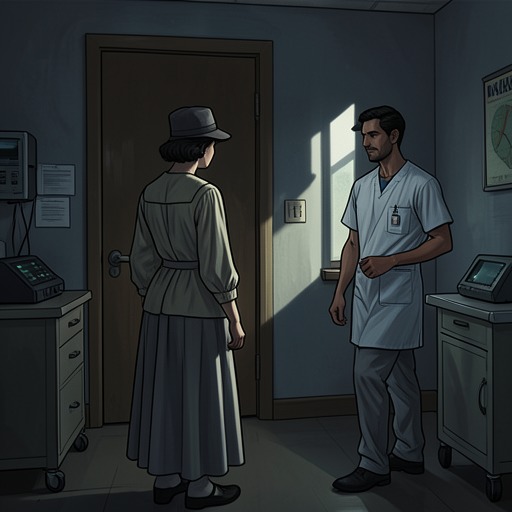
By the time Edgar arrived at the hospital, he had already become influential in the art world. Peter Cleave first encountered him in a markedly different condition: confused and shaky, shuffling in like a wounded bear before sitting hunched on a bench with his head in his hands. Once Cleave had settled him and drawn him into conversation, Edgar revealed a forceful personality, an original mind, and considerable charm when he chose to use it. Their relationship became warmly combative, a quality Cleave encouraged in part because he wanted Edgar to feel specially connected to his doctor. That rapport, however, did not make Edgar easy to trust. Cleave regarded his intelligence as restless and devious: Edgar quickly learned how the hospital worked, remained alert to his own interests, and could be relied on to exploit circumstances to his advantage.
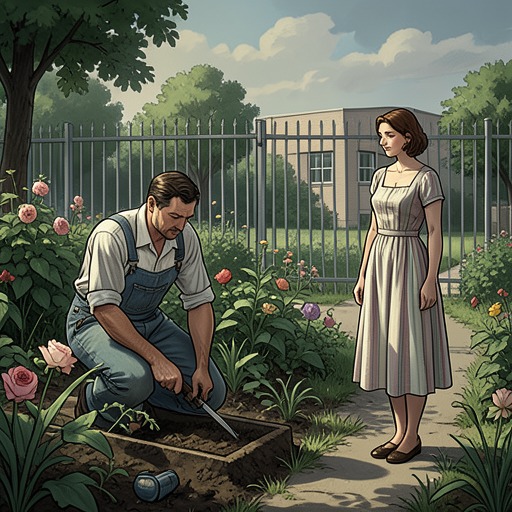
The murder grew out of Edgar’s conviction that Ruth was having an affair. About a year before his admission, he became obsessed with the idea; Ruth, whom others described as quiet and sensible, had modeled for him and often supported him financially. His accusations were wild and violent, and the marriage deteriorated until she threatened to leave. After they had been drinking one night, a terrible quarrel ended with Edgar bludgeoning her to death with a hammer. The attack on her body afterward further demonstrated the severity of his disturbance. He arrived at the hospital in profound shock, but the grief and guilt Cleave expected did not follow. Within weeks Edgar regained his equilibrium and became involved in hospital activities, leaving staff to confront the distance between his outward composure and the violence that had brought him there.
The Conservatory and the Unresolved Delusion
When Max Raphael needed someone to restore the old conservatory in his garden, Edgar was among the hospital’s parole patients and was confident he could undertake the work. The glasshouse had once been built for delicate tropical plants, but by the time the Raphaels arrived it was dilapidated: much of its glass was broken, remaining panes were clouded with dust and cobwebs, sections of wood had rotted, and weeds pushed through the stone floor. Max’s affection for Victorian design made the restoration appealing to him; for Edgar, the project offered a practical role within the estate while placing his artistic ability back in view.
Yet professional function did not amount to insight. Edgar maintained that Ruth had been unfaithful, and treated ordinary details—a flushing toilet, a stain on the floor, a box of washing powder placed on a windowsill—as evidence carrying extravagant significance. He could acknowledge that the murder should not have happened and express regret about drinking, but still insisted that Ruth’s taunts and insults had driven him to it. The hospital considered him intelligent and otherwise recovered, but his certainty that the killing was justified remained unshaken. That contradiction defines the fragile distinction between Edgar’s visible competence and the unresolved conviction that made release unsafe.
Stella, Art, and Possession
After the press revived his case, two psychiatrists testified that Edgar suffered from paranoid psychosis, and the court accepted the insanity defense. Peter Cleave admitted him to the hospital the following day. The renewed attention also exposed the contradiction at the heart of Edgar’s parole: he had been permitted to work in the estate gardens even though his belief that Ruth’s murder was justified had not shifted. Later, after Edgar escaped, Stella went to join him at the Horsey Street warehouse loft. She found him bearded and waiting in the shadows; the reunion was the threshold into a life she imagined as freedom, but one in which Edgar’s need to make art and possess his image of her would soon become inseparable.
Edgar wasted little time turning their relationship into artistic material. He sketched Stella for an hour, watching her with a gaze she experienced as impersonal and concentrated, while his pencil moved in uncertain lines, smudges, cross-hatching, and whorls. He told her he wanted to draw her before modeling her in clay. During those early days she sat for him for hours after their mornings together in bed; on the third day he posed her nude from the waist up, standing before a wall while Nick watched from elsewhere in the loft. Edgar’s matter-of-fact direction made the exposure seem almost ordinary, yet Stella found the experience intensely arousing. She was also unsettled by the drawing: she could sense herself in it without recognizing a clear likeness. Nick called it truth; Edgar rejected that judgment, then crossed the room and kissed Nick on the forehead. The moment shows a capacity for spontaneous affection alongside his insistence that the terms of seeing and representing others remain his own.
The return to sculpture brought a different kind of uncertainty. Edgar worked clay slapped onto a wire frame in the rough shape of a head, mounted on a battered wooden stand. Nick had found the clay and tools, and Stella had paid for them, even as their money grew short. Edgar’s efforts repeatedly turned into frustration: as soon as he had made some impression on the clay, he would grow furious and destroy it. Stella tried to reassure him that his skill might take time to return, but he had little patience for excuses or for the limits of his facility. His artistic work thus became a measure not of recovered mastery but of strain, while Stella increasingly put aside her own practical needs and treated concerns about money as things she should not raise with him.
The intimacy that had seemed to bind the three people in the loft also became the material for Edgar’s jealousy. When Nick left, Edgar accused Stella of being with him and mimicked her denial in Nick’s public-school accent. The accusation converted the household’s closeness into evidence against her, just as ordinary domestic details had once sustained his suspicions about Ruth. Later, when Edgar tentatively tasted an orange, Stella remembered that he had believed Ruth was poisoning his food. That echo changed her understanding of the danger: she had rationalized his violence and explained away his jealousy, but now feared the delusion itself and understood that she had to get away. She tried not to show her terror, believing that he might become violent if he detected it. The episode makes the pattern of Edgar’s relationships painfully clear: artistic attention can make another person feel uniquely seen, but his delusional certainty can turn that intimacy into surveillance, accusation, and threat.
Flight, Capture, and Final Confinement
After Stella left the Horsey Street warehouse loft, Edgar remained there for three days, working without rest on the head he had been making. On the fourth day, someone apparently warned him that the police were coming. He fled with a few clothes and books stuffed into a duffel bag; the police arrived only minutes later, and Stella appeared at the loft shortly afterward. They impounded the studio’s contents, including the drawings and the head he had left behind. The timing left the police to find Stella where Edgar had just been, while the work that had absorbed him became material for others to examine.
For a time Edgar disappeared into an underground network of artists and criminals who sheltered and fed him. He was thought to have moved from studio to studio and flat to flat. One report placed him in a remote cottage near the sea in Cornwall, but Peter Cleave suspected that he had stayed in London, where he knew his way around. Eventually Edgar went north to look for Stella. He was picked up in Chester, twelve miles away, and returned to the hospital. Cleave did not know whether Edgar had intended to carry Stella off or murder her. His purpose remained uncertain even as his journey made clear that he was still directing himself toward her.
The extent of the violence behind Edgar’s earlier crime also emerges more fully in the account of his confinement. He had not only bludgeoned Ruth Stark to death: he cut off her head, placed it on his sculpture stand, and worked it with his tools as if it were damp clay. A policeman described the result as almost unrecognizable apart from the teeth and clumps of matted hair. Cleave’s thought that it could have been Stella, and nearly was, binds Edgar’s past violence to the danger of his later attachment. The stand and tools make the boundary between sculptural practice and bodily violation brutally unstable: the same artistic equipment that could shape an image was turned against the person whose head became its material.
Cleave held Edgar alone in a room on the top ward of the Refractory Block, insisting that the arrangement was not intended as punishment. Edgar remained hostile and uncooperative, and Cleave had not yet told him that Stella was dead. He wanted to hear Edgar’s account first, while recognizing that the news would cause acute suffering whenever it reached him. The circumstances of Edgar’s escape also remained contested: Max suspected that Stella had given him clothes and knew he meant to flee, rather than that Edgar had taken them impulsively. With Stella gone and Edgar again under hospital control, their relationship persisted less as a shared life than as an unresolved struggle over what she had meant to him and what he might do in response to losing her.
Idealization and the Unfinished Image
In their last recorded conversation, Edgar spoke of Stella with cynicism and contempt, reducing her to an animal. Peter Cleave did not take that performance as transparent evidence of indifference. He suspected Edgar might still have idealized her as a goddess, concealing that attachment from the doctor who controlled his confinement and was preparing to marry her. The possibility remains Cleave’s interpretation, not a confession from Edgar; his account of the relationship is therefore shaped by the same uncertainty that shadows Edgar’s motives throughout the story.
Cleave also reads the head Edgar left in the studio as more than a failed or unfinished likeness. Edgar had claimed to be working against habit and convention, trying to unsettle the certainties through which people see. Cleave wonders whether the sculpture was an attempt to approach the unstable image of Stella that Edgar had created and could no longer sustain. The work offers no final key to its maker: its significance lies partly in the gap between Edgar’s stated artistic purpose and Cleave’s psychological reading of it.
That gap leaves Edgar’s ending deliberately unresolved. He remains hostile and confined, while Stella’s death is withheld from him and his response to the loss is still unknown. Cleave imagines that the news will bring acute suffering, but cannot yet say what Edgar’s version of their history will disclose. His attachment to Stella, like the head left behind, survives as an image whose meaning cannot be settled by appearance alone.