Nick
AsylumNick is an artist, friend, and indispensable intermediary in Stella Raphael and Edgar Stark’s life on the run. He helps Stella find Edgar after the escape, gives the fugitives money and shelter, and later provides her with a separate flat when life in the warehouse loft becomes intolerable. His generosity makes their hidden existence possible, but it cannot protect him from Edgar’s jealousy or from Stella’s need to escape the consequences of the affair.
Identity and Introduction
Nick first appears in disguise as a shabby, paint-spattered young man who takes the chair opposite Stella in the cafeteria at Victoria Station. His straw-colored hair, patchy beard, stained tweed jacket, grimy collar, and lowered eyes make her suspect that he is a policeman. Instead, he tells her that Edgar has sent him to bring her to him. Nick says he and Edgar had watched her the previous day to make sure nobody followed her, explaining the coordinated caution behind their meeting.
Stella initially denies knowing Edgar and distrusts Nick, partly because the affair had seemed so exclusive that the presence of a third person who knew about it unsettles her. What persuades her is not a grand assurance but Nick’s nervous vigilance: his glances around the room resemble her own watchfulness at the entrance. Once she accepts him, his relief is visible. Nick’s public-school accent also contrasts with his worn clothes, while the paint on them hints at the artistic life he shares with Edgar.
Helping the Fugitives
Nick drives Stella to the warehouse hideout, taking an abrupt reverse turn into an empty yard near the river and the wholesale fruit and vegetable market beneath the railway viaduct. He leaves her briefly by the car, then leads her through a dark passage toward the loft. The place is hidden and exposed at once: its locked gates and deserted surroundings offer concealment, while Stella’s fear that she might be murdered registers how completely she has entered unfamiliar territory.
When Stella reaches the loft on a later visit and finds the door locked, Nick is absent and Edgar has not arrived. She waits on her suitcase until Nick comes up the stairs, to her enormous relief. His role is not simply to deliver her to Edgar; he helps manage the dangerous, uncertain practicalities of their meetings. A private joke between Stella and Edgar, Rubens, has become a joke Nick shares too, a small sign that she has been admitted to their circle.
Nick is part of the loose community of artists around the loft. During Stella’s first days there, visitors arrive despite Edgar’s fugitive status. Nick lets one artist in while the three are eating sardines on toast, and more visitors follow over the next several days. Their casual friendliness initially alarms Stella, who wonders why so many people know where Edgar is hiding, but she gradually warms to the men and their unconventional, shabby ways. Her unease about the possibility of betrayal strikes Nick as almost incomprehensible; the idea that anyone might betray a friend has apparently not occurred to him.
Art, Money, and Shelter
Nick has a small income from an unspecified source and is generous with it, usually bringing money back to the loft for Edgar. Seeing the strain of Stella and Edgar living together in cramped circumstances, he borrows a small flat in Soho to give them more room. His help is material as well as emotional: he supplies resources, connections, and shelter without which the fugitives’ life would be harder to sustain.
He also gives Edgar an audience for his work. Edgar continues shaping Stella’s head in clay, and the sculpture’s gouges and stabs turn the likeness into an account of their increasingly tortured relationship. Nick recognizes the importance of the work and admires it as an artist. Stella sees that his response matters to Edgar in a way hers no longer does: Nick understands what Edgar is attempting, and his recognition briefly eases the tension between the lovers.
One evening Nick and Edgar return with a case of red wine and a box of groceries. Their talk turns to painters; Nick sketches the paintings he is planning, while Edgar offers rapid suggestions that Nick listens to and records. For Stella, the evening restores a glimpse of the funny, affectionate, spirited Edgar she misses. Nick’s company seems to help Edgar as well, and Stella is grateful for the interval of food, drink, laughter, and shared artistic attention. It is a temporary reprieve, not a cure for Edgar’s suspicion.
A Fractured Alliance
The reprieve ends when Edgar turns on Nick and orders him out of the loft, then emphatically tells him not to return. Stella and Nick are both sober and troubled by Edgar’s behavior. Nick’s expulsion makes visible the precariousness of his place: he has helped create the fugitives’ refuge, yet Edgar can abruptly exclude him from it.
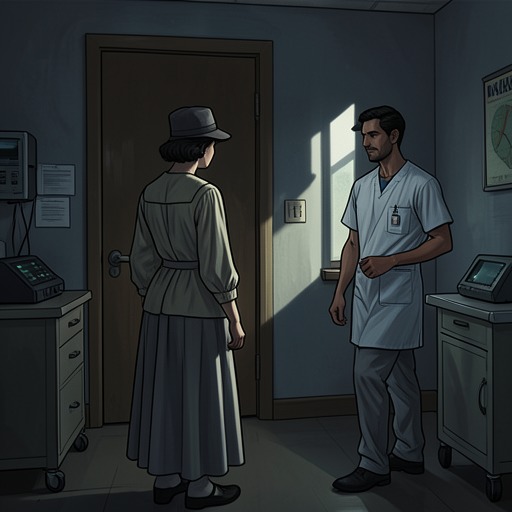
After Stella later leaves the loft, she tries repeatedly to reach Nick. He has gone back to find it empty and fears the worst; hearing her voice on the telephone brings enormous relief. He comes to the pub, shares a drink with her, and takes her to the tiny flat. Stella is grateful for its proper bathroom. In the hot bath, she feels some of the anxiety, guilt, and squalor of the preceding days lift, and tries to block Edgar from her thoughts. Nick has provided a temporary refuge at a moment when she has nowhere else to turn.
That refuge does not become a stable companionship. Nick is afraid to return to the loft and afraid to go out, while Stella has little money and no clear way to obtain more. On the third day, after another restless night, she passively agrees to have sex with him. She thinks of Edgar during the encounter; afterward, Nick’s apparent satisfaction becomes the occasion for her to attack and humiliate him. She mocks his weakness and rejects the sympathy and concern he tries to offer. Then she dresses and leaves without knowing where she is going. The episode exposes the difference between Nick’s care for Stella and what she wants from him: he can offer attention and shelter, but he cannot substitute for the lover she remains fixated on.
Aftermath and Narrative Significance
Nick is later taken in for questioning and released with a caution. The account adds that his father was a judge, a detail that marks a contrast between his background and the poverty suggested by his clothes and the artists’ living conditions. After Stella disappears from the warehouse, Nick is no longer present in the subsequent account of Edgar’s movements, though his earlier assistance remains part of the network that sheltered the fugitive.
Nick also becomes entangled in Edgar’s interpretation of Stella’s sexual history. When Edgar later speaks as if Stella and Nick had been together, Peter Cleave recalls that Stella had candidly told him she had allowed Nick into her bed only once, in the hotel. Peter recognizes in Edgar’s accusation the same process by which Edgar had reorganized his memories of Ruth Stark to support a belief in her promiscuity. Nick is thus more than a helper or rival in the plot: his limited sexual encounter with Stella becomes material for Edgar’s recurring delusion, which transforms uncertain or isolated events into evidence of betrayal. Against Edgar’s possessive suspicions, Nick’s generosity and concern remain real, but they are not enough to keep the unstable alliance intact.