Ozelot
BlackwaterOzelot is a secret Mark VIII Panzerter whose improvised first deployment transforms a proposed machine into an unplanned combat trial. Designed to make the transition from the Mark III quick and familiar, it combines an established cockpit system with markedly greater performance; launched under fire by Roland Horn, it proves fast enough to startle Union pilots and powerful enough to destroy or disable a formidable range of targets. Its debut establishes both its promise and the cost of bringing an advanced prototype into battle before its existence can remain confidential.
Identity and Development
Ozelot is the Mark VIII in the Tharcian Panzerter line. Its identity is initially withheld from Roland: Charlotte Huber explains that she is the navy’s tech chief and the only person certified to work on the Mark VIII. The secrecy is practical as well as personal; she had not mentioned the role earlier because it had not been relevant. Her expertise gives her direct responsibility for introducing and preparing the machine when circumstances suddenly make it necessary.
The number VIII sits within a development history that Charlotte briefly clarifies. Marks VI and VII were ground types, known mainly by the names Tiger and Lowe, while the navy had also heard rumors of a torpedo bomber based on the Tiger. The succession of numbered marks and animal names places Ozelot within a larger program of Panzerter development, but the scene distinguishes it as a new space-capable machine rather than another ground type.
Design and Pilot Transition
Ozelot was being prepared for trials involving mock battles against Panthers. Its designers intended to let pilots move to a high-performance machine with minimal transition time: the control systems are identical to those of the Mark III, and its readouts, icons, and displays are meant to feel familiar. The continuity of controls is central to the design. In the crisis aboard ship, Roland does not have time for a conventional training period; the prototype’s familiar interface makes an immediate launch conceivable.
The machine’s performance upgrades are substantial. Charlotte identifies three times the main thrusters, a more efficient fuel-injection system, triple-redundant systems, fully armored joints, and new composite armor. The combination implies both greater propulsion and reinforced survivability, while the redundant systems and familiar controls are pertinent to a machine being brought online in dangerous, improvised conditions. The evidence establishes the listed features but does not specify their individual test results or the precise protection offered by the new armor.
The cargo pod presents Ozelot as a complete trial machine rather than an empty prototype: it is fueled and ready, stored among weapons, shields, and spare parts in a capacious hold lit by newly restored floodlights. Its exterior retains the familiar Tharcian Panzerter head design, with the knight-like, mid-century-soldier appearance and gas mask associated with machines since the Mark III. Against that recognizable silhouette, its clean dark-gray plating and smooth lines make it appear unlike any machine Roland has seen. Charlotte formally presents it to Ensign Horn, and his awe marks the moment when a classified development project becomes an object he must rely on.
Emergency Launch and Combat Trial
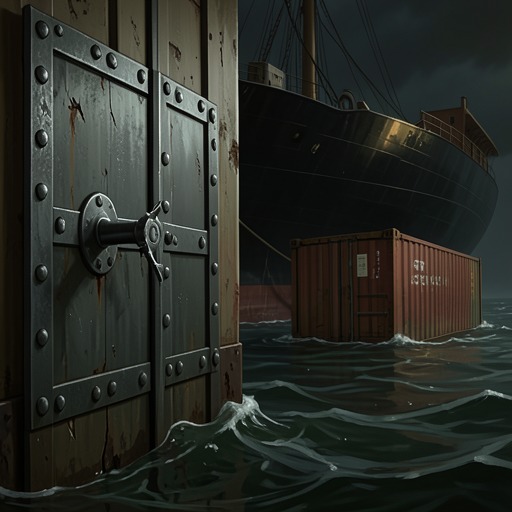
Ozelot’s intended evaluation is overtaken by an attack. Panzerter-caliber rifle fire punches into the cargo hold, damages containers, widens breaches in the hull, and forces Roland to break off his pursuit of Valentin Fulbright. Charlotte’s voice trembles as the ship takes further impacts, but Roland recognizes that the machine must be launched directly from its container. He hopes not to wreck it: the immediate priority is survival, and the prototype’s planned testing conditions no longer apply.
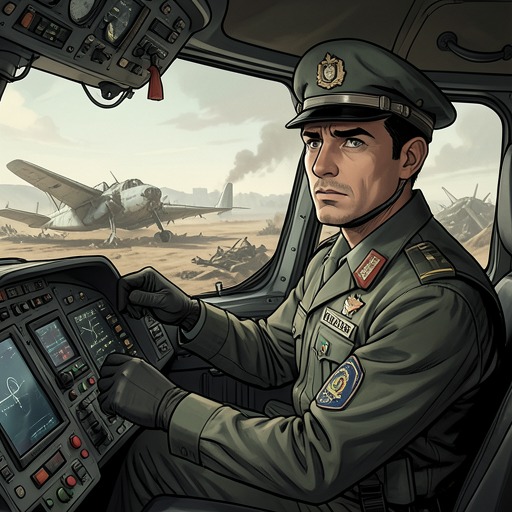
Charlotte directs him to bring the engine and sensors online while she loads his comm-key. As rounds tear through the front of the pod, Roland switches on the battery and rolls the ignition lever. Ozelot responds at once: its displays illuminate, power floods the cockpit, and the engine’s high-pitched whine settles into a purr perceptible through the pedals, control arms, seat, and restraints. The cockpit’s display shows the unit’s silhouette and the cables still restraining it. The sequence makes the machine’s design legible through use: a pilot confronted by an unfamiliar high-performance Panzerter can still activate it through immediate controls and recognizable instrumentation, even as the surrounding pod is under fire.
Once deployed, Ozelot’s movement supplies the sharpest evidence of its performance. A stream of Teflon-coated 50 mm rounds that would ordinarily be expected to penetrate armor instead meets a machine that rolls clear, its thrusters burning brilliant blue, and disappears from the attackers’ view. Rocco Swift sees it before his targeting computer registers it. Its speed, acceleration, and agility are unlike anything he has encountered in a Tharcian Panzerter, leading one of his pilots to identify it as a new model. The combat scene turns Charlotte’s specifications into an observable contrast: established expectations about the vulnerability of a Panzerter do not account for Ozelot’s ability to evade the incoming fire.
Results and Secrecy
In retrospect, Roland describes the emergency outing as a combat trial: Ozelot took out about a dozen tinhats, disabled another, destroyed a pair of corvettes, and destroyed a destroyer. He treats the record as evidence that the machine performed well under actual combat conditions, while contrasting his actions with the caution a test pilot might have shown about breaking a prototype. Charlotte’s snort at that observation underscores the difference between a planned evaluation and the sortie that actually occurred. The account supports a striking tally, but it does not turn the episode into a controlled test: Ozelot was launched under attack, and the results came amid immediate battlefield demands.
The consequences reach the fleet’s senior command. On 4 November 2135, at the Tharcian Naval Command Complex in Tranquil City, Deimos, Fleet Admiral Von Braun reads a report stating that Ozelot’s existence has been compromised. He accepts that the secrecy breach would eventually have happened, but the report’s promise does not erase the exposure. It describes the emergency field test, named by Warrant Officer Huber, as shooting down five Martians and disabling a sixth, alongside the destruction of two corvettes. This official account gives a specific tally that differs in wording and detail from Roland’s retrospective list; together, they establish the scale of the machine’s debut without suggesting that either account is a formal, complete technical assessment.
Von Braun’s reaction places Ozelot in a wider procurement dispute. He privately regrets that the navy should have waited before committing to the Panther, which Congress’s Naval Acquisitions Committee wanted because Rainer Orbital Industries claimed to have a working space- and ground-type ready. The report on Ozelot arrives in a context where competing programs and claims of readiness shape acquisition decisions. Its combat performance lends urgency to the question of which machines should be fielded, even as its compromised confidentiality shows that a promising design can become strategically visible through an improvised test.
Significance
Ozelot’s introduction is structured around a reversal: a machine prepared for mock battles is activated not in a controlled evaluation but inside a damaged cargo hold, with enemy fire tearing into the pod. The same design feature that makes it suitable for trials—continuity with Mark III controls—also makes an emergency launch possible. Its first proof is therefore inseparable from danger, and its exceptional performance arrives with the loss of secrecy.
The prototype also marks a change in what Tharcian Panzerters can do. Rocco’s targeting system cannot keep pace with the machine he sees, while Roland’s eventual tally extends from small targets to corvettes and a destroyer. The episode presents technological advantage through a gap between expectation and observation: rounds that should have penetrated fail to catch Ozelot, and its movement outruns the equipment meant to track it. Yet the machine is not introduced as a detached specification sheet. Charlotte’s rare certification, Roland’s hurried ignition, the cables holding the unit in its pod, and the later command report connect the prototype’s material capabilities to the expertise, risk, and institutional consequences surrounding its use.