TNV Blackwater
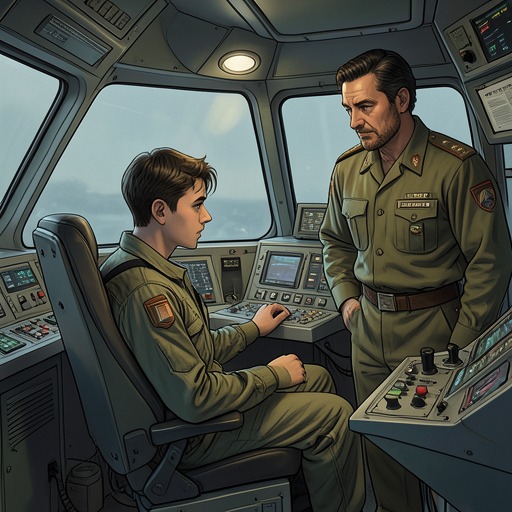
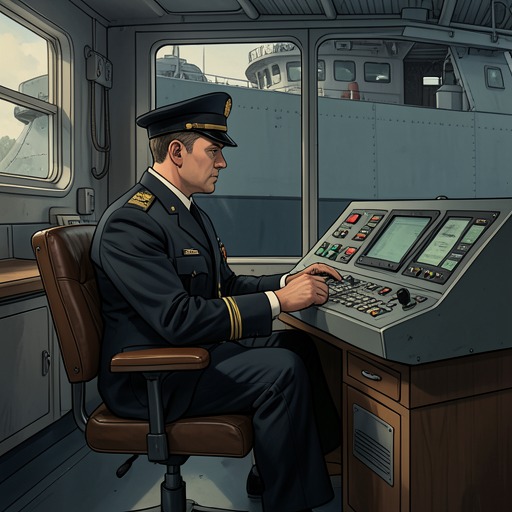
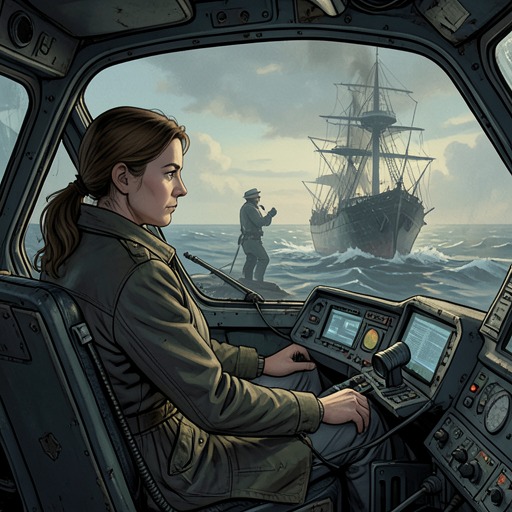
BlackwaterThe TNV Blackwater is a Tharcian light cruiser whose unusual blend of heavy armament, fighter capacity, and operational flexibility turns an apparent escort into a force in its own right. Under Henri Marcell, it serves not only as a warship but also as a mobile base for feints, reconnaissance, and civilian protection, making its capabilities consequential well beyond its own firepower.
Design and Intended Role
The TNV Blackwater is stationed aboard the docking bay of Island Fredrick, in the Lusatia cluster of Tharcian space at Mars Lagrange 9 (Promise). When Fleet Admiral Von Braun first explains what the vessel is to become, Marcell is confused: its intended role does not fit the familiar label of an escort. That mismatch is embodied in the ship itself, which carries the space-frame of an Oceanic-class light cruiser while departing from the expected layout of that class.
An official points out that missile cells occupy the central hull where expected features should be, and asks whether the ship is an Oceanic-class light cruiser. The explanation is structural as well as tactical: the TNV Blackwater shares the cruiser space-frame used by its former class and most recent Tharcian cruisers, except battlecruisers. Its angular hull is shaped to deflect railgun fire and disperse lasers. At its pointed bow, however, a gap accommodates angled launch-bay doors that fold outward for flight operations. The ship thus preserves the recognizable foundation of a cruiser while making room for a different kind of work.
Its armament is formidable for a vessel described as an escort. The listed fit includes thirty-six point-defense cannons, four forward-facing torpedo tubes arranged in two pairs on either side of the launch deck, and amidships missile cells whose magazine is shared across the dorsal and ventral sides. The account begins to specify an additional weapon system after noting those features, but does not identify it in the available passage. Separately, the ship can field thirty-six Panzerters. Marcell concludes that it is more like a squadron than an escort carrier: it has the capacity to deploy substantial fighter strength while remaining as fast as an escort, even if speed is not necessarily its defining design priority.
Command, Deception, and Tactical Use
The TNV Blackwater’s value lies not only in what it can carry, but in how its capabilities fit into a larger formation. In a plan aimed at disrupting a Tharcian move on Phobos, Union officers describe concealing three battlecruisers and two heavy cruisers in the radar shadow of light cruisers and smaller ships. Electronic-warfare systems are to make the force appear to contain many additional small vessels. The plan treats the light ships’ position and electronic signatures as instruments of deception, using apparent depth and scale to shape what the opposing force believes it sees.
The same emphasis on perception informs Marcell’s decisions around the ship. When a flotilla of civilian vessels enters the system from the Amazon Sea, reportedly fleeing a Union attack, he studies their positions and relative speeds and grows suspicious. He recognizes that Orbit Patrol—not the squadron alone—can expose the situation: if the squadron illuminates the ships with targeting sensors, a single nervous vessel might fire and unravel the facade. This caution matters because the TNV Blackwater and its squadron must preserve their readiness without needlessly triggering a wider confrontation.
Readiness is constrained by supply as well as deception. The squadron has taken on spare parts, fuel, and food, but has not received the Panzerters it was supposed to obtain. Marcell recognizes that the missing aircraft are a serious reduction in available firepower, and hopes that the young pilot in the colony will prevail. The contrast is central to the ship’s role: its theoretical ability to field thirty-six Panzerters does not guarantee that those aircraft are available in practice. The vessel’s strength depends on the material and personnel needed to operate it.
During another operation, Marcell orders Schuster to follow the Union formation, Opera to inform the rest of the squadron, and cutters to accompany them for navigation. He also orders an open-channel broadcast claiming that a large task force from the belt will arrive in the upper shoal zone in five hours, after refueling at Deimos. The broadcast is presented as a deliberate signal to the opposing force, not as a report of a confirmed arrival. The TNV Blackwater’s operations therefore combine movement, coordination, and misinformation: its commander uses the ship as the center of a formation whose apparent strength can be made to exceed its actual numbers.
The mine operation further shows how the ship’s capabilities alter an enemy’s choices. The mines can magnetically attach to spaceborne vessels, while their sensors distinguish friendly identification signals. Once attached, adjustable explosives form shaped charges capable of opening a hull to hard space. Searching a minefield forces ships to move slowly and use point defenses manually, leaving them more exposed to fast-moving missiles. Marcell judges that the squadron’s forward momentum should conceal the launch of a missile. When the enemy commander mistakes a third missile for another minelayer and conserves point-defense rounds, the resulting misjudgment gives the attack an opening. Here the ship’s weapons are part of a wider tactical system: concealment and the opponent’s interpretation of the threat help make the ordnance effective.
Rescue, Reconnaissance, and Civilian Protection
The TNV Blackwater’s work extends beyond engagements with combat ships. When a Tharcian pilot is addressed over communications, the order is to land on the ship, refuel, and rearm; from that moment, the pilot is declared part of the Blackwater’s crew. The exchange presents the vessel as a place where a pilot can be incorporated into an ongoing operation, with fuel and weapons replenishment tied directly to the ship’s capacity to sustain action.
Marcell also sends a mission to a military transport with a deliberately bounded objective: go to the vessel, determine what it carries, search for survivors, and return. The assignment joins intelligence-gathering to rescue rather than treating the transport solely as a target or source of supplies. The ship’s role as a mobile command platform makes such a mission possible, while the instruction to come back keeps the expedition’s purpose distinct from an open-ended pursuit.
Civilian need also affects command decisions aboard the TNV Blackwater. Marcell orders Schuster to request food and water inventories from every civilian and military vessel, as well as ammunition counts from military ships. He is concerned that point-defense cannons must not run dry during a fight, but he also faces a choice about food and water: ration his own people strictly and give supplies freely to civilians, or maintain normal provisions for his crew to keep them at full readiness. The available account establishes the dilemma and the information-gathering meant to inform it, but does not state which policy he ultimately chooses.
In a later operation, the TNV Blackwater passes overhead and slows to recovery speed. The maneuver places its flight-recovery function in practical view, complementing the earlier descriptions of the launch-bay doors and the ship’s large Panzerter capacity. Across these episodes, its carrier-like features support more than combat sorties: they make the vessel a hub for bringing pilots in, restoring them, and coordinating missions in a difficult operating environment.
Record, Limitations, and Legacy
The TNV Blackwater’s record shapes how senior command understands its usefulness. Fleet Admiral Von Braun argues that a single crippled escort cruiser cannot turn the tide of a battle, but emphasizes that Marcell gave the enemy a bloody nose and escaped alongside the civilians he was escorting, a feat he repeated at Promise. He identifies Marcell’s combination of daring and discretion as the qualities needed in a guerrilla fighter and calls him the right person to command the ship. The judgment values the Blackwater not as a war-winning weapon by itself, but as a platform whose commander can impose costs, survive, and protect others amid unequal conditions.
The ship’s service is also framed against a personnel shortage. Marcell reports that the destruction of Naval Air Station Fredrick means a thirty-percent drop in pilots coming down the pipeline. That loss makes the TNV Blackwater’s capacity to field thirty-six Panzerters especially significant, while also underscoring the limits on converting designed capacity into operational strength: aircraft and trained pilots are not interchangeable, and the ship has already gone without the Panzerters it expected to receive.
Marcell therefore proposes an exploratory committee to examine designing more ships with the TNV Blackwater’s capabilities from the ground up. The proposal treats the vessel as a successful but unusual model whose useful features should be built into purpose-designed ships, rather than left to the compromises of an adapted cruiser frame. Von Braun’s decision to promote Marcell to captain and give him a sealed binder accompanies a new assignment: the destroyers Venomous and Violence, along with the frigates Terror in the Night, Thousands May Fall, Man in the Arena, and New Heaven, will accompany him. The TNV Blackwater’s confused identity—escort, cruiser, carrier, and squadron-like force—has become an operational precedent. Its significance rests in that combination, and in the way Marcell turns it toward deception, survival, and the escort of civilians.