Panzerter 3.5
BlackwaterPanzerter 3.5 is Duncan Glenn’s improvised, armor-reinforced Panzerter: a visibly altered machine that its maintainers name for its position between established versions. Introduced beside Roland Horn’s craft before a dangerous diversion, it is at once practical equipment and a wry emblem of the pilots’ habit of returning from combat at a cost. Its later role in the operation below Island Fredrick puts that repair-born hybrid into the same battlefield logic of concealment and misdirection that shapes the wider engagement.
Identity and Modification
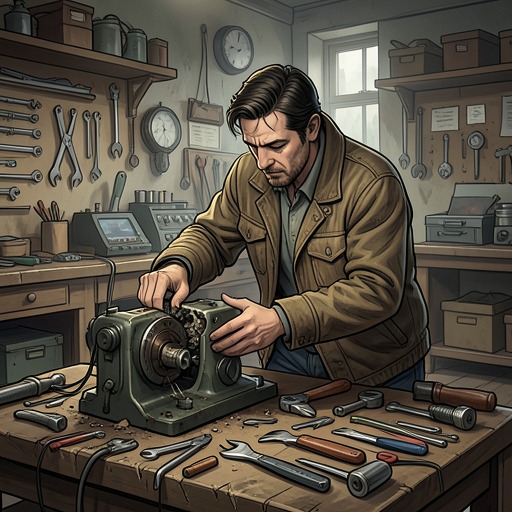
Glenn’s machine has been repaired and reinforced with additional armor welded onto it. When Roland sees it floating beside his own Panzerter, the added plating makes the boundaries between models difficult to discern: he struggles to tell where the Panzerter III ends and the Mark IV begins. The machine is therefore not presented as a clean new production model, but as a modified craft whose physical form records the work done to keep it usable.
The maintainers call it Panzerter 3.5. The decimal name gives a concise, informal answer to the visual uncertainty: the craft seems to occupy the space between the III and IV rather than fitting neatly into either category. Commander Anna Strauss agrees that the designation is appropriate, adding that she has been thinking “three and a half” whenever she sees it. The name arises from the machine’s appearance, but its half-step also opens the way to a joke about what its pilot brings back from missions.
Introduction and Naming
The craft enters the narrative as part of the preparations for a risky operation. Commander Anna Strauss says that Duncan Glenn and Roland will both be deployed, while Glenn will help create a diversion alongside smaller ships. Roland questions the risk of sending both pilots and starts to ask about Glenn’s damaged machine; seeing the repaired Panzerter beside his own interrupts the question. Its welded-on armor makes the alteration immediately legible before anyone explains the new name.
Glenn raises an eyebrow at the name, then asks whether calling it three and a half is effectively the same as the number he has heard. Anna’s reply changes the joke’s subject from classification to survival: she says she calls it a half because Glenn seems always to come back with half the unit he left with, then adds that returning is still better than not coming back at all. Her smile and the exchange’s light tone do not erase the danger implied by the remark; they make the machine’s nickname carry both workshop humor and the cost of repeated missions.
Equipment and Operational Context
The preparations around Glenn’s Panzerter also include protective clothing. Anna takes two padded vests from a rack and hands one to each pilot. The marines have removed the shoulder pads and other extra material and painted the vests white, preserving freedom of movement while adding protection against spalling. The scene thus places the modified machine within a broader effort to adapt equipment to the pilots’ needs, though the evidence does not specify any further changes to the Panzerter itself beyond its added armor.
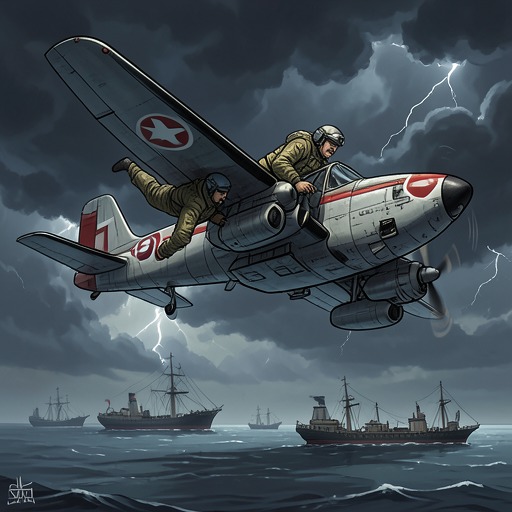
The planned diversion later places Glenn with a force operating below Island Fredrick. Torpedo frigates angle their bows to fire almost vertically into the approaching Union formation, while escorts move away from the torpedo boats. Their task is to breach the shoal zone and return in a way that makes the Union believe they are fleeing torpedo boats. Glenn clings to the side of a destroyer as the final wing of his diversion force moves behind the search pattern. Panzerter 3.5 is associated with that deployment, but the account does not separately describe its movements or claim a specific action for the craft during the attack.
Deception and Narrative Significance
The machine’s altered identity belongs to a campaign in which appearances are repeatedly engineered to influence an opponent’s decisions. Earlier, a Union task force plans to disguise itself electronically as civilian ships fleeing the Amazon Sea, while radar shadows and electronic warfare are intended to make larger combatants appear to be numerous smaller vessels. Later, Henri Marcell answers the enemy’s concealment with a false open-channel broadcast: he claims that a large task force from the belt is five hours away after refueling at Deimos, despite admitting that he does not know whether a squadron is actually present in the upper shoal zone. These are fleet-scale deceptions; Panzerter 3.5’s hybrid appearance is a more local, material kind of ambiguity, not itself identified as a deliberate disguise.
The craft’s clearest significance lies in the contrast between improvisation and formal categories. Its added armor has made the distinction between versions hard to read, and its maintainers respond with a name that refuses a strict either-or classification. At the same time, the joke attached to “half” keeps the machine grounded in the human consequences of its use: Glenn and his unit undertake diversions in which ships risk engagement to influence the larger battle. Panzerter 3.5 is therefore not merely a model designation. It is a repaired combat machine whose name carries the texture of field maintenance, the camaraderie of its crew, and the persistent danger behind their banter.