Impervious
BlackwaterImpervious is a Tharcian I-Class heavy cruiser whose concealed missile fire makes it a central threat in the Union assault near the Pommern Cluster. It is introduced as the operation’s priority target and proves formidable both in the damage it inflicts and in the defenses that protect it; when its magazines finally detonate, the ship breaks apart and its wreckage damages other vessels, turning the attack’s principal target into a source of destruction in its own right.
Identity and Operational Importance
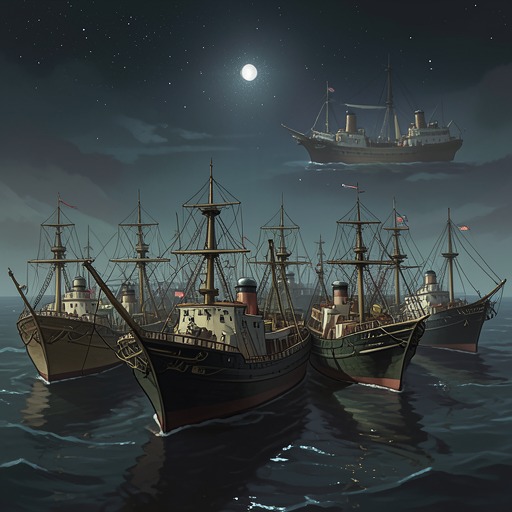
Impervious is identified as one of four heavy cruisers assigned to the Gulf of Promise and the largest dedicated warships in that sector. Its angular, arrowhead-like hull bristles with weapons, marking it as a purpose-built combatant rather than a lightly armed support ship. Union planners designate it the first-priority target because its missile bays could inflict fatal losses on lighter ships if it slipped behind the Union’s screening vessels.
The operation’s stakes are defined in part by the danger Impervious represents. The Union is warned that losing three of its cruisers, or allowing its screens to fall below fifty percent strength, would constitute mission failure and force a retreat. Three other heavy cruisers are listed as secondary targets, but the briefing singles out Impervious for special attention: surprise is essential, and the planned strike is meant to destroy it before its position and missile armament can dictate the battle.
Concealment and the Battle
The broader Union plan depends on controlling what the Tharcians believe they are seeing. A task force is to masquerade electronically as civilians fleeing the Amazon Sea, while delayed and relayed reports are intended to make the Tharcians think an attack began hours earlier than it did. The Union’s battlecruisers and heavy cruisers, meanwhile, hide in the radar shadow of lighter ships; electronic-warfare suites make the force appear to contain more small vessels than it actually does. This planned deception helps explain the operation’s emphasis on surprise, but it does not make Impervious easy to find or neutralize.
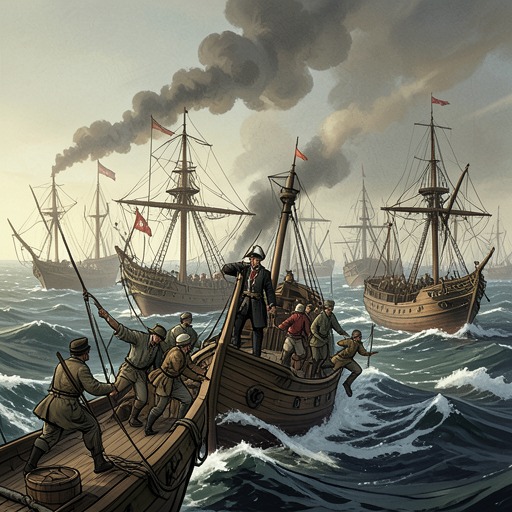
During the fighting, Impervious takes position behind screening vessels and fires a steady stream of missiles. Cluster missiles attributed to the cruiser overwhelm the point defenses of three Union destroyers. The scene makes the danger of its original tactical role concrete: protected by other ships, it can attack while remaining difficult for incoming fire to reach. Later, Union pilot Rocco Swift encounters the same problem directly, finding the missile cruiser concealed behind a thicket of smaller vessels that shield it as it continues firing.
Defenses and Resistance
Impervious is protected by dense point-defense fire and an unusual form of railgun ammunition. Instead of the standard ultra-heavy, super-dense rounds, its lighter railgun batteries fire clusters of metal pellets about the size of golf balls. The cruiser fills the space around itself with high-speed metal, creating a hazard for Panzerters caught in the pattern of fire. The barrage also destroys torpedoes before they can close to effective range; Swift watches another torpedo salvo disappear into the storm of metal.
Those defenses complicate the Union’s attack beyond the cruiser’s concealment behind screening ships. The protective fire can threaten both aircraft and torpedoes, while the screening formation further limits opportunities to target the ship directly. The result is a layered defense: Impervious is not simply a heavily armed target waiting in the open, but a missile platform sheltered by other vessels and surrounded by weapons intended to stop attackers before they can reach it.
Destruction and Consequences
Impervious is ultimately destroyed when its missile magazines detonate. The blast breaks apart the heavy cruiser and sends wreckage through nearby smaller ships, extending the destruction beyond the target itself. Its loss is an important Union success, but it does not end the wider battle: the cruiser Advantage is lost shortly afterward, overwhelmed by railgun fire from the battlecarriers and their Panzerters, and the Gulf Squadron’s fortunes remain poor even as Commander Henri Marcell’s own ship, Blackwater, performs well.
The wreck of Impervious gives the ship a final, destructive presence after its weapons fall silent. Its role reverses from concealed attacker to debris field: the same vessel whose missiles had overwhelmed Union defenses now breaks apart and shreds smaller ships around it. That reversal suits the larger battle’s emphasis on tactical uncertainty, in which a successful strike can alter the balance without making the surrounding danger disappear.
Significance
Impervious concentrates several pressures that shape the engagement: the need for surprise, the risks of relying on screens, and the difficulty of overcoming a defender that can use both concealment and layered weapons. The Union briefing identifies the cruiser as the threat that must be addressed first; the battle then shows why, as its missile fire devastates destroyers and its defenses blunt attacks by Panzerters and torpedoes.
The ship also anchors a contrast between strategic planning and battlefield experience. Before combat, the Union’s deception is designed to manipulate Tharcian perceptions of fleet size, timing, and approach. In the fighting, however, electronic tricks matter less to Swift than the physical problem of the cruiser hidden behind smaller ships and protected by pellets that destroy incoming torpedoes. Impervious is therefore not just a named target in an operation plan: it is the point at which the plan’s abstract urgency becomes immediate material danger, and its eventual explosion demonstrates that destroying a threat can itself produce further losses.