T4X-2 Martian
BlackwaterThe T4X-2 Martian is a Union space-type Panzerter: a maneuverable, heavily protected, reconfigurable combat machine that can fight among ships and other Panzerters. Its design gives pilots both a wide view of the battlefield and a broad choice of weapons, but the story repeatedly shows that capability is conditional. Catapults, ammunition, fuel, repair work, and human judgment determine whether the machine’s potential becomes usable force.
Design and Capabilities
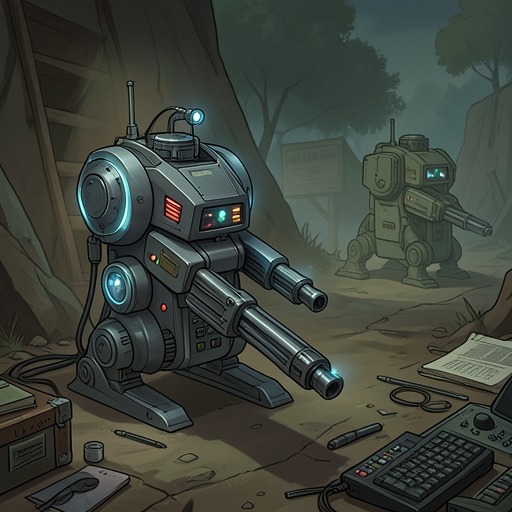
Known to military bean counters by its designation, the T4X-2 combines backpack-mounted thrusters with armor shaped to balance protection and thickness. Its configuration can be adapted to a mission, with options including 105-mm machine guns, torpedo launchers, breacher grenades, collapsible harpoons, and boarding axes. A saucer-shaped head houses a sensor ring that provides a 360-degree view, giving the pilot broad awareness in a crowded fight.
The machine’s mobility and versatility are established through Rocco Swift’s combat experience at Vespa and in the Sea of January. Its abilities are not cost-free: Chief Technician Bailey reports that Rocco has again stressed the Martian’s knee joints beyond standard tolerances, requiring their replacement. The exchange makes maintenance a direct counterpart to battlefield performance: the machine can maneuver aggressively, but repeated strain translates into repair work and time away from the flight line.
The Martian’s weapons also reflect the limits of adaptation and the lessons of combat. On a sortie from the PFSS Grain & Steel, Rocco carries a Type-5 57-mm machine gun, whose six rotating barrels and dense penetrators can threaten Panzerters and light ships but are less effective against capital ships with thick armor and redundant systems. Breacher grenades and a boarding axe supplement the gun. Laser rifles used at Vespa had proved effective, but their tendency to overheat and explode during prolonged combat led the maritime unions to retool the design; until then, machine guns replace the earlier mix of weapons.
Launch and Combat Use
Aboard the PFSS Grain & Steel, the T4X-2 operates within a carrier system designed to put Panzerters into space quickly. The battlecarrier has three launch decks arranged in an inverted T, each with two catapults and a collapsible elastic mitt for recovery. With eighteen Panzerters in a squadron, organized into flights of six, the ship can launch a squadron in under a minute and its full wing in just over a minute with practice. The deployment system is powerful but tangible: while the ship cuts thrust to launch its machines, Rocco feels the movement through his Martian and hears railguns firing behind him; the lights flicker with each shot.
Before launch, Rocco checks his weapons while waiting for the preceding Martians to take the catapult. Magnetic locks secure the machine’s feet, and he bends its knees and leans forward as the countdown reaches zero. The catapult accelerates him into space, with Duncan Glenn following a second later and the rest of the flight emerging from the carrier’s flanks. The sequence shows how the machine’s mobility begins not with its own thrusters but with a carefully coordinated shipboard launch operation.
In the battle near the Pommern Cluster, Rocco uses the Martian’s maneuverability to dip, roll, and evade while firing controlled bursts at a frigate’s point defenses. His flight’s combined fire disables the light ship’s drive. He then presses onward through ships and wreckage, keeping his rifle ready to clear a path for Wayne Wendel Wheeler and the others. The T4X-2 is suited to close, fast-moving engagements, but the fight also exposes the danger of relying on a single weapon system: Wheeler reports that an entire salvo consists of dud rounds, suggesting the squadron’s magazines may be defective. Rocco continues the engagement, attacking another Panzerter with his rifle and kicking one before firing into its hips.
The machine’s role also extends to intercepting and assessing larger formations. When Rocco’s squadron spots military transports, he orders evasive action while keeping them under pursuit, reasoning that their military cargo must be important. He applies thrust and maneuvers through space as the transports dive and their escorts approach along the dorsal hulls. In another engagement, he counts eight torpedoes available while judging how many might be needed against a scout cruiser protected by destroyers and corvettes. The Martian’s flexibility allows it to carry out varied tasks, but tactical options remain bounded by the number and reliability of weapons on hand.
Logistics and Maintenance
The T4X-2’s value depends on supply and fleet readiness as much as on its specifications. Gunnery Sergeant Hoffmann notes that the Blackwater can field thirty-six Panzerters, a number that makes the ship resemble a squadron as much as an escort carrier. Yet Captain Henri Marcell still has to retrieve the machines and their pilots. Elsewhere, the Gulf Squadron has received spare parts, fuel, and food but not the Panzerters it was supposed to receive. Marcell recognizes that this absence is a major reduction in available firepower, while also hoping that a pilot in the colony can succeed.
The strain is not limited to combat units. As Marcell organizes a civilian evacuation, he asks for reports on food and water aboard every ship, as well as ammunition counts for military vessels, so that point-defense weapons will not run dry during a fight. Civilian vessels have been crowded with evacuees and pets and were not equipped for an extended journey. Marcell must weigh rationing for his own personnel—whose calorie needs rise with near-constant combat and an enlarged pilot complement—against the health of civilian children. These decisions establish the material context in which Panzerters operate: combat readiness shares a finite supply chain with the survival of the people the fleet is trying to protect.
When Rocco returns to the Grain & Steel, technicians secure fuel lines to his Martian’s backpack and legs and connect a data cable at the base of its neck. The machine has sustained hits, but redundant systems allow it to remain on the flight line so long as critical components such as the fuel tanks, engine, or magazine are not compromised. Damage to joints can ground it for about an hour, while damage to the head can endanger pilots. The design’s redundancy therefore does not eliminate vulnerability; it determines which kinds of damage can be absorbed and which demand a pause or carry more serious consequences.
The maintenance burden is also visible in Roland Horn’s testing assignment. Technicians require him to test the Vulcans on a Panzerter III by firing at the edge of the colony, and first to walk the machine around inside the pressurized settlement so they can collect data on thruster performance in an atmosphere. The test distinguishes established vacuum performance from an unverified operating environment. In a damaged ship, a technician later identifies herself as the tech chief and the only person in the navy certified to work on the Mark VIII. Together, these details place specialized knowledge and testing at the center of the wider Panzerter system: equipment cannot simply be deployed because it is available; it must be assessed, repaired, fueled, and supported by qualified maintainers.
Narrative Significance
The T4X-2 Martian joins the story’s image of advanced combat to the less visible conditions that make combat possible. Its panoramic sensor ring, adaptable weapons, and thrusters give pilots substantial tactical freedom, but a failed salvo, worn knee joints, missing machines, or an absent supply can narrow that freedom at once. The repeated attention to the catapult, magazines, fuel lines, and repair work keeps the machine from appearing as a self-sufficient weapon.
That tension is clearest in the contrast between the rapid launch of an entire squadron and the slower labor required to keep individual machines usable. The Grain & Steel can deploy its wing in just over a minute with practice, but every return brings technicians, inspection, fuel, and possible repairs back into view. The T4X-2 is therefore both a force multiplier and a maintenance commitment: its effectiveness is produced not by design alone, but by the coordinated work of pilots, ships, supply crews, and specialists.