Panther
BlackwaterThe Panther, also called the Mark V, is a newer Panzerter distinguished by a taller, sleeker frame, thick armor, enhanced sensors, and the speed and firepower to threaten older machines. Its arrival is also a story of compromised reliability: rushed development and acquisition decisions put the model into service with serious engine and other mechanical problems, making the Panther both a formidable battlefield opponent and an unfinished weapon.
Design and Mechanical Condition
At a hangar where older Mark III Panzerters fill the repair bays, their faults point to years of deferred maintenance: outdated components need replacement, avionics bays stand open, and sensor suites lie disassembled. Two Panthers are also held up in support harnesses with their backpacks removed. Their presence among the hangar’s damaged machines foreshadows the model’s own reliability problems rather than presenting it as a clean technological advance.
The chief petty officer in charge of maintenance blames Rainer Orbital Industries for rushing the design. As he describes it, the company was trying to win two contracts at once: one for a next-generation ground-assault machine and another to replace the Mark IV. The Panther’s defects are thus linked not only to individual breakdowns but to a procurement process that rewarded speed and ambitious contracting over a dependable design.
The Hangar Assault
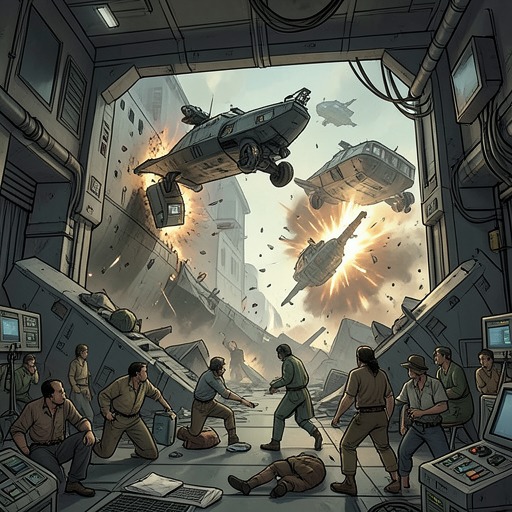
When three Panthers emerge from a hangar engulfed in fire, their scale and profile immediately set them apart from Roland Horn’s Panzerter III. They are taller and sleeker, with thickly armored torsos and enhanced sensor units. The targeting computer registers them as friendly, creating a dangerous moment of uncertainty; their weapons settle it. One carries a torpedo launcher, another a submachine gun, and the central machine the 88-mm rifle common to Panthers. Each also carries an angular shield.
The torpedo carrier fires into other hangars. Although atmospheric conditions greatly reduce the torpedoes’ range, the weapons still inflict horrific damage. Designed to pierce a ship’s hull and ignite its atmosphere before bulkheads can seal, they could prove fatal to the colony if Roland does not stop them. He dives, fires his Vulcans into the long black torpedo tube, and reaches for his charged plasma sword. The rounds rupture the launcher, drawing the Panthers’ attention as he brings the blade into the attack.
The torpedo-carrying Panther evades Roland’s first swing, but the dodge leaves it open to a kick to the hips. Keeping that machine between himself and the other two, Roland uses it to obstruct their lines of fire while he stays aggressive against the numerical and armament disadvantage. A second sword strike cuts a shallow trench through its arm and disables it; Vulcan fire then shatters its visor, blinding it before Roland topples it with another kick. The model’s armor and weaponry make it dangerous, but the encounter also shows how quickly a Panther can be neutralized when its equipment and position are turned against it.
Speed and Combat Performance
In a later space engagement, Rocco Swift identifies an incoming machine as a Mark V Panther after its thruster flares distinguish it from the Mark IVs he has been fighting. It moves faster, though not necessarily with greater agility. Its heavy rifle fires rounds Rocco estimates at 90 millimeters, powerful enough to make a direct hit fatal; his return fire hammers its shield without stopping it from roaring past.
Two Panthers pursue Rocco. He judges them fast but ungainly, then uses a corkscrewing dive to draw them after him. A burst of rifle fire misses, but as he climbs past the machines he attaches a breacher grenade to one. The shaped charge turns its torso into a storm of liquid metal. The second Panther destroys another grenade with its Vulcans, but the blast blinds it long enough for Rocco to close, kick it, and fire twenty rounds at point-blank range. He kicks away from the enemy machine before it explodes. The exchange demonstrates the Panther’s speed and heavy weapons while exposing a vulnerability to close-range attacks and tactical misdirection.
Procurement and Reliability Aftermath
The model’s defects become part of a larger wartime procurement problem. Fleet Admiral Von Braun reflects that the Navy should have waited before committing to the Panther. Despite his advice to Congress, the Naval Acquisitions Committee wanted the machine because Rainer Orbital Industries claimed it already had a working model suitable for both space and ground use. The company also made engines for MAVAG’s Tiger Ground Assault Panzerter, while Skara and large portions of the admiral’s staff were complicit in the arrangement.
After Skara’s death, his replacement, Hausnerr, faces many of the same problems as Von Braun. Wartime procurement authority gives the admiral the means to respond: he subsidizes the Panther’s competitors. That pressure motivates them to address the engine’s gremlins and other reliability concerns. The response does not erase the consequences of the rushed decision, but it makes the Panther’s mechanical flaws a direct cause of changed acquisition policy.
Role and Significance
The Panther’s recurring contrast is between visible combat strength and underlying technical instability. In battle it is larger, more heavily protected, faster, and armed with weapons capable of threatening both individual pilots and a colony’s infrastructure. Yet its reliance on an unreliable engine and the rushed circumstances of its design complicate any simple equation of newness with superiority. Its hangar failures, attacks on Roland and Rocco, and role in Von Braun’s procurement response connect machine performance to maintenance labor and institutional decision-making. The Panther is not merely a more powerful successor to the Mark IV; it is also evidence of what happens when acquisition urgency outruns dependable engineering.