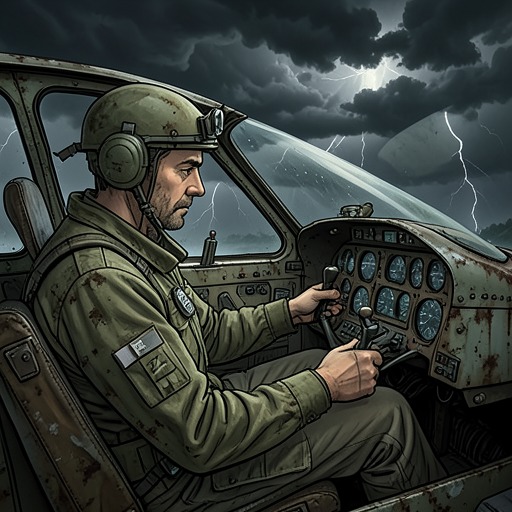
Roland's Panzerter Mark III
BlackwaterRoland's Panzerter Mark III is an aging combat machine whose history with Roland turns it from a stopgap into a hard-won companion. Its weapons, field modifications, damage, and final disablement register the costs of successive missions; when Roland leaves it behind after crashing into a military transport, his regret gives the machine significance beyond its battlefield utility.
Design and Combat Role
At the start of the sortie described in the evidence, the Panzerter is equipped for close combat with a Type-5 57-mm machine gun: a bullpup-style rifle body surrounding a Freon cooling jacket and six rotating barrels. Its high rate of fire and dense penetrators make it effective against other Panzerters and light ships, but insufficient against capital ships, whose armor and redundant systems present a different problem. Roland also carries breacher grenades and a boarding axe, giving the machine equipment for fighting at close range and for boarding operations.
The machine’s capabilities are not separable from its vulnerabilities. In an earlier engagement, a squadron mate reports that an entire salvo consisted of dud rounds and that the magazines might be defective. This leaves the unit facing a weapons reliability problem rather than a straightforward shortage of firepower. The incident is a reminder that a heavily armed Panzerter depends on functioning ammunition as much as on its pilot’s skill.
Modifications for the Long-Range Mission
Roland is asked to reach a military transport located deep within a debris field, beyond the range his Panzerter III could comfortably manage. The crew therefore fits it with drop tanks to provide enough fuel for the outward journey, relying on Roland’s use of terrain to make a return on internal reserves seem possible. The mission demands not just an alteration to the machine but a calculation about what its pilot can accomplish with limited fuel.
Before launch, the unit has also received hastily welded additional armor, concentrated on the lower legs, torso, backpack, and head. Its shield has been reinforced with another shield welded over it. Drop tanks hang to either side of the backpack, clear of the thrusters, and smaller tanks sit on the backs of the shins. The maintainers have used flight-recorder data to adjust the thruster governors and have taken the machine’s balance into account, so it is expected to fly normally even if Roland discards the boosters. That flexibility has a cost: once the boosters are jettisoned, the machine’s operating time falls sharply.
The armor embodies a tactical tradeoff. It is intended to help Roland survive the journey and whatever awaits at the transport, but it adds weight and strain to the older machine. Its protective value will not remain separate from its consequences: during the later impact, the reinforced structure contributes to the failure of the joints.
Damage, Survival, and Abandonment
While hiding in an old colony, Roland is discovered when an enemy Panzerter breaks through a weakened section of an inner wall and lines up a shot. Roland pushes off and accelerates away, firing back as he evades. The encounter presents the machine as a means of escape under immediate pressure, although Roland’s shots achieve only glancing hits. Even as the pilot escapes the attack, he notices that the Panzerter feels more responsive than before, a small change in handling set against the danger of being hunted.
The decisive damage comes during the approach to the military transport. Roland’s restraints lock him into his seat as high-speed crash bags inflate with water, cushioning the impact. The system helps him survive the collision, but the machine does not emerge intact. Its up-armored lower legs have blown out both knees, and its reinforced torso proves too heavy for its wrists to withstand the force. The collision drives the aging Panzerter into the transport; afterward, none of its joints will work properly again. Armor added to extend the mission has helped turn the impact into a final mechanical failure.
Roland then faces the practical problem of continuing without the machine. His survival pack supplies water and a few hours of air, and its compressed-gas thrusters allow him to maneuver in zero gravity. He hesitates before opening the cockpit because doing so will waste the air inside it. The damaged Panzerter remains part of that decision: it is not simply an unusable vehicle but the shelter and equipment around which his immediate survival has been organized.
A Veteran Machine and Its Pilot
After the crash, Roland looks back at the Panzerter as a machine that has endured battles across the Gulf and the shoal zone and has fought advanced opponents without being immediately outclassed. His response contrasts with his earlier impatience toward Mark IIIs. As a cadet, he had treated them as temporary relics from the previous war, a waiting room before a modern machine; he had also resented being continually associated with old equipment. The particular Mark III has changed the terms of that judgment through what the two have survived together.
The change is marked by a small personal object: a volume knob from the old unit, kept by Roland and later fitted to another machine. When a maintainer protests that the current communications knob works, Roland removes it and installs the old one instead. It does not fit perfectly; its arrow partly obscures the setting, but Roland prefers the clearer indication it gives him. He tosses the removed knob back to Charlotte, who is displeased. The improvised replacement is a modest act, yet it lets a piece of the disabled Panzerter remain in use after the vehicle itself can no longer serve.
Roland’s farewell to the machine is consequently more than regret over lost equipment. He recognizes the old Mark III as the vessel of his own passage through the war: a machine he once expected to outgrow has helped him save lives and fight across multiple theaters. The contrast between its proud battle scars and irreparable joints closes its arc. The Panzerter has carried him as far as its aging structure permits, and Roland preserves a part of it even as he moves on without it.