Rabo Karabekian and Allison White
BluebeardRabo Karabekian and Allison White’s relationship turns on a small omission with large consequences: Rabo has shared a house with Allison, depended on her work, and paid her well, yet habitually calls her “the cook” instead of using her name. When Allison gives notice that she and Celeste will leave, she makes clear that the problem is not material deprivation but the failure to recognize her as a person. Her departure exposes a pattern Rabo has repeated in marriage and offers him a judgment of his art that unsettles his faith in his own collection.
A Household Relationship, Not an Equal Friendship
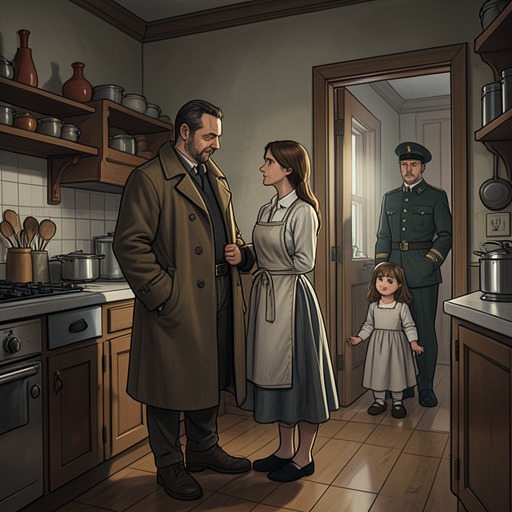
Allison is Rabo’s cook, and she and her daughter Celeste live and work in his large house. The arrangement includes comfortable quarters with ocean views, access to the property and its cars, refreshments, and pay Rabo describes as generous. These benefits are real, but they do not amount to the human consideration Allison wants. Her complaint is not that Rabo has failed to provide for her; it is that he has failed to know her in the ordinary, spoken sense of using her name.
The household’s atmosphere changes when Circe Berman arrives. Allison explains that she and Celeste had already been close to leaving because life in the house felt dead; Circe made it exciting enough for them to stay. They had agreed that once Circe left, they would leave too. After Circe goes, Allison gives Rabo two weeks’ notice. What Rabo experiences as a sudden blow is, from Allison’s perspective, the completion of a decision deferred during a more lively interval.
The Name Rabo Does Not Use
Rabo responds to the notice by insisting that he needs Allison and asking what he could do to persuade her to stay. He inventories the advantages he has provided: rooms with ocean views, freedom for Celeste’s young friends to use the property, snacks and refreshments, use of the cars, and a salary he considers exceptionally good. The list shows how he understands the relationship—as a set of favorable conditions and services that ought to secure her continued presence.
Allison’s answer is disarmingly simple: Rabo could learn her name. She says that whenever she hears him speak about her, he calls her only “the cook.” He protests that he knows her name because he writes Allison White on her weekly check, even asking whether he has misspelled it or entered her Social Security information incorrectly. That defense only sharpens the distinction she is making. He can register her correctly as a payee without thinking of her as an individual in the daily life they share.
Allison recalls the years before Circe arrived, when she and Celeste were alone in the house with Rabo: they had slept under the same roof night after night, and he had eaten her food. She stops before finishing the thought. Rabo recognizes, retrospectively, how difficult the confrontation was for her, but in the moment he can only prompt her to continue. Her pause makes the accumulated intimacy of ordinary domestic life part of the accusation: proximity and dependence have not produced recognition.
A Repeated Failure to See Women
Allison says she wants to be a human being rather than “a nobody and a nothing” if she must live under the same roof with a man, then corrects herself to say “any person.” The correction broadens the claim beyond men alone, while keeping its immediate force in the unequal household where Rabo’s habits have made her feel invisible. Celeste joins the exchange by saying that she, too, thinks Rabo is afraid of women.
Rabo connects Allison’s accusation to Dorothy, his first wife, who had told him that he often treated her as if he did not care what her name was, as if she were not there. Allison’s complaint is therefore not an isolated misunderstanding between employer and employee. It repeats a failure in Rabo’s intimate life: he can live alongside women without adequately acknowledging them as distinct people. The echo makes his response to Allison’s notice more than anxiety about losing a valued cook; it confronts him with a pattern that has already damaged a marriage.
Rabo admits to himself that Allison is a perfectly presentable woman and concludes that he is the problem, not she. The thought marks a shift away from the amenities he has offered as proof of good treatment. But that recognition comes as Allison is preparing to leave, and it does not undo the years in which she has had to ask him to see her.
The Painting Allison Chose
When Rabo turns the conversation toward his famous art collection, Allison clarifies that she does not hate the paintings; they simply mean nothing to her. She speculates that her lack of education might explain why she does not appreciate them. But she makes one exception: the picture Rabo sold, depicting two Black boys and two white boys. Allison had looked at it and tried to guess what would happen next. In her view, it was the only picture that was really about something.
The painting had hung in a guest-room bathroom that Rabo rarely entered. He sold it to a real-estate and insurance millionaire in Lubbock, Texas, who claimed to own the most complete collection of Dan Gregory paintings and had built a private museum for them. Rabo had parted with the picture after the collector discovered that he had been Gregory’s apprentice and asked whether he had any of his master’s works to sell. Allison’s response reverses the value Rabo initially assigns to her opinion: what he hopes to retrieve from the exchange is praise for a painting, but what she offers is a challenge to the significance of the collection he still possesses.
Her criterion is narrative and human rather than prestigious: the picture mattered because it made her wonder what would happen to the people in it. That judgment connects Allison’s demand to be recognized as a human being with her response to the one painting that held her attention. She objects to being reduced to a household role, and she remembers the artwork that seemed to hold lives and possible futures rather than merely occupy a wall.
Departure and What Remains
Before going upstairs, Allison tells Rabo that she and Celeste will get out of his way and do not care if they never discover what is inside the potato barn. The remark gives their departure a final edge: they are leaving not only the household but also the curiosity that Rabo’s sealed studio might otherwise have invited. Their interest in Circe and the excitement she brought had kept them there; with Circe gone, neither the house’s comforts nor its mysteries are enough.
After Allison and Celeste leave the conversation, Rabo is alone downstairs. He is afraid to go upstairs and does not want to be in the house at all; he considers returning to the potato barn as the half-tamed old raccoon he had been for Edith after her first husband died. The image turns the domestic exchange into a measure of his isolation. He has the rooms, the cars, the art, and the barn, yet the people whose presence gave the house life are leaving. Allison’s relationship with him ends in this scene not with reconciliation, but with a clear naming of what he has withheld: recognition that cannot be replaced by a paycheck or by material comfort.