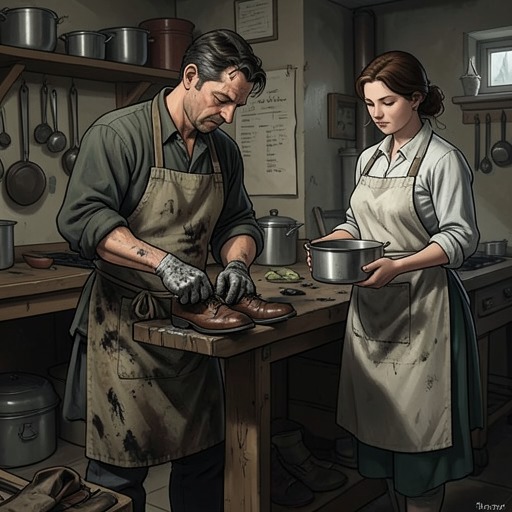
Rabo Karabekian and Edith
BluebeardRabo Karabekian and Edith share a marriage shaped by her energetic care and his belated recognition of what that care sustains. Edith turns their house into a lively, welcoming home and coaxes Rabo out of isolation with poems and food; when she dies unexpectedly, the man who had imagined his own funeral must confront the empty house, reopen his barn, and find a way back to painting. Their story joins domestic companionship to artistic renewal, while exposing how little Rabo had understood the labor and affection that made his life habitable.
Meeting and the Shape of Their Bond
Rabo first sees Edith Taft Fairbanks on a truck trip, when he is negotiating to rent a barn from her husband. He regards the husband as an affable idler, a harmless waste of life; after that man dies and Rabo becomes Edith’s second husband, the former object of Rabo’s contempt becomes a model for how to inhabit a life. The reversal gives their relationship an understated beginning: Rabo comes to occupy the place of a man whose apparent uselessness he had misjudged.
Edith’s first appearance offers an image that will define her care for Rabo. She is carrying a tamed raccoon, and Rabo describes her as someone who can tame almost any animal: an overwhelmingly loving, uncritical nurturer of anything that looks half alive. When he later lives like a hermit in the barn, Edith approaches him with nature poems and good things to eat left outside his sliding doors. She does not first persuade him through argument or demand that he change. Her attentiveness reaches him at the threshold of his chosen solitude, and, as he tells it, she tames him.
The animal metaphor becomes their private shorthand, but it also gives their tenderness an edge of comic asymmetry. At their wedding reception, while Rabo is dressed in a suit made for him by Isadore Finkelstein, Edith introduces him to a female relative from Cincinnati as her tamed raccoon. The label is affectionate, yet it places Rabo in the role of a creature to be cared for, rather than the masterful artist he might have preferred to imagine himself as. His promise to be buried in that same dark-blue suit preserves the joke as part of his future, even after the marriage that gave it meaning has ended.
A Home Made by Edith
Edith’s care is not confined to her private attention to Rabo. Even when the household consists only of the two of them and the servants, she fills their Victorian house with love, merriment, and hands-on domestic life. Though privileged, she cooks alongside the cook, gardens with the gardener, does the food shopping, feeds the pets and birds, and makes personal friends of wild rabbits, squirrels, and raccoons. Her attention crosses the boundary between household work and affection: the animals are not merely fed, and the domestic routines are not merely managed. Edith makes contact, and the house becomes a place where life is tended.
The scale of that welcome appears in the parties and long visits the couple used to host. Edith’s friends and relatives, mostly, sometimes stayed for weeks. This sociable abundance contrasts with Rabo’s few alienated blood relatives and his vanished Army companions, some killed in the battle in which he was captured and lost an eye. He admits that those who survived may not have liked him as much as he liked them. Edith’s household thus supplies a form of kinship that Rabo’s family history and wartime experience have not preserved: a home populated by guests, servants, animals, and an ongoing practice of welcome.
That domestic warmth also has a human cost that Rabo only recognizes through a later confrontation. After the cook announces that she and her daughter will leave, she explains that they had planned to go before Circe Berman arrived; Edith’s presence had made the house lively enough that they stayed, and they had always intended to leave when Edith was gone. Rabo is shocked and offers inducements, pointing to the rooms, cars, refreshments, and high pay he provides. The cook’s answer is that he could learn her name. She identifies herself as Allison White and says she wants to be a human being, not a nobody living under the same roof with him.
Allison’s rebuke makes Rabo’s failure to notice people part of the marriage’s afterlife. Her complaint recalls what his first wife, Dorothy, had said: that he treated her as if he did not care what her name was, as if she were not there. Allison also tells him that she thinks he is terrified of women, and her daughter agrees. Edith’s own generous domestic practice stands in sharp contrast to this pattern of male inattention. Rabo may have been loved and kept in a lively home, but the later household conflict shows that Edith’s attentiveness did not automatically become his own.
Death and the Reversal of the Expected Future
Rabo’s plans for his own death reveal how thoroughly he assumes that he will precede Edith. He has in mind what people will say about him afterward, and this is when he first locks the barn, using only one padlock and hasp. Like his father and, as he generalizes, most husbands, he takes it for granted that he will be the first of the pair to die. He imagines Edith holding his wake in the barn, explaining that the whiteness on display is his last painting even though he did not paint it, and giving the work its long title: I Tried and Failed and Cleaned Up Afterwards, so It’s Your Turn Now.
Instead, Edith dies first, only two months after the imagined plan takes shape. Her heart stops, and she falls into a flower bed. The doctor says there was no pain. The starkness of the account reverses Rabo’s expectation without giving him a last exchange or a managed farewell: the woman who had brought him back from isolation is suddenly absent, and the future he had scripted for himself has become irrelevant.
At Edith’s burial at Green River Cemetery, a few yards from the graves of Jackson Pollock and Terry Kitchen, Rabo sees the mourners through an image of souls unencumbered by their unruly bodies. Around the rectangular grave he imagines pure, innocent neon tubes. He calls the vision crazy, but its visual vocabulary is also the language of a painter trying to see beyond the physical fact of death. Edith had cared for whatever looked half alive; Rabo’s graveside vision attempts to imagine the person beyond the body that has fallen into the earth.
The funeral arrangements further expose the difference between Rabo’s fantasy and the actual aftermath. Edith’s wake takes place in the home of one of her friends, a mile up the beach, rather than in the barn as Rabo had once instructed her. The husband does not attend. Nor does he return to the house in which he had spent a third of his life and a quarter of the twentieth century, loved without reason and content to be useless. Instead, he goes to the barn, unlocks its sliding doors, turns on the lights, and looks at the white expanse. Then he drives to a hardware store in East Hampton that carries art supplies and buys everything a painter could wish for except the ingredient he must supply himself: soul.
Companionship, Grief, and Artistic Renewal
Rabo later describes the marriage through the image of resurrection. He says he died with Terry Kitchen and Edith brought him back to life; after Edith died, Circe Berman brought him back. The parallel places Edith’s care in a larger sequence of lives and losses, but it gives the marriage its particular consequence: her companionship had restored Rabo, and her death becomes another rupture from which he must be revived. The image is not a claim that grief disappears. It marks how profoundly his ability to live again has depended on other people.
The opened barn makes the loss visible as both an absence and an invitation. Rabo had locked it while imagining a posthumous joke in which Edith would explain the white space to visitors. After her death, he returns alone, sees that whiteness, and buys materials for painting. The sequence turns a private arrangement for his own memorial into the beginning of work he must undertake in the present. The barn no longer waits for Edith to speak on his behalf; Rabo has to supply what the canvas cannot.
Edith remains present in the objects and habits through which Rabo remembers her. His will specifies burial next to her at Green River Cemetery in the dark-blue suit made to order by Isadore Finkelstein, the same suit in which she had called him her tamed raccoon. The instruction is a final act of attachment, but also a sign that Rabo’s account of himself has been shaped by her teasing and care. He had imagined being buried first and leaving directions for her; instead, he must arrange his own eventual burial beside a wife whose death came before his.
Rabo’s account finally presents the marriage as more than shelter for a solitary man. Edith’s practical tenderness connects him to food, animals, guests, and the ordinary work of keeping a home alive; her attention reaches him even when he has withdrawn behind barn doors. After she dies, the house and barn cease to be simply the setting of a life that had been comfortable and loved. They become the places where that love is remembered, and where Rabo begins again, with the absent Edith’s care still defining what he has to recover.