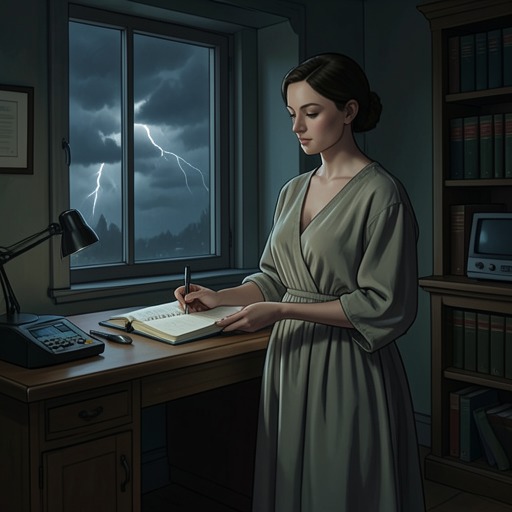
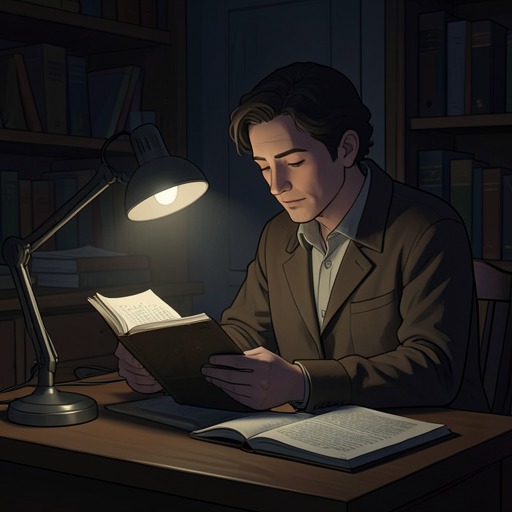
Circe Berman and Abe Berman
BluebeardCirce Berman and Abe Berman’s marriage continues to shape Circe’s life and work after Abe’s death. He remains her intended reader and the measure of what she considers truthful writing; his final message, recalled in a conversation with Rabo Karabekian, also becomes the starting point for her theory that human beings may receive signals from elsewhere. Their bond thus persists not as a resolved account of their marriage, but through the standards, words, and questions Abe leaves behind.
Marriage and Bereavement
Abe was a brain surgeon, and Circe was forty-three when she came to live and work at Rabo’s house, six months after Abe died of a brain hemorrhage. She had left behind a large, empty house of her own in Baltimore and selected Rabo’s home as a place to write Abe’s biography. Her immediate project therefore makes their relationship the subject of a book as well as an ongoing private presence: she writes about the husband whose absence has altered where she lives and what she is doing.
The accounts of Abe’s death are not perfectly uniform in the remembered chronology. Circe initially describes his death as six months earlier; when discussing his writing advice, Rabo says Abe died of a stroke seven months ago. The narrative gives both intervals without explaining the discrepancy. What remains consistent is the central fact: Abe is dead, and Circe’s work continues in relation to him.
Abe as Circe’s Reader
Circe explains that a writer should write for one person rather than attempting to satisfy a broad audience. When Rabo asks who that person is for her, she identifies Abe. She imagines him as the reader whose interest and sense of truth must govern what she puts on paper, even though he can no longer read it. In her account, writing for him is also why her books seem strong and trustworthy to young readers: she does not write as though one teenager were addressing another, but measures her work against the judgment of the particular person she knew.
That principle makes their relationship active within Circe’s writing rather than merely biographical background. Abe supplies an imagined audience, a private standard, and the source of a discipline she believes readers can feel. Her book about him and her broader account of how to write are therefore linked: the husband she is writing about is also the person for whom she writes.
The Final Message
Circe later tells Rabo that she has never shared the very last thing Abe said before he died. At the end, he could no longer speak, but he could still write short messages with his left hand, although he was normally right-handed; it was the only hand that retained some ability to function. She identifies the final message as “I was a radio repairman.”
The sentence is striking precisely because it arrives through the limited means Abe still had. Circe offers two possible interpretations rather than claiming certainty: perhaps his damaged brain believed the statement literally, or perhaps he had concluded that the brains he had operated on were receivers of signals from elsewhere. The message becomes the hinge between the specific experience of Abe’s dying and a more speculative idea about human identity. Circe does not settle what he meant; she makes the uncertainty itself part of what his last words leave her to interpret.
A Theory Carried Beyond the Marriage
Circe develops the radio image into a theory that sudden changes in behavior and personality might mean that a person has begun receiving signals from another station, one with different ideas about what that person should say and do. She raises the possibility while discussing Rabo’s father and Terry Kitchen, extending Abe’s last message beyond the story of his own illness. Her interpretation transforms his words into a way of thinking about changes in other people, not simply a final statement to be decoded in isolation.
The idea remains a possibility, not an established explanation. Rabo later tries the human beings as radio receivers theory on his friend Paul Slazinger, who imagines Green River Cemetery as full of broken radios whose transmitters continue to operate. That continuation shows how Abe’s message travels: Circe receives it from her husband, elaborates it in conversation, and Rabo carries it onward. Abe’s presence persists in the novel through this relay of memory and speculation, even when the meaning of his last communication remains open.