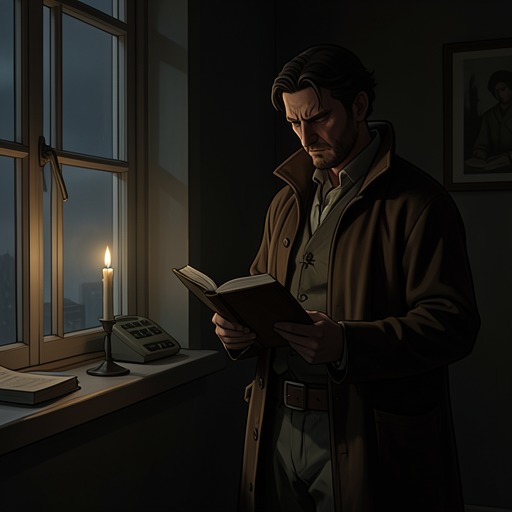
Rabo Karabekian and Paul Slazinger
BluebeardRabo Karabekian and Paul Slazinger are former best friends whose durable connection is founded not on shared artistic judgment or literary exchange, but on loneliness and severe wounds from World War II. Their relationship takes shape across two distinct moments in Rabo’s life: an earlier meeting among painters who joked about their poverty and lack of seriousness, and a later reunion in which Slazinger arrives at Rabo’s house in a straitjacket and is welcomed rather than sent away. The friendship is both affectionate and unsentimental: Rabo admits what he has not read, what he cannot respect, and what he nevertheless owes to a fellow survivor.
Friendship Without Literary Admiration
Rabo’s account of the friendship begins with an uncomfortable disclosure to Circe Berman: although he owns Paul Slazinger’s books, keeps them together on a library shelf, and displays their author’s flattering testimonials about their closeness, he has never read an entire book by him. He has read reviews of most of them and thinks he knows roughly how they go, but this indirect acquaintance is not the same as taking Slazinger’s writing seriously. The handsome evidence of literary intimacy on the shelf conceals a real distance between the two men as readers and writers.
Rabo explains that the distance has a cause. Slazinger has been reckless in life, and Rabo cannot approach his published reflections on love, hate, God, humanity, and whether the ends justify the means with the solemnity they invite. Rabo does not frame his own failure to read as a debt to be repaid: he owes Slazinger no quid pro quo, and Slazinger has never honored him as a painter or collector. That lack of mutual professional affirmation does not cancel the friendship. Instead, it clarifies what sustains it: Rabo names their bond as loneliness and the grave wounds they carry from the war.
The relationship therefore resists the easier story of two men united by reciprocal admiration. They do not validate one another’s work, and Rabo’s candor does not disguise that fact. Their attachment rests elsewhere—in shared damage and in a familiarity that can survive frank judgments about what the other does, writes, or understands.
A Meeting Among Painters
The earlier account of their connection reaches back to an evening when Rabo and other painters discussed why their shows, despite exciting some critics and prompting a major Life magazine story about Jackson Pollock, had not earned them enough to live on. They jokingly blamed their clothing and grooming. Rabo remembers that everything they said seemed to be a joke, even as later events would make the joking tone seem painfully inadequate: only six years afterward, the lives of Pollock and Terry Kitchen would become gruesomely serious.
Slazinger was present that evening, gathering material for a novel about painters—one of dozens of novels he never wrote. At the end of the night, he remarked on the painters’ passion and their apparent unseriousness. Rabo answered that everything in life was a joke; Slazinger did not agree. Their exchange gives the friendship an early point of contact: Slazinger looks at the painters from the position of a prospective novelist, while Rabo speaks from within their joking company. Even then, they do not share a settled view of life. The moment instead establishes a difference that the later friendship can contain.
Crisis and Welcome at Rabo’s House
Years later, Slazinger returns to Rabo’s life in a crisis. The Springs Volunteer Fire Department Rescue Squad brings him to Rabo’s house around midnight after he has awakened neighbors by shouting for help through the windows of his home. The rescuers are prepared to take the veteran to a Veterans Administration hospital at Riverhead. Slazinger calms down and promises that he will be all right if they take him to Rabo instead, so the volunteers ring Rabo’s doorbell and bring him, restrained in a straitjacket, into the foyer.
Rabo and Circe Berman are in their nightclothes. Rabo receives the rescuers among the foyer pictures of little girls on swings; Circe, after looking at Slazinger, turns away and begins straightening the pictures. Rabo reads her response as fear of insanity. The scene is not presented as a triumphant cure or a demonstration that Rabo can manage Slazinger’s condition. Its immediate significance is narrower and more intimate: Slazinger has asked to be brought to his old friend, and Rabo takes responsibility for receiving him at home.
Once the rescuers remove the straitjacket, Slazinger is gentle and asks only to be put to bed. He specifies the upstairs room he wants: the one with Adolph Gottlieb’s “Frozen Sounds Number Seven” above the fireplace and a bay window looking across the dunes toward the ocean. He insists on that room and no other. Rabo imagines that Slazinger has been dreaming in detail of moving in with him, perhaps for hours, perhaps for decades, and calls himself Slazinger’s insurance plan. In Rabo’s sardonic formulation, Slazinger has finally given up, gone limp, and arranged to be delivered to the beach house of a fabulously wealthy Armenian. Beneath the joke is a concrete act of reliance: in the middle of the night, Slazinger chooses Rabo’s home as the place where he can be cared for.
Illness, Care, and the Limits of Control
Rabo does not treat Slazinger’s behavior as simple irresponsibility. Slazinger has been in and out of psychiatric institutions since he lay face down on a Japanese hand grenade when he was young. Rabo says that Slazinger seems to have been born with a particularly nasty clock that makes him go crazy about every three years. The image makes recurrence central to the friendship: the crisis is not an isolated lapse but part of a pattern whose timing and force Slazinger cannot command.
During the night, Rabo listens as Slazinger talks about his trip to Poland and raves about writing well if only he were hiding or imprisoned there. He also praises the Polly Madison books as the greatest literature since Don Quixote. Rabo does not pretend that these claims are sound, but he distinguishes Slazinger’s condition from a voluntary performance. When Slazinger says he cannot help being what he is, Rabo understands that the dangerous substances in his bloodstream are produced and released by his own body, leaving him no choice but to think wildly. The care Rabo offers is therefore not agreement with Slazinger’s delusions; it is the willingness to stay and listen while recognizing that the illness is not a matter of choice.
Slazinger describes himself as “that sort of molecule.” He then enlarges the image into a theory of literature: writing is an insider’s newsletter about the affairs of molecules, meaningful only to other molecules afflicted with thought. The exchange connects their friendship to a shared vocabulary of embodied vulnerability. Slazinger’s literary intelligence remains present in the midst of his crisis, but the molecule is also a figure for the limits imposed by a body and mind that cannot simply be persuaded into obedience.
Trust, Secrecy, and the Potato Barn
Slazinger’s return also brings him into contact with the mystery of Rabo’s locked potato barn. He claims to have kept his theory locked in his own head all these years, then taps his temple and tells Rabo that he is not the only old man who has saved the best for last. When Rabo asks what he knows about the barn, Slazinger swears that he knows nothing. Yet he reasons that an old man would lock something away so tightly only if he were saving the best for last, and concludes with the maxim, “It takes a molecule to know a molecule.”
The exchange does not establish that Slazinger knows what is in the barn; he explicitly denies knowing. Its force lies in the speculative intimacy between the men. Slazinger reads Rabo’s secrecy as evidence of a hidden final work, while Rabo’s locked studio becomes a surface on which Slazinger can project his own idea of belated revelation. The barn and Slazinger’s guarded theory echo one another: each old man may, in the other’s imagination, be holding something back until the end.
That imaginative trust is notable beside the practical limits of their relationship. Rabo has not read Slazinger’s books, does not endorse his judgments, and refuses the idea that their closeness requires artistic reciprocity. Yet when Slazinger is frightened and ill, he comes to Rabo; when he speaks in unstable, extravagant terms, Rabo listens; and when Slazinger imagines a last secret, he turns to Rabo’s locked barn. Their companionship is not a cure for loneliness or war wounds. It is a way of recognizing those wounds without pretending that either man can undo them.