Rabo Karabekian and his father
BluebeardRabo Karabekian’s relationship with his father is a bond of inherited catastrophe, disappointed hopes, and belated, unfinished forgiveness. The father’s survival of the Armenian massacre leaves him unable to embrace the new life his wife imagines in America; Rabo grows up amid his father’s loneliness and later realizes that his own anger has kept the old wound active long after his father’s death.
Family History and Exile
Rabo’s parents lose their blood relatives in the massacre of Armenians under the Ottoman Empire. His mother survives by pretending to be dead, while his father escapes the soldiers by hiding in the privy behind the schoolhouse where he taught. He does not witness the killings themselves. What remains most terrible to him is the stillness of the village afterward, where he believes himself to be the only inhabitant at nightfall. His parents’ different experiences become the foundation of their different responses to survival.
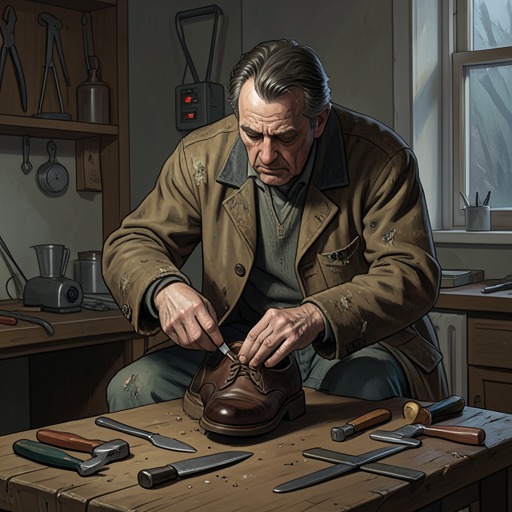
Rabo’s mother manages to set the massacre behind her and imagines a family future in the United States. His father never does. Rabo later interprets the father’s life in San Ignacio as a form of self-punishment: despite his education, he becomes a cobbler, the trade of his father and grandfather, rather than return to teaching or resume writing poetry. He is skilled at shoemaking, a craft Rabo also learns as a boy, but complains about the life he has made. In Armenian, a language understood by Rabo and his mother but not by the surrounding community, he can express his distress and invoke the poets and Shakespeare he knows in translation. The old language preserves intimacy within the family while underscoring their isolation in California.
Loss, Work, and Rabo’s Departure
The father’s prospects worsen when the Luma County Savings and Loan Association fails. The family loses its savings and the building that housed the father’s shoe-repair shop and their home; the shop becomes vacant, and his machinery is sold at auction. By the time Rabo remembers finding him at the kitchen table, the father has become a tenant in a building he once owned. The domestic scene also reveals the father’s attention to Rabo’s future: he has been reading the letters from Marilee Kemp, which the young Rabo regards as a kind of family asset that might one day help him care for his father.
The father reads those promises more skeptically. He tells Rabo that Marilee has promised him everything but has nothing to give, and compares her to Vartan Mamigonian, who had deceived Rabo’s parents in Cairo. The letters’ early references to Dan Gregory, he observes, have disappeared; he concludes that their writer is trying to borrow Gregory’s reputation. His warning is an act of practical judgment, but it also turns the family’s earlier betrayal into a lens through which he assesses Rabo’s hopes.
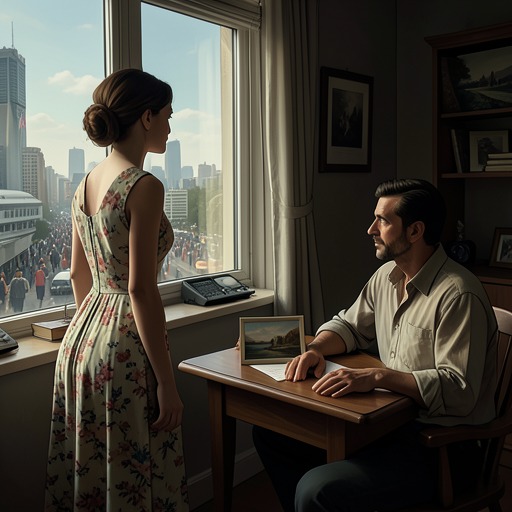
In 1933, as Rabo leaves for New York City during the Great Depression, his father gives him a photograph of the house that Vartan Mamigonian had claimed his parents were buying with much of Rabo’s mother’s jewelry. The photograph and a bogus deed had remained in the parents’ bedside table for years. The father asks Rabo to tell him if he ever finds the house, insisting that it belongs to him. Later, after returning from the father’s funeral, Rabo tears up the photograph. He blames his father’s own choices, rather than Mamigonian alone, for keeping the family in San Ignacio and preventing the father from finding a community where he might have taught again and been less lonely. The destruction of the picture registers Rabo’s anger at a father he believes helped perpetuate his own unhappiness.
Death and the Afterlife of Resentment
The father dies alone at the Bijou Theater in San Ignacio in 1938. He had gone to see a film about cod fishermen in the North Atlantic; when it ended and the audience went home, he remained behind. Rabo imagines that the film’s complete unfamiliarity to his father might have offered a rueful kind of satisfaction, since the father welcomed signs that the world he had loved as a boy had vanished. Rabo understands that estrangement as his father’s way of honoring the friends and relatives lost in the massacre. The account makes the theater death more than an isolated biographical fact: even in America, the father remains oriented toward a lost world.
Rabo returns to San Ignacio for the funeral after five years away, one of only three people there. He had measured himself and his father for suits from Sears, Roebuck, an unusual moment of physical closeness in a relationship where he cannot recall their having touched before. His father’s trousers initially do not fit, and he says the suit is for his own funeral. When Rabo sees him laid out years later, the lower half of the casket is closed, so he asks the mortician whether his father is wearing pants. The trousers do fit. This small, practical detail gives the remembered exchange its afterlife: the father had quietly arranged what Rabo had thought the order would fail to provide.
Survivor’s Guilt and the Attempt to Forgive
Decades after the father’s death, Circe Berman’s questions revive Rabo’s thoughts about him. She proposes that the father suffered from survivor’s syndrome because he was ashamed not to have died alongside his relatives and friends. Rabo replies that his father was ashamed Rabo had survived too. He believes his mother had at least as much claim to such a burden, since she had been directly among the dead while pretending to be one of them. In recalling her, he refers to the old woman’s jewelry that his mother found near the body; the family’s survival and later life in America are tied, in Rabo’s account, to those jewels.
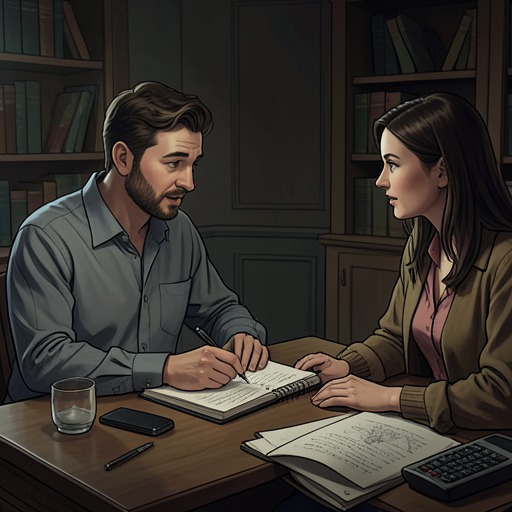
Circe presses the moral question beyond diagnosis. She tells Rabo that he still has not forgiven his father for having been what circumstances made him, and that this is why he is angry. Rabo disputes her reading, then insists that he had an ordeal of his own: he lost his left eye while serving as a lieutenant in an Army Engineers camouflage unit near the end of World War II. He recalls being taken prisoner while unconscious, treated in a German military hospital, and sent on to a prisoner camp after his wound healed. He concedes that the injury caused little pain, but maintains that his own wartime experience gives him a claim to the language of survival as well.
Rabo tells Circe that he has forgiven his father a hundred times and jokes that this time he wants a receipt. The humor does not resolve the conflict; it exposes how often he has attempted to declare it finished. His later account of the father’s life keeps returning to resentment, especially the fear that his father would have mocked his postwar paintings, as he mocked other artists’ work. Rabo imagines that the father would have jeered not only at his Abstract Expressionist friends but at his own son. The possibility hurts because Rabo recognizes that, even after death, he is still seeking a judgment from a father he expects to disappoint him.
Inheritance and Estrangement
The father’s skepticism and self-denial remain part of Rabo’s understanding of himself, but the relationship is not reduced to rejection. The father reads Marilee’s letters closely, gives Rabo the photograph of the supposed house, shares the family’s Armenian language, and makes a suit for the funeral that Rabo later discovers does fit. These specific gestures coexist with the father’s inability to imagine a renewed life in America and Rabo’s conviction that he could have chosen differently.
The inherited loneliness also has consequences for Rabo’s own family life. Looking back, he calls his failure as a husband to Dorothy one of the things he is most ashamed of, and connects it to the estrangement of his sons, Henri and Terry, from him. The book thus places the father-son relationship within a recurring history of survival that does not automatically become belonging: the father cannot recover his lost family and community, while Rabo, despite having a family of his own, later loses closeness with his wife and sons. His conversation with Circe does not offer a clean reconciliation with the dead. Instead, it makes visible how memory carries the father forward—as grievance, explanation, and an unfinished effort to forgive.