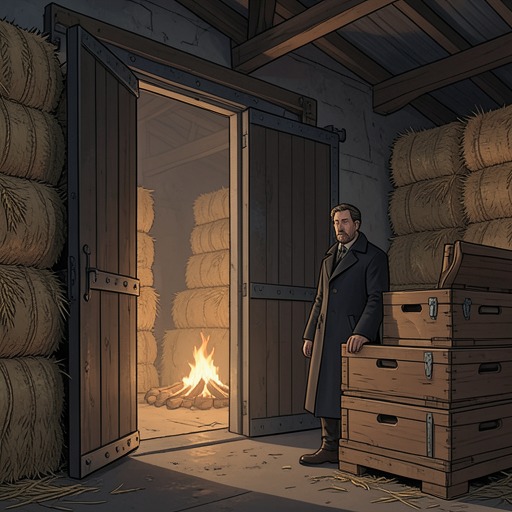
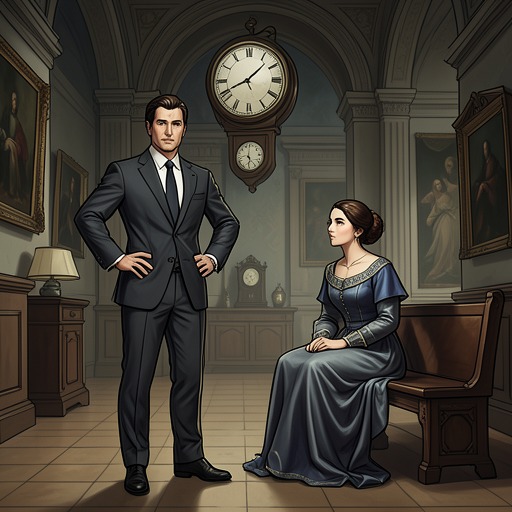
Pöppenrade estate's harvest deal
BuddenbrooksThe Pöppenrade estate’s harvest deal is a turning point in Thomas Buddenbrook’s business life: a risky purchase he initially embraces as a chance to recover his nerve, but cannot reconcile with the firm’s inherited standards. Negotiated through his sister Tony’s friendship with Armgard von Maiboom, the transaction binds family connections to commercial opportunity. Its outcome arrives by telegram during the firm’s centenary festivities, when hail damage turns Thomas’s private misgivings into immediate relief—and marks the deal as part of the decline he had hoped to reverse.
Background and the Request
Tony tells Thomas that Armgard’s husband, Ralf von Maiboom, is deeply indebted and that the apparently prosperous estate conceals serious financial trouble. His gambling and accumulated debts have left him in urgent need of money. Armgard has confided the situation to Tony, and, as Thomas recognizes, her friendship with Tony has also become a route by which her husband can approach the Buddenbrook business for help.
The need is immediate: von Maiboom requires 35,000 marks courant within less than two weeks and must sell at once. Thomas first assumes that the request concerns an advance against the coming harvest. He explains that the family firm has sometimes advanced money to landed proprietors, but only when the borrower’s character or circumstances gave them adequate security. By Tony’s account, von Maiboom offers neither. The proposal, then, is not simply a loan; it is a purchase under the pressure of a seller’s financial emergency.
Thomas’s Decision and the Terms
Thomas objects that the proposed transaction would mean buying an entire year’s harvest for half of what it would later be worth. He sees the moral danger clearly: to him, such a bargain would amount to taking advantage of a vulnerable man and making a profit through usury. He insists that the Buddenbrook firm has never made such a transaction in its more than a century of business. Tony, by contrast, argues that von Maiboom is approaching them voluntarily and hopes to make the arrangement privately.
After Tony leaves, Thomas’s refusal turns into an intense private reconsideration. He begins to see the purchase as the kind of coup that might restore his fortunes, renew his confidence, and make him feel capable of decisive action again. The prospect is not only a financial calculation: success seems to promise a return of the power and good luck he feels he has lost. He pushes his scruples aside by telling himself that the deal can help a hard-pressed landowner and that Tony’s connection to Armgard gives him a special reason to intervene.
Thomas also thinks of the rivalry with Strunck & Hagenström. He expects personal connections to give his firm the advantage over a competitor and plans to handle the matter discreetly, as a private approach rather than a routine transaction on the firm’s letterhead. After pacing through the rooms and imagining the harvest’s grain filling the firm’s vessels, he writes to von Maiboom late that night. The letter, composed in one draft by candlelight, seems to him tactful. On May 30 he travels to Rostock and hires a carriage for the journey into the country.
A Short-Lived Revival
For several days after the decision, Thomas appears markedly lighter. He jokes with Tony, laughs with Christian, teases Klothilde, and spends an hour playing with Hanno on the third-floor balcony, helping him lift toy sacks of grain into a little model warehouse while imitating the workers’ calls. On June 3, he gives an effective, witty speech at an assembly on a tax question, winning agreement and making his opponent, Consul Hagenström, look ridiculous. The sequence suggests how much Thomas has invested in the deal: for a moment, business risk seems to have restored not only his confidence at work but also his ease with his family.
That lift does not last. Tony draws attention to the approaching centenary of the firm, founded on July 7, 1768, and Thomas seems almost affronted by the reminder. He grows quiet and uneasy, leaving his office to walk alone in the garden. The transaction has also unsettled Herr Marcus, Thomas’s partner, who loses his temper when the deal is mentioned, refuses to participate in any profits, and disclaims responsibility for it.
Thomas eventually reveals his regret to Tony while she is saying goodbye to him in the street. He squeezes her hand and says that he should have resold the harvest immediately. His words and abrupt withdrawal expose the fear beneath his earlier excitement: he can no longer defend the enterprise to himself. When Tony tries to raise the subject again, he retreats into silence, ashamed of having shown weakness and embittered by his inability to justify the bargain.
The Telegram at the Centenary
The harvest’s fate becomes known during the centenary celebration at Thomas’s house. The festivities are already a strain for him: he finds the music and conversation banal and feels unable to summon the joy the occasion ought to inspire. At a quarter past twelve, while the municipal-theatre orchestra’s program is nearing its close, a young office apprentice brings him a telegram. Even amid a crowded celebration, business messages are delivered at once.
Thomas steps aside to read it. His face and breathing register the force of the news, and he remains apart from the apprentice, repeating that small amount of hail while struggling to absorb what has happened. He retreats to a sofa in the quiet grand hall and tells himself that it is better this way. After several minutes, he folds the telegram, puts it in his breast pocket, and gets up to return to his guests. The relief is real, but it does not restore his mood: when the music starts again, he sinks back onto the sofa in disgust.
The news of the damaged crop gives the deal an abrupt reversal. Thomas’s imagined profit and renewed business power collapse into the knowledge that the purchase has gone wrong. His relief at the outcome is inseparable from regret: the venture had been intended as proof that he could still take risks and revive the firm, yet its failure leaves him with no triumphant recovery to show for the moral compromise.
Aftermath and Significance
The harvest deal belongs to a longer history of pressure on the family business. Earlier, Thomas had defended preserving capital against payments to relatives, arguing that compensation to Gotthold could open the way to further claims on the inheritance. When the family later calculates Johann Buddenbrook’s estate, it counts losses from the Bremen bankruptcy and the unrest of 1848 and 1855 alongside accumulated profits. Against this background, Thomas’s hope that one bold purchase could revive the firm is set against generations of disbursements, losses, and anxieties about its continuing strength.
The centenary also brings the family’s written record into the foreground. Tony draws attention to the date of the firm’s founding, July 7, 1768, and the coming hundredth anniversary. The commercial institution Thomas hopes to renew is therefore also a family inheritance, measured not only in grain and capital but in a history the Buddenbrooks have carefully recorded and transmitted. His desire to make a decisive deal collides with the standard of commercial conduct he invokes as his own tradition.
After Thomas’s death, his will directs that the firm be dissolved and its affairs liquidated within a year. Tony is deeply hurt that the business will not be kept alive for Hanno, its sole heir. Under Herr Kistenmaker and Herr Marcus, pending contracts and stored grain are sold hastily or allowed to lose value; the estate, assessed on paper at 650,000 marks, yields far less than expected. The liquidation is not presented as a direct consequence of the Pöppenrade purchase alone. Rather, the failed harvest deal anticipates the larger pattern: an attempted recovery that cannot arrest the family firm’s weakening, followed by a settlement that converts its inherited continuity into a series of damaging sales.