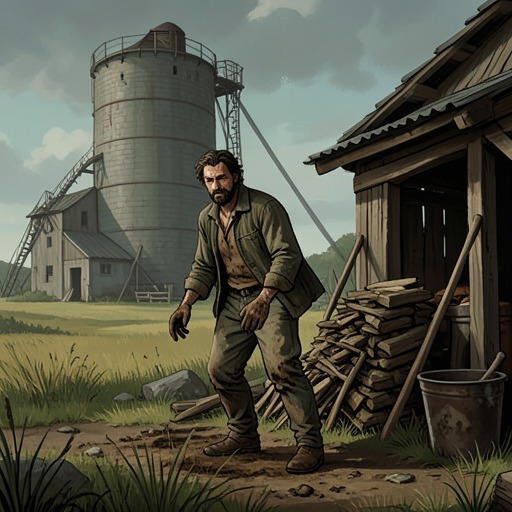
Candide's encounter with the enslaved man in Surinam
CandideCandide's encounter with the enslaved man in Surinam is the moment when suffering ceases to be an abstract objection to optimism and becomes a testimony about an economic system. The man’s missing left leg and right hand, his explanation of how he lost them, and his connection between forced labor and European sugar force Candide to name as madness the belief that everything is right when it is wrong.
Arrival at Surinam
Candide and Cacambo come toward Surinam with two sheep still remaining, carrying treasure that Cacambo believes exceeds the King of Spain’s wealth. Their approach seems to promise an end to their troubles; Cacambo imagines happiness ahead. Instead, they see a man lying on the ground, wearing only half his clothing: blue linen drawers. He has lost his left leg and right hand. The contrast is immediate: the travelers’ wealth and expectation of relief meet a body that bears the cost of labor and punishment.
Candide addresses him in Dutch and asks what has happened. The man says he is waiting for his master, Mynheer Vanderdendur, whom he identifies as a famous merchant. Candide asks whether this master treated him so. The answer begins with an apparent confirmation, but the man explains the injuries through customs and practices: the mill takes a finger while he works at the sugar cane, and the hand is cut off; when a person tries to escape, the leg is cut off. Both events, he says, have happened to him. His account makes clear that the violence is not simply a single encounter between master and worker: it is enforced through a routine that mutilates workers and punishes flight.
The Cost of Sugar
The man gives the injuries an economic destination in one stark sentence: this, he says, is the price at which sugar is eaten in Europe. His body connects the distant consumer to the violence of production. Sugar, usually encountered as a commodity, becomes inseparable from the hand lost at the mill and the leg lost in an attempted escape. The scene does not describe the travelers buying or consuming sugar; instead, the man’s testimony supplies the human cost behind its European use.
He also recounts the circumstances of his sale. His mother sold him on the coast of Guinea for ten patagons. She told him to bless and adore their fetishes, promising that they would make him live happily, and presented enslavement to white masters as an honor that would make his parents’ fortune. He now doubts that his labor made their fortune, and knows that it did not make his own. The distance between the promise and the outcome is measured not only in money but in the injuries and deprivation he describes.
The man compares his condition with that of dogs, monkeys, and parrots, judging them a thousand times less wretched than himself. The comparison is not a claim that he possesses less humanity; it exposes the extremity of the treatment to which he is subjected. His own account places clothing, bodily integrity, freedom of movement, and material benefit under the pressure of a system that extracts labor while offering neither the promised happiness nor protection from violence.
Kinship and Religious Hypocrisy
The man sets the practices of enslavement against the religious teaching he hears on Sundays. Dutch preachers who have converted him declare that everyone is a child of Adam, black and white alike. He says he is no genealogist, but draws the implication: if the preachers speak truth, the enslaved and the enslavers are cousins. The reasoning is plain and deliberately difficult to evade. A shared religious ancestry cannot be reconciled with the barbarous treatment of one’s relations.
His testimony brings doctrine and practice into the same scene without allowing the doctrine to excuse the violence. The Sunday declaration of common descent stands beside the routine amputation of a worker’s hand and the cutting off of a fugitive’s leg. The contradiction is not presented as an abstract theological puzzle: it is embodied by the speaker, whose injuries make the distance between proclaimed kinship and lived treatment visible. The man’s words turn the language of shared humanity against a society that professes it while maintaining enslavement.
Candide’s Renunciation
Candide responds by invoking Pangloss and calling the encounter an abomination that Pangloss had not foreseen. He says that this is the end: at last he must renounce the teacher’s optimism. Cacambo asks what optimism means, and Candide defines it as the madness of maintaining that everything is right when it is wrong. The exchange gives the scene its decisive intellectual consequence. Candide does not answer the man’s account with another general argument about the order of the world; he identifies the doctrine that would make such suffering appear acceptable and rejects it.
The encounter also changes the scale of Candide’s judgment. Before hearing the man, the travelers’ talk concerns the perishability of worldly riches, virtue, and the happiness of seeing Cunegonde again. The suffering before them is not an illustration that Candide can leave at the level of philosophical debate: he looks at the injured man, sheds tears, and enters Surinam weeping. His response is compassion, but it is also a break in his previous insistence that apparent wrong must somehow be right.
The scene does not end with a rescue or a remedy. Once inside Surinam, Candide and Cacambo first ask whether a vessel in the harbor can be sent to Buenos Ayres. They approach a Spanish sea-captain, who offers reasonable terms and arranges to meet them at a public-house; the travelers go there with their two remaining sheep. Their departure plans resume, but the encounter has already marked a turning point: the wealth carried toward the town cannot answer the man’s testimony, and Candide’s tears accompany an explicit renunciation of optimism.