Castle of Thunder-ten-Tronckh
CandideThe Castle of Thunder-ten-Tronckh begins Candide in a world that calls itself magnificent and orderly: a Westphalian estate where hereditary rank, domestic hierarchy, and Pangloss’s optimism seem to confirm one another. Candide’s expulsion over his first kiss with Cunegonde breaks that sheltered order, and the castle’s later destruction by Bulgarian soldiers turns the supposed security of the household into rubble.
Setting and Household
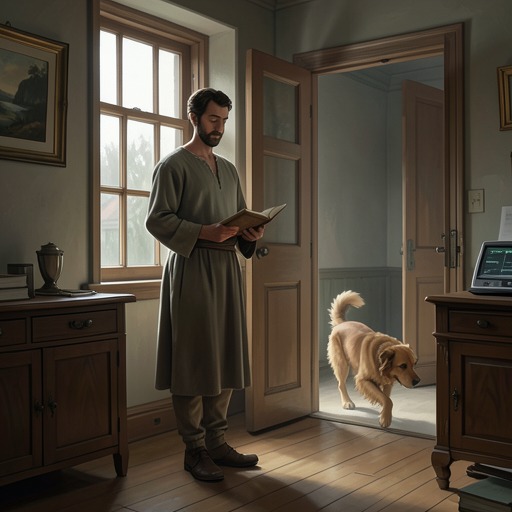
The castle belongs to the Baron of Thunder-ten-Tronckh, presented as one of the most powerful lords in Westphalia. Its claim to magnificence is deliberately modest: it has a gate and windows, while its great hall is hung with tapestry. The household’s resources are likewise made to sound grand through comic repurposing: the farm dogs can form a pack of hounds, the grooms serve as huntsmen, and the village curate is the Baron’s grand almoner. The residents call the Baron “My Lord” and laugh at his stories, a small ritual that makes deference part of the estate’s daily life.
The family’s rank is also treated as a performance sustained by pedigree. The old servants suspect that Candide is the son of the Baron’s sister and a neighboring gentleman, but the match was rejected because the man could prove only seventy-one quarterings; the rest of his genealogical tree had been lost over time. Inside the castle, the Baroness’s size and the formal dignity with which she receives visitors are presented as further marks of her social importance. The family includes their seventeen-year-old daughter, Cunegonde, and a son described as worthy of his father.
Pangloss and the Castle’s Worldview
Pangloss serves as the family’s preceptor and intellectual oracle, and Candide listens to him with the trust of youth. His metaphysical system makes the estate itself evidence for its own superiority: in this best of all possible worlds, the Baron’s castle is the most magnificent, and the Baroness the best of all possible baronesses. The argument turns material arrangements into proof of purpose, just as the existence of spectacles is treated as proof that noses were made to bear them.
The castle therefore does more than shelter the opening action. Its modest features are inflated into signs of cosmic and social perfection, joining Pangloss’s abstract certainty to aristocratic self-regard. The joke is structural: the household’s version of the best possible order is stated before the narrative subjects it to events that expose how little protection that order provides.
Candide’s Expulsion
The first decisive rupture begins near the castle, in a small wood called a park. There, Cunegonde sees Pangloss giving an experimental natural philosophy lesson to her mother’s chambermaid. Curious about the causes and effects she observes, she returns to the castle pensive and newly drawn to learning; she also imagines that she might be a sufficient reason for Candide, and he for her.
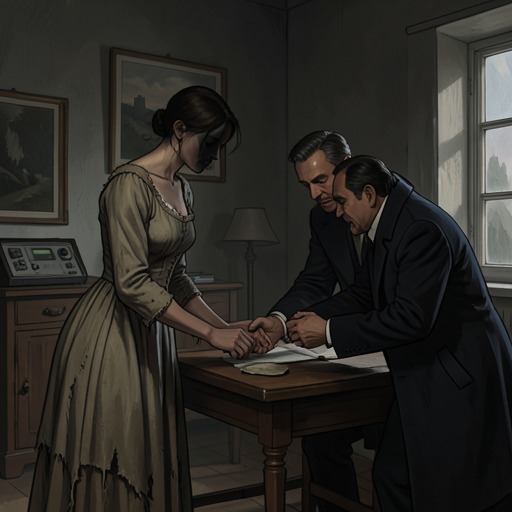
The next day, after dinner, Candide and Cunegonde find themselves behind a screen. When she drops her handkerchief, he picks it up; she takes him by the hand, and he kisses it. Their innocent exchange intensifies until their lips meet and their hands stray. The Baron comes past the screen, sees them, and drives Candide from the castle with kicks. Cunegonde faints and, after recovering, is boxed on the ears by the Baroness. The scene turns the estate’s carefully maintained hierarchy into immediate physical force: Candide’s place in the household lasts only while he does not cross the boundary set by its patriarch.
Destruction and Narrative Significance
After Candide later meets Pangloss, he learns that the castle has been attacked. Pangloss reports that Bulgarian soldiers violated and killed Cunegonde, killed the Baroness, and struck the Baron on the head as he attempted to defend his daughter. The Baron’s son suffered the same fate as his sister. The castle itself was left with not one stone standing; its barns, sheep, ducks, and trees were gone as well. Pangloss adds that the Abares had inflicted the same devastation on a neighboring barony belonging to a Bulgarian lord.
The destruction answers the opening image of the estate without restoring its earlier terms. A place introduced through its gate, windows, tapestry, pedigree, and confident philosophical explanation is reduced to the loss of its family and every listed feature of its working grounds. In the wider satire, the rapid reversal makes the castle a first test of the claim that things cannot be otherwise than they are: the household’s assurances of order do not prevent either private violence or the organized violence of war.