Kingdom of the Bulgarians
CandideThe Kingdom of the Bulgarians enters Candide as a power that turns hospitality into enlistment and war into an officially sanctioned spectacle. Its armies are described with polished ceremony, but the kingdom’s authority over Candide and the devastation inflicted on villages expose the violence beneath that orderly surface.
Setting and Military Authority
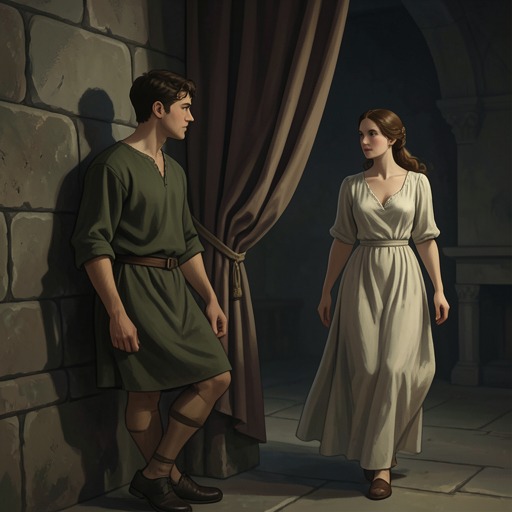
The Bulgarian episode begins after Candide has been driven from the castle in Westphalia. He walks without knowing where he is going, weeps, and sleeps hungry in a field as snow falls. The next day, numb with cold, exhausted, and without money, he reaches an inn near the town of Waldberghofftrarbk-dikdorff. Two men in blue assess him as a well-built young man of suitable height and invite him to dinner. The episode makes his vulnerability plain before the kingdom’s military machinery claims him: he is hungry, disoriented, and in no position to understand the meaning attached to his hosts’ welcome.
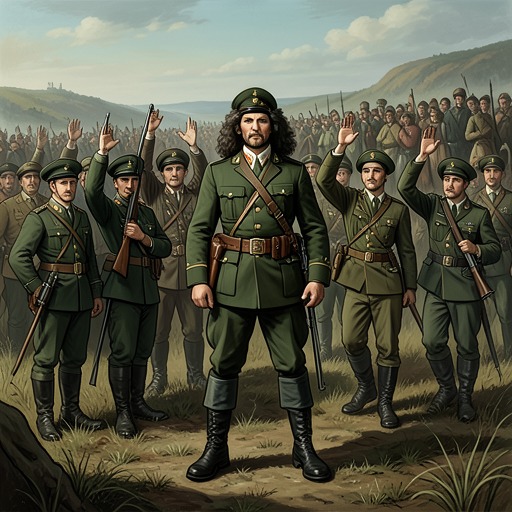
After Candide drinks the king’s health, the men announce that he is now the support, defender, and hero of the Bulgarians, and that his fortune and glory are assured. The declaration is immediately contradicted by what follows. Candide is fettered and carried to his regiment, where he is drilled in a sequence of commands—turning, handling and presenting his rammer, firing, and marching—and beaten thirty times with a cudgel. As he learns the exercises, the punishment falls to twenty blows and then ten; his comrades regard him as a prodigy. Military recognition thus arrives not through a voluntary achievement but through enforced obedience, with reduced beating treated as evidence of progress.
The kingdom’s control extends from compulsory service to control over movement. When Candide later goes for a walk, believing that people, like animals, may use their legs as they please, four soldiers bind him and carry him to a dungeon. Offered a choice between being flogged thirty-six times through the regiment or receiving twelve bullets in the brain, he rejects both but is forced to choose. He selects the gauntlet in the name of liberty and endures it twice before the narrative continues. In this encounter, the language of choice and freedom is stripped of practical force: the state’s offered alternatives are punishments, and even Candide’s choice is made under compulsion.
War and Its Human Cost
The Kingdom of the Bulgarians presents battle as a spectacle of disciplined grandeur: trumpets, fifes, hautboys, drums, and cannon combine in music the narrator compares to Hell. The ceremony does not soften the arithmetic. Cannons lay about six thousand men low on each side; muskets kill another nine or ten thousand, and bayonets account for several thousand more. The total approaches thirty thousand dead. Candide, trembling, hides during the butchery, while the two kings have Te Deum sung in their respective camps. Sacred celebration and mass killing proceed side by side, making victory’s public ritual part of the satire rather than a moral answer to the slaughter.
Candide leaves the battlefield over heaps of dead and dying and reaches an Abarian village burned by the Kingdom’s army under the laws of war. He encounters wounded old men facing the murder of their wives and children, dying daughters, people half-consumed by flames who beg for death, and ground strewn with brains and severed limbs. The account then reverses the identity of the destroyer but not the devastation: an Abarian village has suffered the same treatment at the hands of the Kingdom’s enemies. Candide crosses ruins and palpitating bodies until he is beyond the seat of war, carrying only a few provisions in his knapsack and still keeping Cunegonde in his thoughts. By showing both villages laid waste, the episode makes the reciprocal violence harder to mistake for a peculiarity of one army; the orderly phrase laws of war exposes how institutions can regularize slaughter without making it less terrible.
Satire and Philosophical Function
The Kingdom of the Bulgarians tests Pangloss’s claim that the world is arranged for the best against a society whose military order makes coercion look like honor. Candide is named a hero while being forced into service, and the armies’ orderly ceremonies accompany slaughter on a vast scale. The gap between public language and what happens to bodies is the episode’s satirical instrument: calling violence regular under the laws and usages of war exposes the institution’s capacity to normalize it, not to justify it.
The Bulgarian episode is one of the rapid reversals through which Candide, published in 1759, puts philosophical claims under pressure from experience. Later, Candide and Cacambo reason that an unknown country may be one where all is well, since things went badly for Candide in Westphalia. The Kingdom’s military world belongs to that accumulating evidence against easy assurances. The conclusion turns instead toward work: Candide insists that they must cultivate their garden, Pangloss connects labor to humanity’s original purpose, and Martin urges them to work without disputing. That ending does not offer a political solution to the violence Candide has witnessed; it shifts the answer from abstract explanations toward practical activity.
Narrative Form and Enduring Effect
The introduction links the force of Candide to its unusual compression: Voltaire wrote it in three days, yet its swift prose has room for concrete violence and sustained intellectual attack. The Kingdom of the Bulgarians belongs to that compact design. Its military order is not developed into a separate political history; instead, a few sharply juxtaposed details make war’s official dignity collide with its human cost. The introduction also describes the book’s laughter as undiminished across generations, a durability grounded in the way its brisk, comic movement exposes the distance between institutions’ claims and what they do.