Lisbon
CandideLisbon is where a sea disaster gives way to urban catastrophe, and where officials answer destruction with a public ceremony claimed to prevent its return. The city’s role is not merely geographical: the shipwreck, the earthquake, and the Lisbon auto-da-fé place human loss beside confident explanations that cannot withstand what happens. Lisbon becomes the setting in which Pangloss’s reasoning and the authorities’ purported remedy are tested against deaths, destruction, and a further shock.
The City at the End of the Voyage
The approach to Lisbon begins in a tempest within sight of the port. As the ship is battered, James the Anabaptist tries to help a sailor who has fallen overboard after striking him. James hauls the man up, but the effort sends James into the sea; the sailor, now safe, leaves his rescuer to drown. Candide sees his benefactor rise above the water and disappear. Pangloss responds by arguing that the Bay of Lisbon had been made for James to drown in, turning a particular death into an example for his explanation of the world.
The ship founders. Only Pangloss, Candide, and the sailor survive: the sailor swims ashore, while Pangloss and Candide reach land on a plank. They walk toward Lisbon with some money left and the hope of avoiding starvation. Their arrival carries the immediate weight of James’s death, which they lament, but the city offers no interval in which to recover. The disaster at sea is followed almost at once by a disturbance beneath their feet.
Earthquake and Destruction
The earthquake shakes Lisbon as Candide and Pangloss reach it. The harbour sea swells and foams, smashing vessels at anchor, while whirlwinds of fire and ashes sweep through streets and public places. Houses collapse, roofs are flung onto the pavements, and the pavements themselves are scattered. The account gives the scale of the loss as thirty thousand inhabitants, of all ages and sexes, crushed under the ruins; another passage describes three-fourths of Lisbon as destroyed.
The survivors do not respond alike. The sailor whistles and swears at the prospect of booty, treating the devastated city as an opportunity for gain. Pangloss asks for a sufficient reason for the phenomenon, continuing to seek a rational account even amid immediate destruction. Candide cries that the Last Day has come. The contrast sets material opportunism, abstract explanation, and terror side by side without making any of them capable of undoing the damage.
The Lisbon Auto-da-fé
After the earthquake, the country’s sages choose a public religious ceremony as their means of preventing further destruction. The account says that Coimbra University had declared the slow, ceremonious burning of a few people alive an infallible way to stop the earth from shaking. The claimed remedy converts a natural catastrophe into an occasion for punishment, while treating the suffering of selected victims as a tool for protecting the wider population.
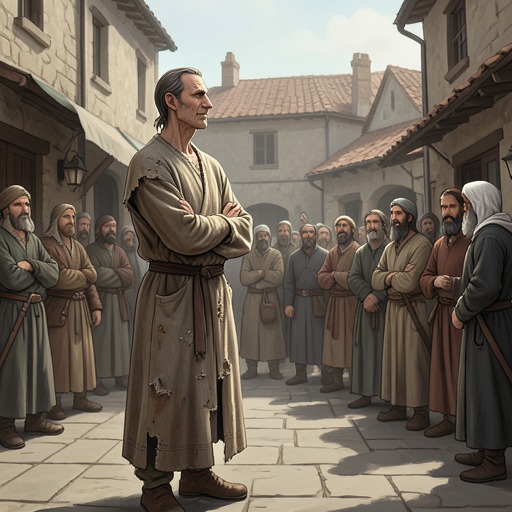
The authorities seize a Biscayan for marrying his godmother and two Portuguese men for rejecting bacon in the food they were eating. Pangloss is taken for speaking his mind; Candide is taken for listening with apparent approval. They are confined in separate apartments described as extremely cold and without sunlight. Eight days later, the condemned are dressed in San-benitos and given paper mitres. Candide’s garments bear reversed flames and devils without tails or claws; Pangloss’s show upright flames and devils with claws and tails. The contrasting designs mark them out differently within the procession, but do not spare either man.
The ceremony combines procession, a sermon, and church music with bodily punishment. Candide is whipped in time with the singing. The Biscayan and the two men who refused bacon are burned, while Pangloss is hanged, an outcome the account specifically notes was not customary. On that same day, the earth shakes violently again. The recurrence directly contradicts the ceremony’s stated purpose: the spectacle has inflicted further suffering without preventing the phenomenon it was supposed to stop.
Historical Date and Narrative Significance
The book’s explanatory notes identify the Lisbon earthquake as occurring on November 1, 1755, and state that the Lisbon auto-da-fé actually took place on June 20, 1756, some months after the earthquake. Those dates distinguish the historical occasions recorded in the notes from the compressed narrative sequence in which the catastrophe and ceremony form a continuous episode. The notes also explain that rejection of bacon marked the two Portuguese men as Jews in the logic of their accusation, and describe the San-benito as a garment worn by people condemned by the Inquisition at an auto-da-fé.
Lisbon thus gathers together two linked failures of explanation. Pangloss’s argument treats James’s drowning as necessary to the design of the world; the authorities treat executions as an infallible safeguard against earthquakes. In each case, a confident account assigns meaning or purpose to suffering, but the narrative immediately supplies the human cost and, in the ceremony’s aftermath, a renewed earthquake. The city’s destruction makes those claims concrete: Lisbon is where theories of necessity and prevention meet events they cannot control.