Paraguay
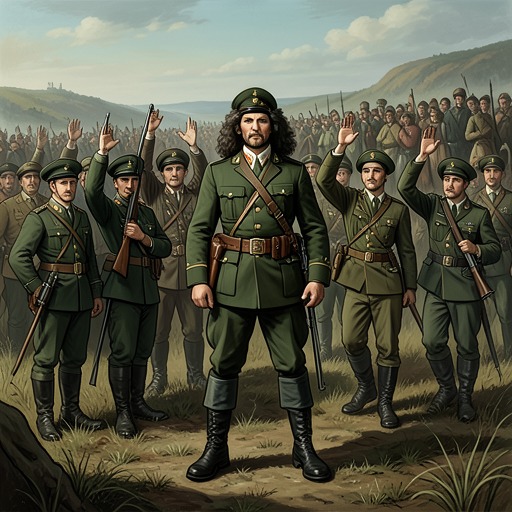
CandideParaguay is depicted as a Jesuit-governed territory whose immense scale and disciplined military presence make it a new arena for Candide and Cacambo. Its apparent order rests on a stark division between the Fathers, who possess everything, and the people, who possess nothing; its Commandant’s position also reveals the entanglement of religious authority, colonial rule, and warfare.
Territory and Jesuit Government
Cacambo, who had served at the College of the Assumption, presents himself as familiar with both the government of Paraguay and the streets of Cadiz. He describes the Jesuit kingdom as more than three hundred leagues in diameter, divided into thirty provinces. His account of its governing arrangement is blunt: the Fathers possess all, while the people possess nothing. He calls this a masterpiece of reason and justice, but the disparity he describes makes that praise pointedly ironic.
The Fathers’ political position is equally contradictory. In Paraguay, Cacambo says, they make war upon the kings of Spain and Portugal; in Europe, they confess those same kings. The same institution thus appears as both a military opponent of royal power and a religious servant to it, depending on where it operates. Paraguay is not simply a distant setting for the journey: it is where this divide between European allegiance and colonial authority becomes visible.
Arrival and Reception
Cacambo directs Candide toward Paraguay after the pair flee, proposing that they seek service with the Jesuits and emphasizing that Candide’s knowledge of Bulgarian military drill could make him useful. At the first barrier, Cacambo announces that a captain wishes to meet the Commandant. The travelers are disarmed, their two Andalusian horses seized, and they are escorted between files of musketeers. A sergeant explains that the Commandant will not speak to them until the Father Provincial is present, and that no Spaniard may remain in the province for more than three hours.
Their treatment changes when the sergeant reports that Candide is German. The Commandant permits him to be brought to his summer-house, and the travelers’ weapons and horses are returned. The audience takes place in a green-and-gold marble colonnade among rare birds. A gold-vessel breakfast is served to the Commandant, while Paraguayans eat maize from wooden dishes outdoors, exposed to the sun. The contrast places the hierarchy of the territory inside the scene itself: the officials’ cultivated enclosure and fine meal stand apart from the ordinary people’s food and conditions.
The Commandant and Paraguay’s Military Role
The Commandant is a young German Jesuit, and his authority combines clerical and military offices. He receives Candide as a fellow German, while his position within Paraguay belongs to a system that values Jesuits from outside Spain. The account later explains that Paraguay’s rulers admit as few Spanish Jesuits as possible and prefer those of other nations because they are more subordinate to their commands.
The Commandant’s own career embodies that policy. After surviving the destruction of his family, he entered the Jesuit order, was sent to Rome, and was selected among young German recruits for work in Paraguay. He arrived with a sub-deaconship and a lieutenancy and has since become both colonel and priest. From Paraguay he anticipates resisting the troops of the King of Spain, a prospect that turns Cacambo’s description of the Fathers’ political double role into an immediate military stake.
Narrative Significance
Paraguay brings Candide’s journey into a territory where an apparently rational system is organized around unequal possession and armed control. Its scale, provincial divisions, guarded entrance, and restrictions on Spanish visitors suggest a government that is both institutional and coercive; the Commandant’s welcoming summer-house does not erase the armed reception or the contrast between his breakfast and the people’s maize.
The location also connects the wider violence of Candide’s travels to the Jesuit order’s political reach. The Commandant’s path from a German recruitment network to a Paraguayan command, and his readiness to fight Spanish troops, show how religious offices and military service operate together there. Paraguay’s order is therefore presented not as a refuge from European conflict but as another place where authority, allegiance, and force intersect.