Ashford Hospital
CrashAshford Hospital is the casualty institution where the narrator recovers from the collision that kills Charles Remington and where the accident’s physical, ethical, and erotic consequences are first organized into a sustained narrative. Located near London Airport amid used-car marts, water reservoirs, remand centres, and the motorway systems serving the airport, it is less a refuge from the automobile world than one of its interior chambers: the crash arrives there as broken bones, blood, photographs, police inquiries, and bodies made legible through medical care.
Setting and Function
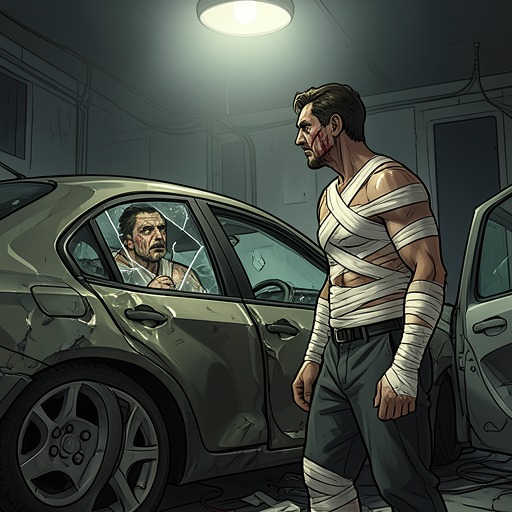
Ashford Hospital receives the narrator after his car strikes Charles Remington’s vehicle head-on on a rain-swept June evening beneath the entrance to the Western Avenue flyover. Although rescuers initially assume that the blood covering him comes from a massive open-heart wound, the most serious damage is internal and structural: both kneecaps have been fractured against the instrument panel, his chest is badly bruised against the steering wheel, his knees have been driven into the dashboard, and a nerve has been severed in his scalp. The hospital therefore becomes the place where the apparent spectacle of the crash is revised into a detailed anatomy of impact.
The casualty wards are also prepared for a larger technological catastrophe. Two wards containing twenty-four beds each are permanently reserved for possible air-crash victims, with the maximum number of survivors already anticipated. When the narrator occupies one of these beds, the hospital’s empty capacity becomes a silent archive of hypothetical disaster. Aircraft rise from London Airport while the injured man lies beneath harnesses and dressings, and the machinery around his body seems to echo the slopes and contours of the nurses’ bodies. The institution holds together two scales of violence: the individual automobile collision that has actually occurred and the mass disaster that its architecture continually expects.
Patients, Staff, and Medical Power
The hospital’s routines reduce the injured body to wounds, fluids, dressings, traction, and controlled functions, but the narrator experiences this reduction as both care and exposure. Nurses empty his urinal, work his bowels with an enema apparatus, guide his penis through the opening of his pyjama shorts, adjust drainage tubes in his knees, cleanse pus from his scalp dressings, and wipe his mouth. Their practical attention to his most infantile bodily zones makes them resemble guardians of his orifices, linking hospital nursing with memories of childhood dependence.
A refined-looking nurse later examines his dressings with deliberate care. Her sponge moves around the central bandage extending from his waistband between his legs, and the narrator imagines that she might be reading the automobile’s components in his skin and musculature, estimating the model and weight of the car from the traces left in his body. When she holds his limp penis and asks which side he wants it placed on, a basic act of nursing becomes an emblem of medical authority over the damaged body. The hospital’s language is therefore not only diagnostic. It also redistributes privacy, agency, and sexual meaning through procedures that the patient cannot perform for himself.
The women’s casualty ward extends this pattern beyond the narrator. He sees patients in traction and an elderly woman whose right leg has been amputated after she is knocked down by a cycling child. She repeatedly wraps a silk scarf around the remaining stump, while the nurses’ treatment shifts between daytime pride and nighttime humiliation. These contrasting forms of attention expose the hospital as a hierarchy of care in which bodies are valued differently according to visibility, visitors, and institutional convenience.
Helen Remington and the Crash Community
Ashford Hospital brings the narrator into direct contact with Helen Remington, the doctor whose husband he has killed. Catherine identifies her as the other driver’s wife, and the narrator later sees her moving toward him on a stick, using the device as a postural disguise for the bruise on her right cheekbone. She carries the wound into the corridor as a visible record of the collision, and her scar, running from the corner of her eye toward the apex of her mouth, becomes for the narrator an imagined biography written into the skin.
Their meeting is governed by hatred, grief, injury, and an immediate erotic charge. Helen has last been seen beside her husband’s body in the ambulance, staring at the narrator with calm hostility. Inside the hospital she refuses to accommodate him, changes her grip on the stick as though prepared to strike him, and deliberately presents the injured side of her face before walking away. Yet the narrator’s thoughts transform the collision into a fantasy of reunion, imagining that sexual contact with Helen might somehow re-conceive her dead husband. The hospital thus produces an unstable community of survivors and bereaved people whose relations are formed through shared impact rather than sympathy.
Catherine’s visits intensify the conflict between public mourning and private fascination. She offers condolences for Charles Remington, but the narrator regards her grief as a stylized performance and resents what he considers her moral display. She is more persistent and vivid when describing the crushed radiator grille and blood spattered across the bonnet, treating the damaged car almost as an object of voyeuristic attention. Her response mirrors the hospital’s own double function: the crash is officially a tragedy requiring inquiry and regret, but it is also a spectacle of metal, flesh, and intimate bodily consequence.
Vaughan’s Surveillance of the Hospital
Ashford Hospital is later revealed to have been under Robert Vaughan’s observation. Vaughan listens to ambulance broadcasts on the VHP band of his car radio and photographs the narrator being carried into the casualty unit, following him from the police pound through the airport reception area, the multistorey car-park, and Helen Remington’s house. His photographic dossier turns the hospital into one stage in a larger study of the automobile’s relation to the human body.
The photographs do not primarily record the narrator’s personal life. Their true subject is the interaction between an anonymous individual and his car: the body’s transit across polished cellulose panels and vinyl seating, the face silhouetted against instrument dials, and the continuing presence of the automobile around the hospital’s roads and approaches. Vaughan’s images therefore make Ashford Hospital an extension of the accident scene rather than its opposite. The institution may remove the narrator from the wreck, but the camera reconnects him to the vehicle and converts convalescence into evidence.
Vaughan’s presence also alters the hospital’s authority. The scarred former computer specialist, associated with traffic-control systems and a hoodlum-like scientific persona, approaches the medical world as an outsider who can produce his own archive of wounds. When the narrator recognizes him as the young doctor-like figure previously seen near Helen Remington’s room, the hospital’s professional spaces become entangled with Vaughan’s private investigation and eroticized collection of accident imagery.
Trauma, Memory, and Narrative Significance
The narrator spends three weeks in an empty ward, and the hospital’s repeated stillness gives the crash a delayed afterlife. Blue police lights revolve within his mind; pain travels from his fractured knees into his thighs and groin; the vacant beds hold imagined histories of collision and bereavement. Rather than producing a clean separation between accident and recovery, Ashford Hospital allows the event to recur as bodily sensation, mental image, sexual fantasy, and ethical uncertainty.
The hospital also exposes the gap between physical survival and moral resolution. The narrator is barely injured compared with Charles Remington, yet he cannot stabilize his relation to the dead man, Helen, or his own responsibility. He considers the collision as an encounter between bodies locked face to face through fractured windshields, with the dead husband lying between the two survivors. Later, he recognizes that his feelings toward the dead man and Helen have become overlaid with half-formed hostilities and dreams of revenge. Medical recovery therefore does not settle the meaning of the crash; it gives the narrator the time, isolation, and bodily evidence through which its meanings multiply.
Ashford Hospital’s significance extends beyond the narrator’s initial convalescence. Vaughan later brings the narrator’s hospital photographs into his album, and the hospital becomes part of the visual grammar that culminates in Vaughan’s death beneath the London Airport flyover. When Vaughan’s body is so disfigured that police initially identify it as the narrator’s, the institutional logic of wounds and identification returns in its most disturbing form. The hospital is thus the first major site where the novel’s central fusion of accident, anatomy, technology, sexuality, and death becomes visible: a place intended to repair bodies, but also a place where damaged bodies are read, classified, remembered, and imaginatively transformed.