Drayton Park
CrashDrayton Park is the narrator's residential setting and one of the novel's most important spatial instruments: an apparently pleasant island of modern housing that is gradually revealed as an elevated viewpoint over a technological world of motorways, aircraft, vehicles, and engineered horizons. From its balconies, avenues, car parks, and forecourt, private domestic life becomes inseparable from the traffic system surrounding it, and the district becomes a place where the narrator's recovery, his relationship with Catherine Ballard, and Robert Vaughan's destructive presence converge.
Setting and Spatial Character
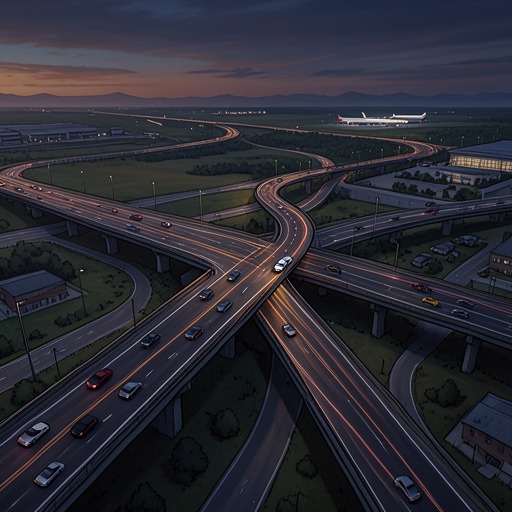
Drayton Park stands a mile north of London Airport, within a modern housing development protected from the distant bulk of London by an access spur of the North Circular motorway. The narrator describes the area as a pleasant island of housing units, landscaped rilling stations, and supermarkets. Its apparent suburban calm is therefore organized rather than natural: the district is sheltered by motorway infrastructure, while its daily life is arranged around shops, roads, parking areas, and the continuous movement of vehicles.
The narrator's apartment occupies a position from which the surrounding system can be read almost as a diagram. After returning from Ashford Hospital, he spends a week in the same reclining chair on the veranda, looking through anodized balcony rails at the unfamiliar neighbourhood ten storeys below. He gradually reorients himself by the motorway's concrete pillars and perspectives of speed, purpose, and direction, using the road network to relocate the houses of friends, the wine store, and the small art cinema where he and Catherine Ballard watched American avant-garde films and German sex-instruction movies. Human beings no longer serve as the clearest landmarks. The embankments and car-park aprons, with their fixed geometry, seem more reliable than the domestic routines and infidelities of the residents.
The Silent Traffic Landscape
Drayton Park becomes especially significant when the surrounding landscape abruptly falls silent. By a rare interruption in flight control, no aircraft are landing or taking off from the airport, while traffic on the motorway is stationary in a southward queue. Cars and airline coaches wait along Western Avenue, and three lines of vehicles climb the flyover before continuing along the newly extended motorway. During the narrator's hospitalization, highway engineers have pushed the motorway decks more than half a mile farther south.
From the apartment, the narrator recognizes that the zone defining his life is now enclosed by a continuous artificial horizon of raised parapets, embankments, access roads, and interchanges. These structures encircle the vehicles below like the walls of a crater. Drivers shift uneasily in the hot sunlight, apparently trapped inside a world that has stopped. The narrator's wounds seem to him like signals capable of unlocking this stasis and releasing the drivers toward the destinations promised by the electric highway. The memory of this stillness persists even when Catherine drives him to Shepperton Studios and the traffic resumes its speed, swerving from one jam to another beneath departing airliners.
Domestic Observation and Exposure
The apartment at Drayton Park is not merely a retreat during convalescence. It is also an exposed viewing platform. When the narrator drives toward the motorway while Catherine Ballard prepares for a flying lesson, a traffic jam brings his own apartment house into sight. From the road he sees Catherine moving inside the apartment, making telephone calls and writing on a pad; he realizes that she is temporarily occupying a role associated with him, while he expects to return to the balcony as soon as she leaves.
This reversal makes him understand that his bandaged body has been visible to tens of thousands of motorists. To those waiting below, he may have appeared as a nightmarish totem, a domestic idiot placed out each morning to contemplate the scene of his own motorway-induced cerebral death. Drayton Park thus reverses the usual relation between home and public space. The apartment is private in function but public in visibility, and the narrator's recovery is performed before the traffic that surrounds the building.
Vaughan and the District's Darker Uses
Drayton Park also provides a setting for Robert Vaughan's increasingly disordered obsession with the crashed car and the sex-death he has imagined for Elizabeth Taylor. During the narrator's last days with Vaughan, the two men sit for hours in a deserted parking lot behind the apartment house, watching plane-tree leaves move across wet macadam while Vaughan listens to police and ambulance broadcasts. The parking lot is a marginal space within the residential district, close enough to the apartment to remain part of domestic life but empty enough to become a theatre for surveillance, anticipation, and fantasy.
The district's relationship to Vaughan changes again before the final confrontation. As Catherine sleeps, the streets below are deserted and the only sound in the pre-dawn lull is the damaged exhaust of Vaughan's car. From the kitchen window, the narrator sees Vaughan's grey face leaning against the cracked quarter window, a deep weal crossing his forehead. Vaughan seems abandoned by the aircraft he has watched rise from the airport, left to maraud through an empty city after Catherine and the narrator have gone.
At dawn, his car is parked beneath the trees on the avenue. The interior shows that he has apparently been living there for several days: the seats are coated with oil and grime, a torn tartan blanket lies across a greasy pillow, and broken bottles and food cans cover the floor. In an evident fit of anger, he has battered the instrument panel, damaging the dials, binnacle, plastic housings, and chrome strips. The car's deterioration makes the vehicle an extension of Vaughan's own damaged body and turns the apparently orderly avenue into the threshold of a derelict existence. When the narrator pushes the broken body panels back into place, the front tyre slowly deflates, giving the encounter a final image of mechanical collapse.
Narrative and Thematic Significance
Drayton Park condenses the novel's central transformation of space. It begins as a comfortable suburban enclave, with supermarkets, neighbours, friends, and familiar routes, but the narrator increasingly understands it through infrastructure rather than community. The motorway, airport, flyover, parking areas, and apartment facades form a single technical landscape in which movement and immobility are equally controlling conditions.
The district also joins intimacy to traffic. The narrator's marriage to Catherine Ballard, his convalescence, his observation of motorists, and Vaughan's sexualized crash fantasies all occupy the same spatial field. From the balcony, the narrator looks down on the traffic and later imagines the vehicles as an illuminated queue waiting for an invisible slip road into the sky. Drayton Park therefore becomes both observatory and enclosure: a place from which the technological landscape can be interpreted, but also a place bounded by it. Its apparent safety cannot separate domestic life from the violent possibilities carried by the road system.