Northolt General Hospital
CrashNortholt General Hospital is the casualty institution to which Seagrave is taken after the failed Northolt stock-car accident reenactment. In the novel, it is less a place of recovery than a threshold where Vaughan’s choreographed violence meets actual concussion, where medical care becomes part of the spectacle, and where the damaged body is carried from the arena into a wider landscape of airports, garages, vehicles, and observation.
Setting and Access
Northolt General Hospital stands in west Northolt, a residential suburb adjoining the airport. Vaughan’s car reaches it after passing through streets of single-storey houses, small gardens, and wire fences inhabited by junior airline personnel, car-park attendants, waitresses, and former stewardesses. Because many residents work shifts, the suburb appears curtained and empty as the cars move through it. The hospital therefore belongs to a transitional environment shaped by transport and irregular labour rather than to an isolated civic centre.
The approach to the hospital continues the novel’s traffic imagery. Vaughan drives through the night with Seagrave injured in the rear seat and Helen Remington beside him, passing from the Northolt overpass into the airport’s peripheral roads. The route links the hospital to the transit economy surrounding it: landing fields, apartment developments, unfinished hotels, filling stations, breakers’ yards, vehicle dumps, repair shops, and panel beaters. Medical treatment is thus located within the same industrial geography as damaged cars and the circulation of passengers.
Seagrave’s Admission
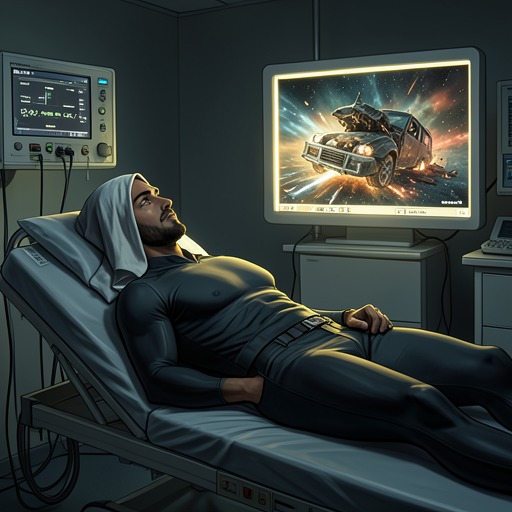
Seagrave is brought to Northolt General Hospital after the reenactment collapses into a genuine accident. The planned spectacle was meant to have his target car struck by a skidding truck and driven into four oncoming vehicles, but the truck locks onto the car’s raw fenders, carries it fifty yards, and rams it into another saloon car. The impact leaves Seagrave concussed. Although he can walk, he wipes his greasy hands on his silver overalls, gropes blankly at the air, and has not recovered his balance; the narrator suspects that the injury is only the latest in a long sequence of concussions.
Vaughan ignores the ordinary visitor parking and drives past the casualty entrance into the space reserved for consultant physicians. He gets out, calls Helen from the car, and escorts Seagrave toward the casualty department. The movement is practical but also theatrical: Vaughan appears to direct the injured man and the doctor as though the hospital were another stage in his production. Vera Seagrave later absolves Vaughan of responsibility, even though the narrator recognizes that Vaughan has been using her husband as an experimental subject.
Vaughan Outside the Casualty Department
The hospital’s parking lot becomes a temporary theatre for Vaughan’s self-dramatization. While Seagrave and Helen remain inside, Vaughan sits on the hood of his Lincoln with one thigh cutting off the beam of the nearside headlamp. He prowls around the vehicle beneath the stares of visitors walking toward the wards, holding himself in the light as if invisible television cameras were framing him. The consultant parking area consequently exposes the continuity between Vaughan’s former public identity as a television scientist and his present role as director of violent automotive scenarios.
Vaughan then opens the trunk of his car, searches through cameras and flash equipment, and selects a pistol-grip cine-camera. He invites James Ballard into the Lincoln and films the entrance to the casualty department while photographs of crashed vehicles lie on the floor. The hospital is made into an archiveable scene: injured people enter the institution, while Vaughan records the threshold from outside. His camera converts medical emergency into material for the same visual system that has already treated collision as performance.
Medical Institution and Damaged Bodies
Northolt General Hospital does not erase the violence produced by Vaughan’s spectacle; it gives that violence an institutional destination. Seagrave’s concussion, unstable gait, and bruised head provide the immediate bodily facts that the reenactment was supposed to simulate. The hospital’s casualty department therefore marks the point at which symbolic choreography becomes clinical consequence, even though Vaughan continues to interpret the injured body through his own aesthetic and erotic logic.
This medical setting also anticipates the novel’s broader attention to rehabilitation and assistive technology. Elsewhere, photographs associated with Vaughan show an injured young woman moving from a crashed sports car to a chromium wheelchair, convalescent care, archery, and lessons in an invalid car. Those images frame recovery not simply as restoration to an earlier condition but as a transformation through wheelchairs, braces, treadles, gear changes, and altered bodily movement. Northolt General Hospital belongs to this same continuum, where injury is translated into medical observation and then into new relations between bodies and machines.
Narrative Significance
Northolt General Hospital concentrates the novel’s refusal to keep accident, medicine, technology, and sexuality in separate domains. The hospital is a site of rescue, but it is also surrounded by wrecking yards and vehicle businesses and watched by a man who treats cameras as instruments of control. Its casualty entrance separates the wounded from the spectators, yet Vaughan’s filming collapses that separation by making the medical threshold part of his private cinema.
The episode also fixes the pattern of James Ballard’s relationship with Vaughan. After waiting beside him in the hospital parking area, Ballard recognizes that the entire course of their association has been established within those few minutes. Vaughan’s handling of his damaged Lincoln—aggressive, distracted, sensitive, clumsy, absorbed, and brutal—becomes a practical model for his conduct with people. Northolt General Hospital is therefore not merely a location in the route from the racetrack to Seagrave’s home; it is the place where Vaughan’s methods, Ballard’s fascination, and the novel’s medicalized vision of injury become unmistakably joined.