Western Avenue
CrashWestern Avenue is the central roadway of the narrator’s technological landscape, linking the airport, motorways, flyovers, car parks, and suburban housing into one continuous field of movement. Its decisive significance lies in the way it converts personal trauma into a spatial ritual. The narrator’s collision at its flyover fixes the road in his memory, but repeated returns transform it from an accident site into a laboratory where bodily injury, sexual desire, mechanical design, and fantasies of death are repeatedly brought together.
Setting and Infrastructure
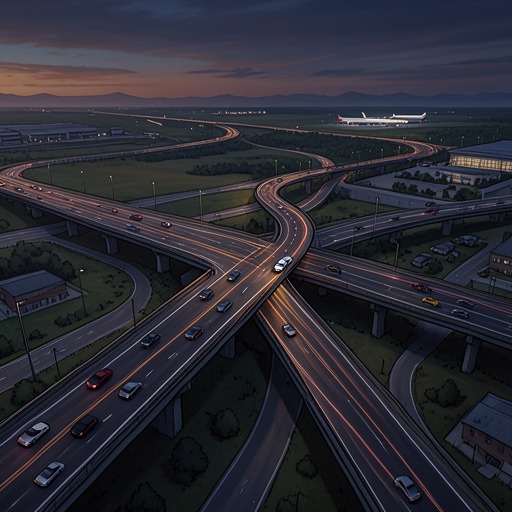
Western Avenue is encountered as part of an immense infrastructural network rather than as an isolated street. From the narrator’s apartment at Drayton Park, the roadway and its access spurs help organize the surrounding landscape: motorways pass on elegant concrete pillars, airport runways extend across the horizon, and new apartment systems spread toward the road. After leaving the hospital, the narrator gradually reorients himself through these structures. The embankments, interchanges, and raised parapets become more reliable points of reference than the people inhabiting the suburban neighbourhood, whose domestic dramas and infidelities seem insubstantial beside the motorway’s “constant and unswerving geometry.”
The road’s power is especially apparent during an extraordinary traffic stoppage. Aircraft temporarily cease landing and taking off, vehicles remain stationary along Western Avenue, and three lines of cars queue up the flyover ramp toward the southern motorway extension. Drivers sit trapped in the heat, and the entire technological horizon appears to form the walls of a crater around them. The narrator reads the silence as a momentary suspension of the ordinary world, imagining that his wounds are signals capable of unlocking the stasis and releasing the drivers toward the destinations promised by the electric highway. When traffic resumes, the vision does not disappear; the road has become an invitation to explore the “viaducts” of the mind.
The Crash and the Return to the Site
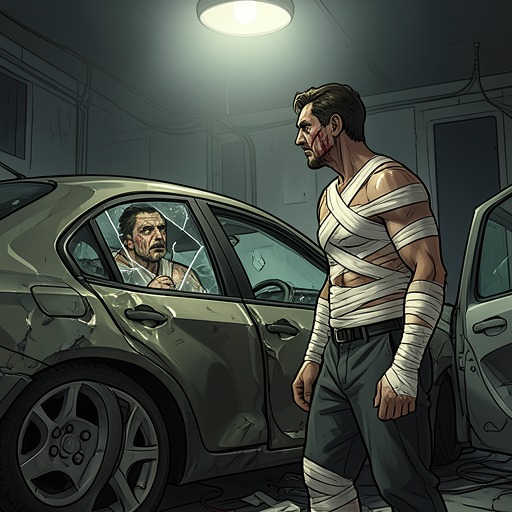
The narrator’s defining encounter with Western Avenue occurs on a rain-swept June evening while he is driving home from Shepperton Studios. His car skids at the intersection below the Western Avenue flyover, crosses into the oncoming lane, loses an off-side tyre, and turns onto the high-speed exit ramp. He avoids two approaching saloon cars but strikes a third head-on. The vehicle carries a young woman doctor and her husband, a chemical engineer employed by an American foodstuffs company. The husband is killed instantly, thrown through the windscreen onto the bonnet of the narrator’s car, while the narrator is cut from the crushed cabin with severe bruising to his chest and knees and a severed nerve in his scalp.
The narrator’s survival does not restore the road to ordinary use. After the accident, he returns with Catherine to the impact point, driving along the route he had taken before the collision and stopping on the concrete verge. The site functions simultaneously as crime scene, memorial, and source of renewed bodily awareness. The dead man’s presence is inseparable from the narrator’s perception of his own body, while the car’s steering wheel, instrument panel, and crushed interior remain extensions of the violence that entered him.
His subsequent rental-car journeys turn Western Avenue into a repeated experiment. He hires different vehicles, from an American convertible to a high-performance sports saloon and an Italian micro-car, and drives the accident route while imagining alternative deaths, victims, and patterns of injury. At the hour of the original crash, traffic repeatedly brings him back to the flyover: sometimes he is carried past the site by a moving stream, and sometimes he is stranded in a jam only ten feet from the precise point of impact. The road therefore produces a ritual of recurrence. Each passage promises mastery over the past, yet each also demonstrates that the past has been built into the traffic system itself.
Traffic, Spectatorship, and Violence
Western Avenue is also a public theatre of collision. During a major traffic jam, the narrator and Vaughan move from the motorway junction toward the flyover through lanes packed with vehicles whose windshields absorb the molten colours of sunset. An airline coach rises beside them like a cliff of faces, while the passengers appear as rows of the dead observing the traffic below. The roadway’s enormous power is paradoxically expressed through immobility: the energy of the twentieth century is consumed in maintaining a motionless pause.
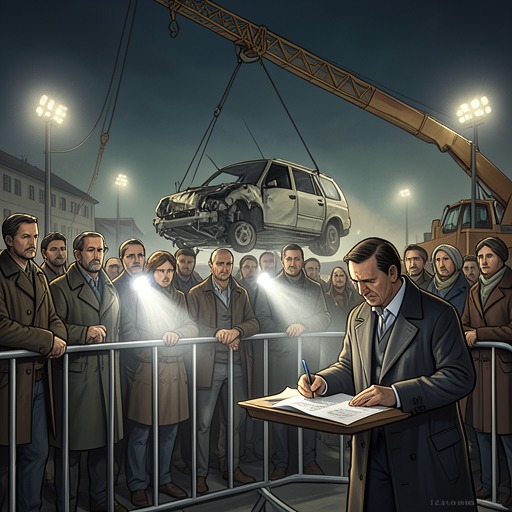
At the eastern descent ramp, three cars have collided. Police vehicles, ambulances, and a breakdown truck form a corral around the wreckage, while firemen and police engineers use oxy-acetylene torches to cut through doors and roof panels. Spectators gather along the pavements and crowd the pedestrian bridge. The smallest vehicle, a yellow Italian sports car, has been almost obliterated by a black extended-wheelbase limousine, which has crossed the central reservation, struck a route-indicator pylon, and then been hit by a taxi. The scene repeats the narrator’s own crash as a civic spectacle, placing private bodily destruction inside the coordinated procedures of emergency services, traffic control, and public observation.
Vaughan’s relation to the road is more aggressive than the narrator’s. At Western Avenue and the flyover, he pushes his heavy car into the traffic stream without attempting to conceal himself. He moves between lanes, surges ahead, falls back, and then begins to imitate Catherine’s driving. His vehicle and Catherine’s sports car travel in a strange mechanical dialogue, their brake-lights harmonized like the exchange between a long-married couple. The road permits pursuit to masquerade as synchronization: proximity, mimicry, and danger become indistinguishable.
Erotic and Psychological Geography
The roadway’s traffic system structures intimate relations as much as it structures vehicles. Near the airport, Western Avenue is bordered by car-hire firms, all-night cafeterias, airfreight offices, filling stations, and a multi-storey car park. A hierarchy of prostitutes occupies the airport and its suburbs, from women working in hotels and terminal concourses to freelancers renting rooms in apartment complexes along the motorway. The road thus connects commercial transit, anonymous sexuality, and temporary encounters, making mobility itself part of the organization of desire.
The narrator’s own sexuality becomes increasingly inseparable from the automobile and its routes. After the crash, sexual vitality returns alongside pain, guilt, and fascination with physical injury. The impact has forced him into direct confrontation with his body, the dead man, and the mechanisms of collision. His repeated drives along Western Avenue allow him to re-enter that confrontation through steering wheels, pedals, windscreens, traffic patterns, and the inherited traces left by previous drivers in rental cars. The road is not merely where desire happens; it is the medium through which desire is translated into bodily risk.
Vaughan’s presence intensifies this transformation. Through him, the narrator studies test collisions at the Road Research Laboratory and watches slow-motion films of vehicles striking concrete blocks. The repeated images first calm and then arouse him, and solitary motorway driving makes him imagine himself at the controls of the impacting cars. Western Avenue consequently joins laboratory simulation to lived catastrophe. Its regulated lanes and engineered flyover are designed to manage movement, yet they also provide the exact geometry within which the characters seek ecstasy, violence, and a new relation between body and machine.
Narrative and Thematic Significance
Western Avenue gives the novel a recurring spatial grammar. It is approached from the apartment, revisited by rental cars, crossed during traffic jams, watched from airport car parks, and used as the stage for Vaughan’s pursuit of Catherine. Its meaning changes without losing its material identity: first the site of an involuntary collision, then an object of investigation, then a field for sexual and homicidal fantasies, and finally part of a larger vision of traffic flowing toward an otherworldly incline.
After the narrator’s acid experience and near-death encounter, the motorway’s jams no longer appear simply oppressive. From the balcony, the vehicles become an illuminated queue awaiting an invisible slip road into the sky. The transformation does not erase the history of violence attached to Western Avenue; it mythologizes it. Cars, aircraft, road signs, and concrete lanes become components of a secular cosmology in which departure, collision, and transcendence share the same infrastructure.
The final image carries this logic beyond any individual driver. Traffic continues without interruption along the flyover while aircraft rise from the airport, carrying the remnants of Vaughan’s semen toward the instrument panels and radiator grilles of countless crashing cars and the bodies of innumerable passengers. Western Avenue therefore survives every personal catastrophe as an unceasing circulation system. Its significance is not that it offers escape from technological modernity, but that it reveals how memory, sexuality, violence, and imagined transcendence have already been absorbed into the road’s continuous flow.