Road Research Laboratory
CrashThe Road Research Laboratory is a government-linked centre for the scientific simulation and study of automobile crashes. Its importance lies in the contradiction between its official purpose and its effect on James Ballard and Robert Vaughan: the Laboratory seeks to reduce accidents by making impact calculable, yet its machines, mannequins, cameras, and technical vocabulary give Vaughan a reproducible model for treating collision as spectacle, sexual fantasy, and a possible route toward death.
Definition and Setting
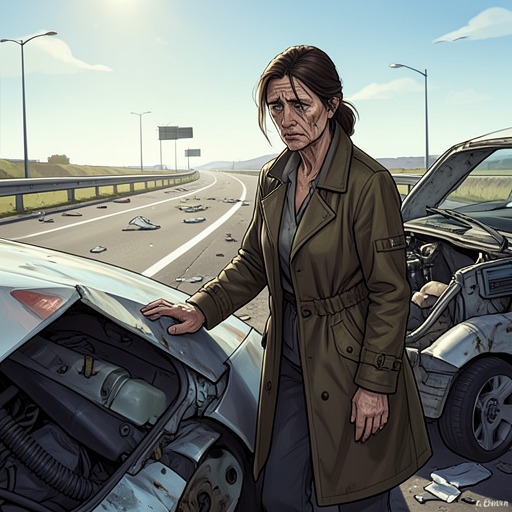
The Laboratory appears as a highly organized research environment devoted to road safety and the measurement of injury. Its test sites contain damaged cars, plastic human figures, rails, recording equipment, metering coils, cine-cameras, and video playback. The apparatus transforms a crash from an unpredictable event into a sequence that can be staged, recorded, repeated, and examined in slow motion. The setting therefore joins medical knowledge, engineering, government administration, and mass spectatorship in one technological space.
The institution forms part of the same infrastructure that has come to define Ballard’s world. Motorways, airport roads, flyovers, traffic interchanges, hospitals, and television studios appear not as separate backgrounds but as a continuous machine landscape. From the balcony of his apartment, Ballard sees the surrounding roads as an artificial horizon enclosing the vehicles below, while the traffic itself alternates between violent speed and complete suspension. The Laboratory gives this landscape an interior logic: it is where the violence implicit in ordinary transport is isolated, measured, and made visible.
Visit with Helen Remington
James Ballard visits the Laboratory with Helen Remington, whose professional future is connected to the institution. She explains that the Laboratory needs a medical officer and that the position offers a larger salary. Her decision is not presented simply as charitable service; she acknowledges a moral virtue in materialism while also insisting that she now possesses a form of knowledge and commitment she previously lacked. The Laboratory thus becomes a possible new professional identity for Helen, one formed through proximity to injury and technical systems rather than through distance from them.
The visit has an uncanny atmosphere. Two lines of damaged cars stand on the concrete, their crumpled bodies occupied by plastic mannequins whose faces and chests are marked with coloured wound zones. Helen studies the figures through the empty windshields as though they were patients under her care, and she reaches through starred windows to caress their plastic arms and heads. Around her, the visitors in smart clothes and flowered hats seem almost as artificial as the mannequins. The scene unsettles the distinction between living observers, simulated victims, and the engineered objects arranged for their inspection.
The Simulated Crash
The central demonstration uses a motorcycle and a saloon car. The motorcycle is shackled to a cradle that will be propelled along steel rails toward the car, while metering coils connect both vehicles to recording devices on trestle tables. Two cine-cameras occupy distinct positions: one beside the track, aimed at the point of impact, and another mounted above the course. A video device displays the engineers adjusting sensors inside the car’s engine compartment.
The car contains a family of four mannequins, with coils attached to their heads, chests, and legs. Their anticipated injuries have already been marked on their bodies in geometric carmine and violet zones. An engineer arranges the driver’s hands in the standard ten-to-two position, turning a familiar gesture of responsible driving into part of the experimental script. The commentator introduces the artificial family as Charlie, Greta, Scan, and Brigitte, giving the mannequins a domestic identity before the apparatus subjects them to destruction.
The motorcycle then accelerates down the track. Its rider is fixed to the handlebars, his thorax covered with metering devices, while the car’s occupants sit motionless behind their coded faces. The motorcycle strikes the saloon car with a violent metallic explosion. Both vehicles veer toward the spectators; the rider sails over the bonnet, smashes into the windshield, and breaks across the roof in a mass of fragments. The car is dragged backward on its hawsers, leaving its bonnet, windshield, and roof crushed and the family of mannequins thrown across the cabin. The front-seat woman’s decapitated torso becomes embedded in the fractured windshield.
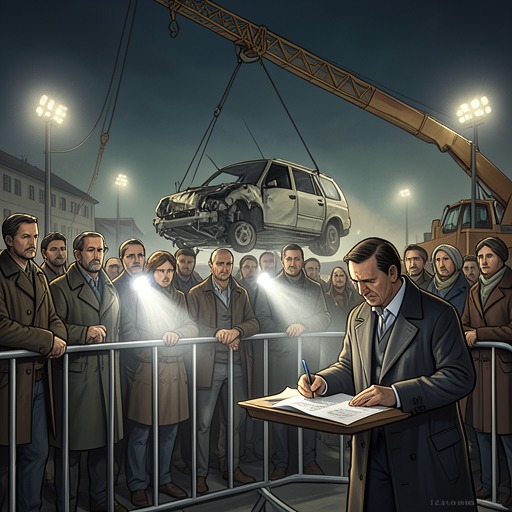
The engineers reassure the crowd and collect the broken sections of the cyclist, carrying the legs and head beneath their arms. Fibreglass shavings glitter across the glass like silver debris from a ceremonial death. The Laboratory’s controlled environment does not remove violence; it gives violence a repeatable form, a recording system, and an audience. Helen responds by offering to watch the crash again on the Ampex in slow motion, while Ballard is left lightheaded by the deliberate rupture of metal, safety glass, and manufactured bodies.
Vaughan’s Appropriation of Expertise
Robert Vaughan recognizes the Laboratory as a catalogue of possibilities rather than merely a safety institution. He urges Ballard to collect its technical handouts, including materials on occupant ejection and the tolerances of the human face in crash impacts. He remarks that the Laboratory’s technology could reproduce major crashes indefinitely, naming the Mansfield and Camus crashes and the assassination of President Kennedy as events that its equipment could duplicate. When Ballard objects that the institution is intended to reduce accidents, Vaughan answers that this is only one point of view.
Vaughan’s response exposes his relation to expert knowledge. He is a former computer specialist whose television career had presented him as an aggressive, glamorous authority on computerized traffic control, and his own motorcycle crash had permanently marked his face and body. At the Laboratory he borrows the language of engineering and measurement while redirecting it toward obsession. The machines promise objective knowledge, but Vaughan sees in them a means of intensifying sensation, studying wounds, and converting public safety into an endlessly repeatable drama.
During the test, Vaughan watches with the concentration of a voyeur. Shielded by publicity folders, he masturbates while following the collision course, checking Ballard’s involvement with a hard, flushed glance. The simulated crash therefore becomes an encounter between institutional spectacle and private sexuality. The Laboratory has separated impact from ordinary life so that it can be measured; Vaughan reunites impact with the body, desire, and death in a single act of viewing.
Narrative and Thematic Significance
For Ballard, the Laboratory is a decisive threshold in understanding the automobile crash. Earlier, Vaughan had shown him slow-motion films of test collisions, and the repeated impacts first calmed and then aroused him. The Laboratory supplies the physical source of those images and makes visible the chain by which a vehicle becomes a recording instrument, a body becomes a measured injury pattern, and an accident becomes a form that can be rehearsed.
Its significance extends beyond the test site. Ballard later drives through the roads around Stanwell, Harlington, Western Avenue, and the airport, repeatedly returning at the hour of his own accident to the flyover and the precise impact point. Traffic jams, stalled vehicles, police broadcasts, and motorway crashes become variations of the Laboratory’s controlled display. Conversely, the Laboratory’s experiment resembles the wider road system: the same society that builds immense structures for speed also produces immobilizing queues, collisions, rescue procedures, and crowds of spectators.
The institution’s safety mission is therefore shadowed by the very fascination it attempts to manage. Its instruments promise mastery over risk, but its staged destruction reveals how deeply modern mobility depends on the possibility of bodily damage. Vaughan later imagines that he can never truly die in a car crash because he will be reborn through twisted radiator grilles and cascading windshield glass. The Road Research Laboratory makes that fantasy technically legible. It is the place where death is manufactured without being final, where wounds become data without ceasing to be erotic images, and where the automobile’s hidden violence is exposed as the governing energy of the technological landscape.