Northolt
CrashNortholt is presented as an airport suburb whose residential streets, overpasses, hospital, and roads form a tightly connected technological landscape. It is not merely a backdrop for Robert Vaughan’s violence: its infrastructure organizes movement, visibility, class, and risk, turning ordinary transit spaces into stages for automotive spectacle and bodily damage.
Setting and Spatial Character
Northolt lies west of the airport, in a residential zone shaped by aviation and shift work. Its single-storey houses stand in small gardens divided by wire fences, and the inhabitants include junior airline personnel, car-park attendants, waitresses, and former stewardesses. Many sleep through the afternoon and evening because they work irregular shifts, leaving the curtained windows and empty streets unusually still when Robert Vaughan drives through them.
The district belongs to a larger network of airport and motorway spaces. From the narrator’s apartment, the landscape extends from the motorways south of the airport across the runways toward the apartment systems along Western Avenue; an access spur of the northern circular motorway shields the housing development from the distant bulk of London. The roads, ramps, embankments, and parking areas gradually become more legible to the narrator than the people living among them. Northolt therefore participates in the novel’s transformation of the city into an immense motion sculpture, a landscape defined by concrete geometry, speed, and direction.
The Stock-Car Stadium
During Catherine Ballard’s absence in Paris for an airline conference, the narrator takes Helen Remington to the stock-car races at Northolt. Several stunt drivers working on the Elizabeth Taylor feature at Shepperton Studios perform displays of “hell-driving” before a half-empty stand and a bored crowd. The event is connected to the film industry through the drivers and to the narrator’s complicated domestic and sexual circumstances through the tickets, which Renata gives him as an ironic response to his affair with the widow of the man he killed.
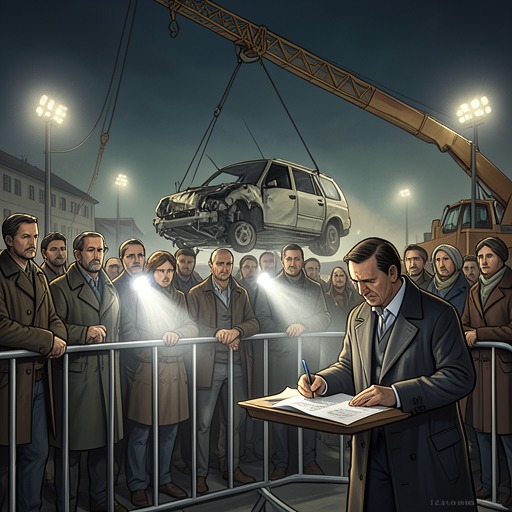
The stadium’s atmosphere is deliberately unglamorous. Stripped-down saloon cars circle a cinder track around a converted football ground while the announcer’s voice booms overhead; at the end of each heat, the drivers’ wives cheer without enthusiasm. Helen sits close to the narrator, her face against his shoulder, but the continuous roar of defective silencers deadens her expression. Northolt thus places intimacy inside a public machine of repetitive impact, making the racing arena an early sign that personal relationships in this world are increasingly mediated by automotive violence.
Roads, Pursuit, and Emergency
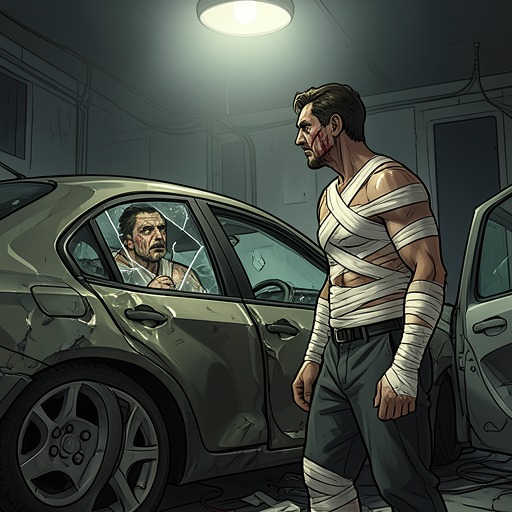
Northolt’s roads become more threatening when Robert Vaughan transports the injured Seagrave and Helen Remington toward Northolt General Hospital. Vaughan drives his damaged Lincoln Continental at speed through the night, tests the narrator’s ability to follow him, crosses traffic lights aggressively, overtakes a police car on the wrong side of the Northolt overpass, and continues beyond the speed limit. The suburban streets are empty not because the area is outside modern circulation, but because its shift-working population is asleep while the road system remains available for Vaughan’s performance.
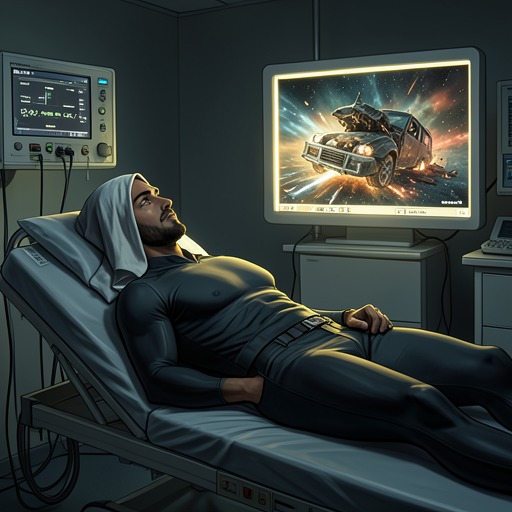
At the hospital entrance, Vaughan ignores the visitor parking area, passes the casualty department, and stops in the lot reserved for consultant physicians. Seagrave, still suffering from poor balance and a bruised head, has to lean against the windshield pillar before following Helen toward casualty. His condition suggests a long history of concussions, while Vaughan’s impatience converts the hospital into another setting for dramatic display rather than a place of quiet recovery.
Vaughan waits beside the Lincoln under the attention of evening visitors, prowling around the car as though invisible television cameras were framing him. He retrieves a pistol-grip cine-camera and studies the casualty entrance through its viewfinder; photographs of crashed vehicles lie on the floor of the car. The hospital therefore joins the racing stadium and the motorway as a site where injury is observed, recorded, and staged. Northolt’s medical institution does not neutralize the crash culture. Instead, it supplies the spectacle with victims, witnesses, images, and an official threshold between bodily damage and public performance.
The Roundabout and the Infrastructure of Risk
After leaving the Road Research Laboratory, Vaughan’s driving demonstrates how Northolt’s road design enables calculated danger. Approaching a major trunk roundabout, he brakes for almost the first time, sends the heavy car into a long slide across the path of a taxi, then accelerates in front of it while its tyres scream and its horn blares. The roundabout, designed to regulate circulation, becomes an arena in which Vaughan tests other drivers and asserts control through near-collision.
The damaged Lincoln makes this performance both clumsy and deliberate. Its second gear has been torn out during a road race with Seagrave, and its faulty transmission forces Vaughan to alternate between sluggish obstruction and sudden acceleration. He may crawl in the fast lane at ten miles an hour, hold up traffic, and appear helpless behind the wheel, only to jerk the car to a halt before a waiting taxi. The mechanical defect becomes part of his theatrical method: Northolt’s roads allow disability, aggression, mockery, and speed to occupy the same driving act.
Northolt in the Electric Highway
Northolt’s significance extends beyond its individual scenes because it belongs to the airport-centered system that defines the narrator’s life. Nearby airport complexes contain a hierarchy of prostitution, ranging from hotel and discotheque workers to women serving terminal concourses and restaurant mezzanines, and finally freelancers renting rooms in apartment developments along the motorway. Car parks, filling stations, cafeterias, airfreight offices, hospitals, and residential units are linked by access roads and flyovers, making transit infrastructure the setting for both commerce and intimacy.
Later, the narrator sees traffic on the motorway not simply as an oppressive jam but as an illuminated queue waiting for an invisible slip road into the sky. He imagines the cars laying down the possible trajectories of Catherine Ballard’s flight and understands Robert Vaughan as someone who cannot truly disappear through a crash, but may be reborn through twisted grilles and cascading glass. Northolt belongs to this altered geography, where roads resemble channels toward paradise and accidents resemble rituals of technological transcendence.
The location consequently embodies the novel’s central spatial reversal. Roads meant to connect destinations enclose the inhabitants like artificial horizons; hospitals meant to repair bodies become stages for filming and display; racing grounds turn collision into entertainment; and suburban streets provide a quiet corridor for reckless pursuit. Northolt is the point at which ordinary urban infrastructure becomes an active producer of the novel’s erotic, violent, and technological reality.