Harlington
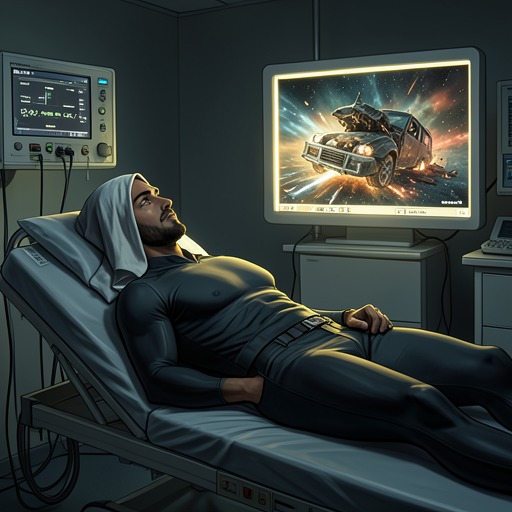
CrashHarlington is presented not as an isolated settlement but as a charged junction within the airport–motorway system. Its perimeter roads and motorway interchanges channel traffic around London Airport, drawing the narrator into a landscape where speed, congestion, and collision continually reshape human intentions. The location becomes decisive when a three-vehicle crash on the Harlington clearway provides the long-awaited real-world counterpart to Robert Vaughan’s fantasies of celebrity injury and eroticized death.
Setting within the Motorway Landscape
Harlington first appears as part of the narrator’s habitual circuit after his hospital convalescence. Driving hired cars from the airport’s southern perimeter roads, he moves around the eastern flank of London Airport toward the motorway interchanges at Harlington. At the hour of his original accident, the traffic repeatedly carries him toward Western Avenue: sometimes he is swept past the collision site, and sometimes he is trapped in a jam only ten feet from the exact point of impact. Harlington therefore functions as a recurrent threshold, a place where ordinary circulation becomes an involuntary return to trauma.
The wider landscape makes personal orientation dependent on infrastructure rather than on inhabitants. From the narrator’s apartment at Drayton Park, the airport, Western Avenue, access roads, and motorway embankments form an artificial horizon around the vehicles below. Aircraft, airline coaches, car-hire firms, cafeterias, airfreight offices, filling stations, and prostitutes occupy connected spaces within the same technological field. Harlington belongs to this network of transit and temporary habitation: it is a route through which bodies, cars, commercial traffic, and erotic encounters are organized by the road system’s geometry.
Repeated Passage and Traffic Regimes
Harlington is defined by the contrast between movement and immobilization. Rush-hour traffic leaving London sweeps the narrator back toward Western Avenue in a huge tidal flow of metal, yet the same system repeatedly produces stalled queues, tailbacks, and motionless intervals. Elsewhere, the motorway’s traffic can appear to have stopped altogether, with drivers sealed inside vehicles beneath the hot sunlight; at other times, the open decks create a fast westward sweep in which road markings, route signs, coaches, and trucks become elements of an almost autonomous machine environment.
This alternation makes Harlington less a destination than a mechanism of compulsion. The narrator chooses different automobiles, including an American convertible, a sports saloon, and an Italian micro-car, but each vehicle carries traces of previous users: heelmarks, cigarette remains, scratches, burns, and worn steering wheels. Driving through the Harlington approaches, he imagines different deaths and different patterns of bodily injury, allowing the road to become a laboratory for possible victims and alternate outcomes. The location’s meaning is consequently produced through recurrence: every passage reactivates the narrator’s accident, while every junction offers another configuration of speed, control, and harm.
The Fatal Collision
The most important event at Harlington occurs three days after the narrator has come to regard Robert Vaughan’s death as an approaching reality. Police broadcasts first mention the multiple injuries of Elizabeth Taylor, then withdraw the report. The brief, garbled announcement is enough for the narrator to recognize the event he and Robert Vaughan are about to witness, because Robert Vaughan has already devised a sexualized death spectacle for the screen actress and has become increasingly frustrated that it has not occurred.
Robert Vaughan drives patiently with the narrator in Vaughan's Lincoln Continental toward the accident site, listening to the police frequency and steadily increasing its volume as though awaiting a final confirmation. They reach the Harlington site half an hour later and park on the grass verge below the overpass. Three cars have collided in the centre of a high-speed intersection. A customized fibreglass sports car and a silver Mercedes coupe have struck each other at right angles, tearing away their nearside wheels and crushing their engine compartments. The sports car is then hit from behind by a chauffeur-driven government saloon, whose bonnet buries itself in the damaged rear of the first vehicle.
The human aftermath gives the collision a grotesque theatrical precision. The young woman driving the government saloon is shaken but uninjured and is helped from her car. The driver of the fibreglass sports car lies dead in the cockpit while firemen and a police constable work to free him from the buckled instrument-panel overhang. He is wearing a woman’s leopard-skin coat; the coat has been torn back to expose his crushed chest, while his platinum hair remains held by a nylon hair-net and a black wig lies on the adjacent seat. The other driver, a former television presenter in the silver Mercedes, lies across her seat beneath the broken windshield. Spectators press around the damaged cars as ambulance workers lift her out, staring at the injuries to her thighs and lower abdomen before she is carried away.
Consequences and Narrative Significance
Harlington is the point at which Robert Vaughan’s imagined crash is converted into an observed event. The broadcast’s uncertain reference to Elizabeth Taylor, Robert Vaughan’s deliberate journey toward the site, the celebrity’s recognizable body, and the spectators’ fascinated attention bind together media report, automobile technology, public spectacle, and sexual fantasy. The crash is not merely an interruption to traffic: it is a social performance produced by emergency workers, police, witnesses, radio communication, and the damaged vehicles themselves.
The location also anticipates the later pursuit of Catherine Ballard. The narrator’s surrounding world is repeatedly organized through junctions, ramps, car parks, car washes, and traffic lanes, while Robert Vaughan turns driving into a form of courtship and threat. At the junction of Western Avenue and the flyover, Robert Vaughan openly follows Catherine Ballard, alternately drawing level with her and falling behind, then mimicking her braking so that their lights move together like a dialogue between long-married partners. Harlington belongs to the same infrastructure of pursuit: roads do not simply connect people but stage their approach, separation, observation, and possible destruction.
After the narrator’s acid experience and near-death, the motorway landscape changes in perception without losing its material force. Traffic queues become illuminated lines awaiting an invisible ascent, and the once-oppressive roads appear as possible routes into a paradisal sky. Harlington consequently remains suspended between concrete geography and visionary meaning. It is a real interchange marked by crushed metal, police broadcasts, and bodily injury, but it is also one of the places where the narrator’s technological landscape reveals its deepest logic: movement repeatedly seeks its destination in collision, and the road’s promise of freedom is inseparable from the violence that makes its forms visible.