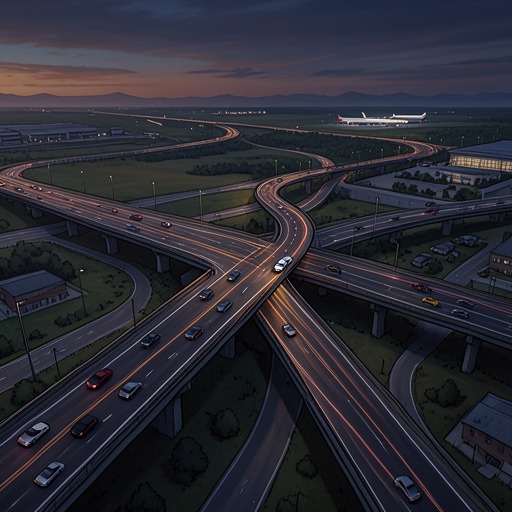
Oceanic Terminal
CrashOceanic Terminal is the novel’s most important airport setting and one of its central technological landscapes. It functions simultaneously as a place of transit, a vantage point from which Robert Vaughan stalks public figures and accidents, a site where James Ballard encounters Vaughan and Helen Remington, and a symbolic threshold where ordinary travel repeatedly opens into fantasies of sexualized violence and death.
Setting and Physical Character
Oceanic Terminal is presented as a highly visible, metallic environment organized by glass, cars, aircraft, balconies, concourses, and observation points. Its elevated spaces allow characters to look down on traffic and accidents while remaining physically separated from them, although that distance continually collapses. From the observation platform, Robert Vaughan watches visiting pop stars and politicians; elsewhere in the terminal complex, accidents involving buses, taxis, and parked cars turn the routines of air travel into scenes of mechanical injury.
The terminal’s architecture links human bodies to machines through surfaces and instruments. In one episode, James Ballard looks down from a balcony while an airline coach rams the rear of a taxi outside the European Terminal. Taxi-drivers and a man carrying a plastic briefcase lift the injured driver from the cab, while a police car forces its way through the blocked concourse, knocking over luggage. The accident converts a space designed for orderly movement into a congested spectacle of emergency response, and the surrounding traffic becomes inseparable from the terminal’s social life.
Vaughan’s Observation Post
Oceanic Terminal is one of Robert Vaughan’s principal locations for surveillance and photographic collection. James Ballard recalls Vaughan watching celebrities with a zoom lens from the terminal’s observation platform, as well as from hotel mezzanines and studio car-parks. Vaughan does not simply observe public figures; he invents an optimum automobile death for each of them. The terminal therefore provides the elevated perspective from which celebrity, transportation, and imagined catastrophe can be arranged into a single visual system.
Ballard later searches for Vaughan by haunting the approach roads to the airport and watching the incoming traffic from filling-station parking aprons. He also waits at the observation platform, hoping to see Vaughan following a visiting pop star or politician. The search reveals how thoroughly the terminal has become associated with Vaughan’s movements: even when Vaughan is absent, the architecture summons his presence as a watcher moving through a dream of violence and sexuality behind a car windshield.
Encounters and Repeated Returns
The terminal is connected to several decisive encounters. After the inquest into the fatal crash involving James Ballard, Catherine Ballard takes him to the airport, where he sits by the window of her office and looks down on hundreds of cars whose roofs form a lake of metal. Soon afterward, Catherine walks him through the lobby, and he sees Helen Remington moving among the cars. Helen appears calm and deliberately turned away from him, yet Ballard has the strong impression that she is lost within the terminal’s ordered spaces.
A week later, Helen waits at the taxi rank of Oceanic Terminal as Ballard drives away from Catherine’s office. He calls to her, stops behind an airline bus, and beckons her into the passenger seat. The terminal thus becomes a meeting place produced by movement: people who might remain separate in ordinary social settings are brought together by vehicles, waiting areas, airport traffic, and the unstable transitions between arrival and departure.
The setting also accommodates Vaughan’s direct confrontation with Ballard. Their last meeting occurs in the mezzanine lounge of Oceanic Terminal, a location Ballard retrospectively describes as the departure point for their lives and deaths. As Vaughan walks through the chromium chairs and tables, his reflection multiplies across the glass wall-panels. The terminal’s reflective surfaces make his fragmented identity visible while placing him among passengers waiting for flight calls, ordinary travelers whose routines contrast with the exhausted fanaticism of his private obsessions.
Violence, Spectacle, and Technological Desire
Oceanic Terminal repeatedly transforms injury into spectacle. When Ballard is rescued after a crash, the formalized gestures of firemen and ambulance attendants resemble a coded performance, and the terminal world extends this logic through filling stations, emergency theatres, aircraft, and traffic lanes. Vaughan’s photographic albums collect the grimaces of casualty nurses, turning the clinical aftermath of accidents into another visual archive of bodies, gestures, and latent sexuality.
The airport’s public accidents intensify this transformation. The crash outside the European Terminal produces a traffic jam of buses and taxis, while the injured driver is carried from the wreck amid flashing headlamps and police movement. Elsewhere, the Road Research Laboratory simulated crash test is treated as a public performance whose violence is rendered in engineered materials: a motorcycle strikes a saloon car, the vehicle’s bonnet, windshield, and roof collapse, and engineers collect the fibreglass sections of the mannequin cyclist as though gathering fragments of a body. The terminal’s surrounding transport system and the laboratory’s controlled destruction belong to the same cultural order, in which technological procedures make death visible, repeatable, and consumable.
The spectatorship associated with the terminal also carries an erotic charge. At a later crash on Western Avenue, spectators study the displacement of a limousine’s radiator grille, the distortion of a taxi’s frame, and the frosting patterns on shattered glass with the calm attention of expert buyers. Ballard feels at ease at the center of the traffic congestion, as if the multiplying vehicles have finally relieved his obsessions. Vaughan, however, loses interest and pushes away through the crowd with his camera, already moving toward the next image. Oceanic Terminal is therefore less a stable location than a machine for producing observation, anticipation, and repetition.
Threshold and Narrative Significance
Oceanic Terminal is a threshold in both physical and psychological terms. Aircraft depart from it, passengers wait for calls, and cars circulate through its approaches, but the terminal’s transitions never lead securely toward a new life. Instead, departure becomes a passage into renewed fixation. Its glass walls and elevated platforms offer apparent freedom and possibility while enclosing characters within reflections, surveillance, traffic, and the recurrent approach of catastrophe.
The terminal’s final importance lies in its relation to Robert Vaughan’s and James Ballard’s intertwined trajectories. At their last meeting, the building of glass, flight, and possibility is remembered ironically as the place from which both their lives and deaths seem to take their departure. Later, after their sexual encounter in the wrecked car, Ballard and Vaughan sit together while light flows across the landscape and the fountain of liquid from crashed cars fades. Their wounds become contact points with the damaged vehicle and with the imagined injuries of the dead and the millions still to die. Oceanic Terminal consequently gathers the novel’s recurrent images into one setting: travel becomes stasis, observation becomes participation, and the modern promise of movement opens onto a terminal congress of bodies, machines, and death.