London Airport
CrashLondon Airport is the central spatial field of the narrator’s recovery and of the novel’s transformation of modern infrastructure into a psychological and erotic landscape. It is not merely an airport but a network of runways, terminals, motorways, flyovers, car parks, rental firms, hospitals, cafeterias, filling stations, apartment complexes, and access roads. Around it, ordinary distinctions between travel and immobility, public transport and private desire, medical care and bodily injury, or real and imagined accidents begin to dissolve.
Definition and Setting
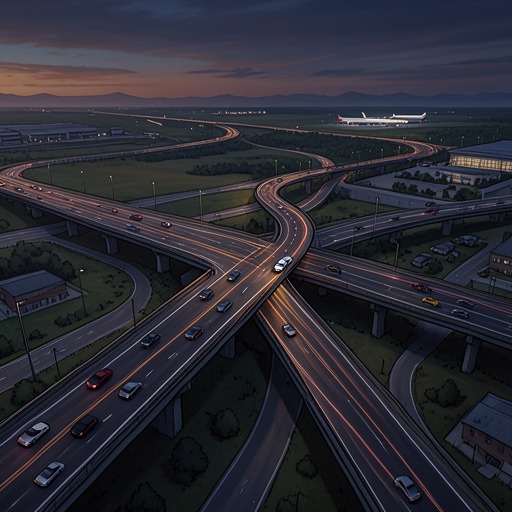
London Airport is surrounded by a vast zone of concrete and structural steel extending from water reservoirs and used-car marts to motorway systems, airline facilities, and new housing developments. The narrator’s apartment at Drayton Park stands about a mile north of the airport, while Western Avenue and the northern circular motorway connect the residential district to the airport’s runways and terminals. From the apartment balcony, the motorway’s raised pillars and embankments become a dominant artificial horizon, enclosing the vehicles below like the walls of a crater.
The airport’s physical organization produces a landscape governed less by human inhabitants than by roads, interchanges, traffic decks, parking aprons, and controlled channels of movement. The narrator gradually reorients himself around this infrastructure after his accident. Houses, shops, cinemas, and neighbors become secondary landmarks; the motorway’s geometry supplies the more dependable coordinates of identity and purpose. The airport therefore functions as a technological compass, a place where direction is designed into the landscape and where human lives appear as transient movements within a larger machine.
Traffic, Stasis, and Circulation
The airport zone repeatedly alternates between frantic motion and uncanny suspension. During the narrator’s convalescence, a rare interruption in flight control leaves no aircraft landing or taking off, while traffic along the motorway and Western Avenue stands motionless. A queue of vehicles climbs the flyover, and drivers sit trapped in the hot sunlight. The silence gives the narrator the impression that the world has stopped, even though the entire landscape remains structured for movement.
That vision remains with him when Catherine drives him toward his workplace at Shepperton. The ordinary traffic resumes, with vehicles speeding and swerving from one jam to another and aircraft engines wearing out the sky above them, but the narrator continues to imagine the immobilized drivers as waiting for a release into the destinations encoded by the electric highway. London Airport thus contains both the promise of limitless circulation and the mass experience of delay. Its roads do not simply carry people from one place to another; they organize desire around speed, interruption, repetition, and the possibility of catastrophic release.
The narrator later drives repeatedly through the airport’s perimeter roads, moving from Stanwell around the eastern flank toward Harlington and then into the rush-hour flow along Western Avenue. At the hour of his own crash, he invariably reaches the flyover and finds himself either carried past the collision site by the jerking traffic or stranded only a few feet from the exact point of impact. The route becomes a ritual circuit in which movement repeatedly approaches the past without quite entering it. Hiring different cars intensifies this process: each vehicle allows him to imagine a different death, victim, and pattern of bodily injury while remaining inside the same airport-centered system.
Social and Commercial Enclave
Around the terminals and access roads, London Airport supports a layered commercial and sexual economy. Prostitutes occupy a hierarchy extending from airport hotels and discotheques near the bedrooms of transit passengers, through terminal concourses and restaurant mezzanines, to freelance workers renting rooms in apartment complexes along the motorway. The airport’s population is therefore not limited to passengers and staff. It includes temporary workers, drivers, service employees, travelers, sex workers, police, doctors, engineers, and spectators, all using the same infrastructure according to different degrees of access and mobility.
The narrator encounters this economy in the multi-storey car park behind the airfreight building. Its sloping concrete decks and empty evening bays provide a secluded extension of the airport’s commercial circulation. A paid sexual encounter takes place there inside a car, while the woman’s question about the narrator’s injured legs brings the accident directly into the encounter. The car park joins transit, anonymity, money, sex, and bodily damage in one enclosed architectural space. It is a place designed for vehicles but repeatedly converted into a temporary human interior.
The airport also serves as a vantage point for observation. Searching for Robert Vaughan, the narrator haunts filling-station aprons along Western Avenue and the observation platform of the Oceanic Terminal, hoping to see him following a visiting pop star or politician. From these points, the traffic and flyover appear as a signaling system within which Vaughan moves like a messenger. Surveillance is made possible by the same infrastructure that enables pursuit: elevated platforms, exposed decks, terminal approaches, and lines of passing vehicles turn the airport into a theater of watching and being watched.
Accidents and Institutional Systems
London Airport’s proximity to motorways makes it inseparable from the medical and administrative management of collision. After the narrator’s crash, he recovers in an empty casualty ward near the airport, a hospital facility partly reserved for possible air-crash victims. Two wards of twenty-four beds are maintained for the maximum anticipated number of survivors, but in the absence of an aircraft disaster one ward is occupied by victims of automobile accidents. The hospital therefore reveals the airport’s preparedness for catastrophe while also showing how one form of transport violence can substitute for another.
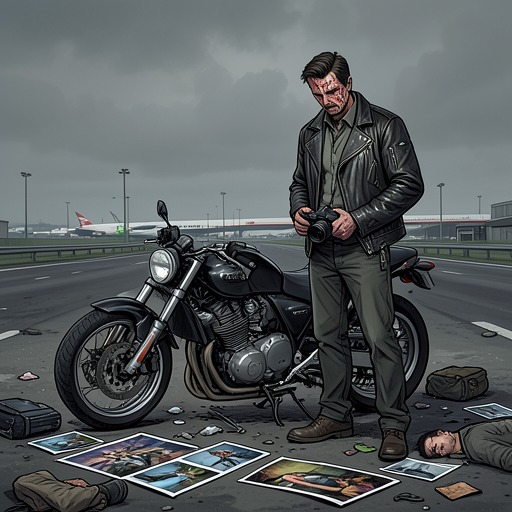
The roads around London Airport provide Robert Vaughan and the narrator with a mobile route to accidents. They listen to police broadcasts and move from one collision to the next, often reaching scenes where firemen and police engineers cut victims from vehicles beneath the motorway. The airport’s expressways become a chain of observation points, linking emergency services, spectators, cameras, and damaged bodies. Vaughan’s pursuit of collision imagery depends on this institutional network: police communications announce the accidents, roads deliver him to them, and cameras convert their aftermath into images.
The same landscape also accommodates the technical production of crash knowledge. The narrator and Vaughan travel west from London Airport to the Road Research Laboratory, where calibrated vehicles are driven into concrete target blocks and slow-motion films of test collisions are screened later in Vaughan’s apartment. The airport’s roads are thus connected to laboratories, hospitals, police systems, and media technologies. Accidents are not isolated incidents but events processed through a social-technical system that measures impact, records injury, treats survivors, and circulates images of destruction.
Symbolic and Narrative Significance
For the narrator, London Airport becomes the most complete image of the modern machine landscape. Its runways, flyovers, traffic lanes, and car parks produce a continuous field in which aircraft, cars, bodies, and memories are all subject to regulated movement. The airport’s scale makes individual human relations appear provisional, while its concrete forms provide the stable geometry through which those relations are reimagined.
The location also gives physical form to the novel’s recurring union of motion and violence. Traffic may be stationary yet charged with latent force; aircraft may rise freely while cars remain trapped below; a road intended to connect destinations may repeatedly return the narrator to the scene of death. During an LSD-induced drive, the motorway around the airport becomes a transformed perceptual field of luminous cliffs, twisting marker lines, suspended vehicles, and altered bodily connection to the steering column. The infrastructure is no longer external scenery but an extension of the narrator’s nervous system.
By the end, the airport’s traffic is seen from the narrator’s balcony as an illuminated queue awaiting an invisible incline into the sky. The ordinary jams and tailbacks have been transformed by memory into a patient procession toward a paradisal route. Aircraft continue to rise from the runways while the narrator imagines the remnants of Robert Vaughan’s sexuality carried toward the instrument panels and radiator grilles of future crashes. London Airport therefore remains both a real transport center and a mythic threshold: a place where technological circulation, bodily injury, erotic fantasy, and the anticipation of death converge.