Western Avenue flyover
CrashWestern Avenue flyover is more than a road structure: it is the decisive threshold where the narrator’s ordinary relation to automobiles becomes an eroticized and apocalyptic obsession. Its ramps, interchanges, traffic queues, police cordons, and concrete elevations organize the novel’s movement from accident to rehearsal, from observation to participation, and finally to Robert Vaughan’s terminal collision.
Setting and Infrastructure
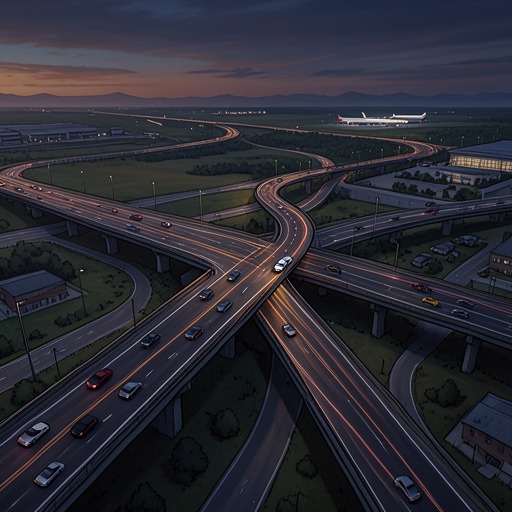
Western Avenue flyover belongs to a dense technological landscape linking Western Avenue, the airport, the motorways, apartment developments, and the access roads between them. From the narrator’s apartment at Drayton Park, the flyover and its surrounding embankments become part of an immense motion sculpture whose geometry seems more stable and legible than the human community below. After the narrator’s hospitalization, the motorway landscape supplies the strongest points of orientation: the roads, ramps, car parks, and concrete structures define the border zones of identity more powerfully than neighbours, friends, or domestic routines.
The flyover also produces a peculiar enclosure. When the narrator looks down from the supermarket car park, stalled vehicles stretch along Western Avenue and three lines of traffic climb the flyover ramp toward the southern extension of the motorway. The raised parapets and embankments form an artificial horizon, encircling the vehicles like the walls of a vast crater. The infrastructure is therefore both a channel for movement and a closed landscape of containment, a place where drivers appear trapped while the road system promises the destinations of the electric highway.
The Narrator’s Crash and Return
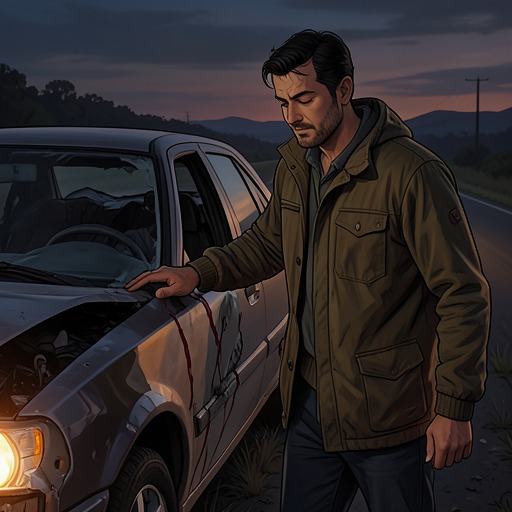
The flyover first enters the plot through the narrator’s crash beneath its entrance. On a rain-swept June evening, his car skids at the intersection, crosses the central reservation, loses a tyre, and turns onto the high-speed exit ramp. He misses two approaching saloon cars but strikes the third head-on. The vehicle carries a young woman doctor and her husband; the husband, a chemical engineer, is thrown through the windscreen and dies on the bonnet of the narrator’s car. The narrator survives with severe bruising and a severed scalp nerve, while the rescuers initially mistake the blood covering his chest for the sign of a massive open-heart wound.
The accident changes the meaning of the flyover. During rescue, the compressed passenger compartment jams the doors, firemen cut through the wreck, and the narrator experiences the emergency gestures around him as a stylized ritual of violence. He is dressed in another man’s blood while the dead man’s widow’s urine forms rainbows around the rescuers’ feet. The flyover thus becomes the first site where bodily injury, mechanical design, sexuality, and spectacle are fused in his perception.
After leaving the hospital, the narrator deliberately returns with Catherine Ballard to the impact point. He drives past the original site, circles north, and retraces the route taken in the minutes before the crash. When the road ahead is empty, he stops on the concrete verge at the place where the collision occurred. This return converts the flyover from a location of involuntary trauma into a chosen scene of reenactment and interpretation. The accident is no longer merely something that happened to him; it becomes a pattern he can approach, study, and eventually repeat through other vehicles and bodies.
Vaughan’s Theatre of Accidents
The flyover is also where the narrator repeatedly encounters Robert Vaughan, whose camera, scars, and damaged cars transform the road into a theatre of evidence. Robert Vaughan watches the narrator near the accident site and later appears at the airport car park, photographing traffic and collisions with the detached concentration of a specialist. His own body carries the memory of a motorcycle crash in which a truck broke his legs, while his scarred face looks like a damaged reconstruction of his former public image as a television scientist.
Robert Vaughan’s relation to the flyover is simultaneously investigative and performative. He studies the wreckage, collects images of wounds, and treats the road as a system whose crashes reveal a hidden union between technology and desire. His Lincoln Continental, already missing second gear after a road race with Seagrave, reproduces his own unstable relation to control: he drives aggressively, distracts himself, delays in the fast lane, and sometimes behaves as though the car possessed invalid controls. The flyover gives these contradictory gestures a public stage, allowing clumsiness, violence, sexual display, and technological mastery to appear as variations of one performance.
The traffic accident observed from the flyover makes this logic communal. Three cars collide at the eastern descent ramp: a black limousine, a taxi, and a yellow Italian sports car. The limousine crosses the central reservation, strikes a route-indicator pylon, and is hit by the taxi; the taxi’s passenger compartment is crushed and translated through an angle, while the sports car lies overturned with two occupants trapped inside. Police, firemen, engineers, ambulances, and a breakdown truck form a working enclosure around the wrecks, while spectators gather on the sidewalks and pedestrian bridge.
The spectators do not respond with panic. Children sit on parents’ shoulders, a thirteen-year-old boy in a cowboy suit chews gum, and the crowd studies the displacement of the radiator grille, the taxi’s distorted frame, and the frosting patterns on shattered glass with the calm attention of connoisseurs. The flyover therefore turns an accident into a public image and a shared interpretive ritual. For the narrator, the immobilized traffic surrounding the scene finally relieves his obsession with multiplying vehicles; for Robert Vaughan, the accident briefly loses interest, because the road matters less as a spectacle than as a source of future enactments.
Apocalypse and Final Collision
The flyover’s traffic is repeatedly associated with an approaching end of the world. After his first accident, the narrator watches the roads from the veranda and imagines the cars as a polished corona extending across the landscape. Minor accidents on Western Avenue create a tailback over the flyover, and the passengers rising from London Airport seem to be fleeing a disaster area. Later, an extraordinary silence holds the airport runways, motorway, and flyover motionless at once. The stationary vehicles become a vision of a world arrested before its next release, while the narrator’s wounds appear as signals capable of unlocking the stasis.
This apocalyptic meaning is not separate from the flyover’s erotic charge. The road’s ramps and impact points become imagined contact sites between injured bodies and engineered surfaces. In the narrator’s vision of Robert Vaughan’s desired final crash, wounds, genital injuries, chromium, windscreen glass, and dashboard instruments form one continuous emblematic system. The flyover is the architectural frame that makes such a collision imaginable: an elevated route designed for controlled circulation becomes a launch point for deliberately chosen destruction.
Robert Vaughan’s end fulfills that design. Ten days after stealing the narrator’s car from the apartment garage, he dies on the flyover while trying to crash it into the limousine carrying the film actress he has pursued. The car jumps the rails and strikes an airline coach below, disfiguring Vaughan’s body so severely that the police initially identify it as the narrator’s. The location collapses identity, vehicle, and corpse into one another: the stolen car carries Vaughan, the wreck resembles the narrator’s death, and the flyover becomes the place where Vaughan’s fantasy of automotive consummation is converted into an actual death.
Aftermath and Narrative Significance
After Robert Vaughan’s death, the flyover remains active as a psychic and visual presence. The narrator hears the news of the actress’s escape while driving toward it with Catherine Ballard, yet he increasingly suspects that Robert Vaughan was a projection of his own fantasies and obsessions. The flyover consequently marks not only Vaughan’s physical disappearance but the narrator’s uncertain recognition that Vaughan’s desires have been internalized. The final crash does not close the system of obsession; it redistributes it between memory, body, road, and surviving consciousness.
The location also links death with rebirth. Looking at Catherine’s aircraft above the motorway, the narrator sees the cars below as trajectories and blueprints for a coming passage through heaven, while recalling Robert Vaughan as someone who could never truly die in a car crash but would be reborn through twisted radiator grilles and cascading windscreen glass. The flyover is thus a secular altar and a mechanical horizon: it stages sacrifice, preserves its images, and sends the survivors back into the same network of roads. Its decisive significance lies in this repetition. The structure does not merely host accidents; it teaches the characters how to read accidents as destiny, intimacy, spectacle, and the technological form of apocalypse.