Grandmother Rong
DecodedGrandmother Rong, matriarch of the Rong family of Jiangnan, is both the source of the family’s prosperity and the reason for a journey that outlasts her. Her descendants send Rong Zilai overseas hoping he will learn how to ease her distress and prolong her life. Instead, she dies while he is crossing the ocean, and the family’s attempt to serve her becomes the beginning of a different future for him.
Family Position and Private Distress
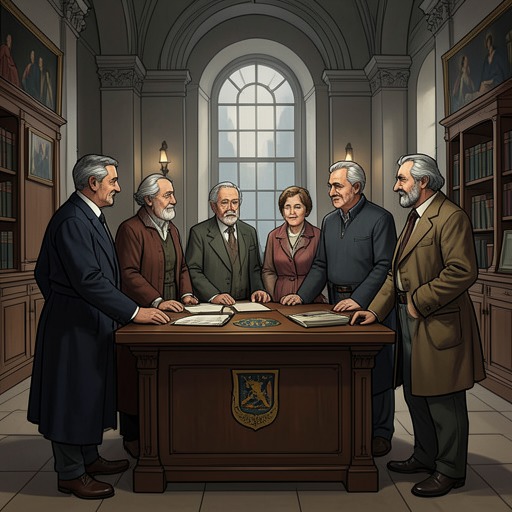
As a young woman, Grandmother Rong gave birth to nine sons and seven daughters over twenty years, and all sixteen children survived to adulthood. Their work established the family fortune, and her place at the top of the clan hierarchy became secure. Her children and grandchildren cared for her assiduously, helping her live longer than she otherwise might have done. Yet neither her authority nor the family’s wealth brought her peace. She was troubled by complex, distressing dreams and often woke in terror; at times, the fear remained with her in daylight. In the grip of these recurring nightmares, her numerous descendants and the riches they had accumulated could feel less like protection than a crushing responsibility.
The household sought help through regular interpretation. Local scholars were invited to the Rong mansion each morning, but their efforts did not solve the problem. Of the interpreters who came, Grandmother Rong was most impressed by a young foreign man who had recently arrived in Tongzhen. He could explain the inner meanings of some of her dreams, and his readings sometimes seemed to anticipate the significance of people who would appear later. His youth made others doubt him, and his abilities had limits: he was better with dreams from the early part of the night than with those near dawn or with dreams nested inside other dreams. He also acknowledged that he had not formally studied divination, having picked up a little by accompanying his grandfather. His understanding of dreams was stronger than his ability to foretell events.
The Plan to Send Rong Zilai Abroad
Grandmother Rong first tried to bring the young man’s grandfather to China. She opened a sliding panel to show him silver ingots and asked him to bring the old man, whose experience she hoped might help her. The request could not be fulfilled: the grandfather was already wealthy and uninterested in earning more, while the ocean voyage seemed too dangerous for a very old man. The young interpreter offered a different practical course: instead of bringing the mountain to her, the family could send someone overseas to learn.
The choice of that person was shaped by two demands. The candidate needed exceptional filial devotion, enough to accept hardship on Grandmother Rong’s behalf, and the intelligence and appetite for study required to master complicated methods of dream interpretation and divination quickly. After considering her many descendants, the family selected her twenty-year-old grandson, Rong Zilai. He departed carrying a letter of recommendation from the young interpreter and the burden of finding a way to extend his grandmother’s life. His voyage was not initially framed as a personal quest for education; it was a family mission organized around her need.
The Dream, the Death, and the Delayed News
A month after Rong Zilai left, as his steamer worked through a stormy sea, Grandmother Rong dreamed that a typhoon swallowed the ship and that her grandson drowned. The dream so overwhelmed her that she stopped breathing; the account identifies cardiac arrest as the cause of her death. The terrible coincidence turned the family’s plan inside out: the journey intended to help preserve her life became, in her dreams, the scene of its loss.
The news reached Rong Zilai only after the long passage. When he presented his letter of introduction to the old man who might have taught him, the tutor handed him a letter announcing Grandmother Rong’s death. Information had traveled faster than the grandson who had been sent to acquire knowledge for her sake. With her gone, he saw no reason to study the specialized art that had prompted his departure and initially decided to return home.
That decision did not end his time abroad. While waiting for a passage, Rong Zilai met another Chinese man, who took him to classes. He discovered that there was much he still wanted to learn, and stayed. By day he studied mathematics and geometry alongside students from Bosnia and Turkey; at night he attended concerts with a senior student from Prague. He remained for seven years, then sailed home in the autumn of 1880 with barrels of new wine. Thus, although Grandmother Rong’s death erased the original purpose of his trip, the education she had set in motion continued under its own momentum.
Narrative Significance
Grandmother Rong’s story binds private suffering to the movement of an entire family. Her children built the Rong fortune, but the dreams that haunt its matriarch make wealth and descendants feel insufficient as safeguards. The family answers her distress with a practical act of care: it identifies a grandson by his devotion and ability, then sends him across the ocean. The plan is at once intimate and consequential, because its intended beneficiary dies before the student can return, while his time abroad opens a path beyond the family’s mercantile inheritance.
Her final dream also gives the episode its stark reversal. The ship is carrying Rong Zilai toward the learning meant to help her, but in her vision it becomes the instrument of his death; the dream, rather than the ocean, is what takes her life. The delayed letter makes that reversal concrete for the grandson only after he has reached his would-be tutor. Grandmother Rong’s brief presence in the narrative therefore shapes events beyond her lifetime: she is the reason for Rong Zilai’s departure, the loss that first makes him turn back, and the absent purpose against which his later decision to remain abroad takes form.