Vasili
DecodedVasili, whose real name is Zhao Qirong, is Unit 701’s trusted bodyguard and escort, a figure whose fearsome authority gives physical form to the dangers surrounding its secret work. He is admired for his courage and relied upon to protect senior personnel, yet his pistol and the possibility that he may be ordered to kill Rong Jinzhen reveal the brutal limit of that protection: safeguarding secrets can mean treating even a fellow member as expendable.
Identity and Presence
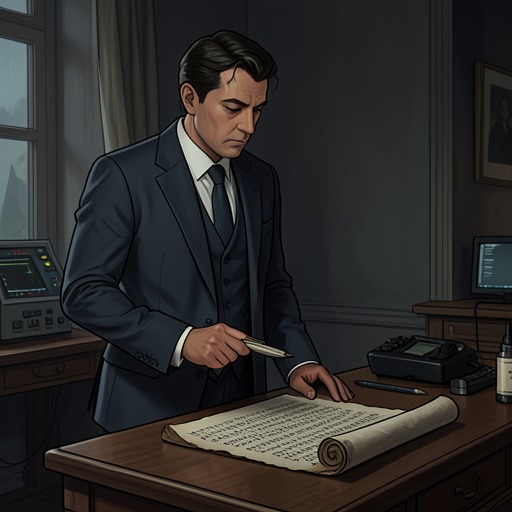
Vasili is a tall, dark-complexioned man with a large mouth, triangular eyes, and a long moustache that curls upward like hog bristles. His stiff manner and determined way of acting seem to make him, in the narrator’s description, radiate death. His standing at Unit 701 is considerable, though it differs from Rong Jinzhen’s: Rong matters for his intelligence, while Vasili’s authority comes from his special practical role. Whenever a senior member needs to travel beyond the compound, Vasili is the person they want along.
His name is an adopted one. Unit 701 calls him Vasili after Lenin’s bodyguard in the 1939 Russian film Lenin in 1918, a reference that makes his function immediately legible: he is the guard who accompanies important people into danger. He is a familiar presence in a conspicuously large windbreaker, his hands usually in its pockets, and he walks with long, energetic strides. The jacket, rigid bearing, and deliberate movement turn him into an instantly recognizable figure before the narrative shows what he does.
Reputation and the Pistol
Among Unit 701’s younger members, Vasili inspires envy as well as respect. They gather to discuss his vigour and acts of bravery, embellishing what they know with speculation about the contents of his pockets. They imagine a German-made B7 pistol in his right pocket and a handwritten special permit from the head of the Intelligence Service in his left, supposedly enough to let him go wherever he needs to go. Some insist that he also carries a second pistol under his left arm. The story preserves the distinction between reputation and proof: no one has seen that weapon, and the young members answer the lack of evidence by saying he carries it only on assignment.
Rong Jinzhen has, however, inadvertently glimpsed Vasili’s actual firearm. During the journey to Beijing, Vasili’s customary windbreaker is accompanied by a brown, hard-shell cowhide suitcase, ordinary in appearance but carrying the files on BLACK. The case holds material whose exposure would be catastrophic. Vasili’s left hand carries the suitcase, while his right hand twitches inside his pocket. Rong recognizes that the movement is not a nervous tic: Vasili is holding his pistol. What had been a rumour to Unit 701’s younger members becomes, to Rong, an unnerving fact at close range.
The weapon has become a habit and a need for Vasili, as Rong understands it. That dependence alters the meaning of the bodyguard’s presence. A pistol is not merely a precaution against an attacker; it is a tool that can be drawn at any moment, and Rong imagines it being used if danger overwhelms them. He fears that Vasili may have one weapon, perhaps two, and hears imagined gunshots as the train carries them toward the capital. The anxiety is sharpened by the principle Rong silently repeats: “Death before divulging secrets.” If they are outnumbered and outgunned, he understands that Vasili would not hesitate to turn the pistol on him rather than allow the secrets to be taken.
Escorting Rong Jinzhen
Vasili’s role becomes especially important because Rong is travelling with top-secret documents. Air travel is rejected as too dangerous: Unit 701 remembers the spring of 1958, when agents from X country abducted a low-ranking cryptographer from Y country after Rong had cracked PURPLE. The account leaves the cryptographer’s fate unknown, presenting the episode as one of the profession’s cruelties. A train offers more possible escape routes and countermeasures than an aeroplane, though the unusual arrangements needed to secure a soft sleeper berth still make Rong uneasy. Vasili accompanies him on this guarded journey.
The trip is therefore a test of the protection Vasili represents. Rong spends the journey anticipating catastrophe and imagining the weapon beside him being used either against intruders or against himself. Only upon reaching Headquarters does his dread begin to ease. He tells himself that no one knows who he is or that he carries classified information, and briefly decides that he need not frighten himself in future. The scene’s tension rests on the contrast between that fragile reassurance and the actual danger Vasili’s pistol embodies: the escort keeps the secret safe, but Rong cannot be certain that he himself is outside its reach.
On the return journey, the contrast reverses. Rong has bought two long-desired books from the Yesterday Bookstore, one of them The Riddle, a translation of The Writing of the Gods by the cryptanalyst Klaus Johannes. With the purchases in hand, he is happy to leave Beijing; Vasili can readily arrange another soft sleeper, and Rong feels at ease where he had been fearful six days earlier. The first winter snowfall has covered the city, and Rong receives the quiet departure as a peaceful, almost dreamlike send-off. The journey home begins with confidence rather than foreboding, showing how strongly his sense of safety depends on circumstance, even while the same escort and the same secretive world remain around him.
The Missing Briefcase and the Search
Vasili’s duty continues when Rong leaves hospital without permission to search for his missing notebook in B City. A search of the train has found no thief, leading investigators to conclude that the thief must have got off in B City. Vasili arrives that evening. His original orders from Director Feng are to escort Rong back to hospital; anticipating that Rong will refuse, Director Feng adds that Vasili must accompany him everywhere and ensure his safety if he insists on remaining in the city. The instruction makes Vasili both protector and constraint: Rong’s determination to search is allowed to continue, but not without a bodyguard at his side.
The investigation reaches a desperate point on its ninth day, with no information about the missing notebook. Headquarters agrees to make the loss public, despite the risk that the thief might hide or destroy the item. A lost-property notice appears in the morning edition of the B City Daily, identifying the owner as a scientist and saying the notebook contains information about new technological innovations. At 22:03 that evening, the Special Investigative Team’s hotline rings. Three people reach for the telephone, but Vasili gets there first and answers. His quickness puts him at the centre of the response, although the account does not identify the caller or establish that the call itself solves the search.
The decisive result comes later: Vasili finds Rong on 3 January 1970, at four in the afternoon, the sixteenth day after the briefcase went missing. The narrative shows him recognizing Rong by his black, trembling hands and moving toward the pitiable, broken man. On 14 January, Vasili accompanies Rong back to the high-walled Unit 701 compound, closing this part of the story. His presence has carried Rong from the guarded outbound journey through the frantic search and finally back behind the compound walls, but it cannot undo the damage Rong has suffered.
Later Account and Narrative Role
A later first-person account identifies Vasili by his real name, Zhao Qirong. The narrator sees him during a ten-day stay at Unit 701 and describes him as one of the people who ought to be considered good, while also acknowledging that he does little to help recover Rong’s tragic history. The narrator’s difficulty is not presented as evidence of Vasili’s indifference alone: most people at Unit 701 are reluctant to revisit what happened, and the memories offered are confused and contradictory. Silence has helped bury the story, leaving even a respected protector unable, or unwilling, to make its past clear.
Vasili’s characterization is built from the gap between the legendary bodyguard and the compromised human presence beside Rong. His windbreaker, hidden hands, imagined permits, and real pistol give him the aura of an almost invulnerable guardian; his assignments, however, place him within a system where the protected person may also be the person he must be prepared to shoot. He is brave and dependable in action, answering the hotline, obeying the order to stay with Rong, finding him, and bringing him back. Yet his protection can secure a person’s return without restoring the life that person had before the crisis. In that contrast, Vasili embodies both the necessity and the cost of Unit 701’s security: a human escort made formidable by the very danger that makes his companionship frightening.