Mrs Lillie
DecodedMrs Lillie is the mother who makes Rong Jinzhen part of a family not by birth but through welcome, care, and an enduring claim of kinship. She shelters him after her daughter’s death, nurses him through a dangerous illness, and sends him toward an unknown life without withdrawing her love. Her actions give the novel’s changing names and uncertain family ties a practical measure: who belongs is shown in who is fed, cared for, and called back home.
Identity and Family Background
Mrs Lillie is the wife of Young Lillie and the mother of Master Rong. In the family’s ordinary arrangement, Rong Jinzhen calls her Mummy, while he addresses Young Lillie as Professor and Master Rong as Sis. The terms do not neatly match the family tree: by generation, Master Rong would technically be his aunt. The household accepts the affectionate, everyday names rather than requiring him to fit a formal genealogy.
His place in that household follows a history of uncertain belonging. After the mysterious woman who gave birth to him died, the baby was initially treated as an unwanted relation. His resemblance to the Killer made him seem like the return of a family misfortune, while his likeness to his grandmother, Miss Lillie, helped save him from abandonment. Mr Auslander later took the child in, and the boy grew up as Duckling before eventually coming to live with the Lillies. These earlier changes of home and identity make Mrs Lillie’s welcome a decisive act of inclusion rather than a mere formality.
Welcoming Rong Jinzhen into the Family
Mrs Lillie and her daughter learned that Rong Jinzhen existed only after the daughter’s younger sister had died at seventeen. Young Lillie had kept the boy elsewhere, in the care of Cheng, a primary-school headmaster, and had not told his wife and daughter about him. When the secret came out, Mrs Lillie was deeply affected by the account of the boy’s losses and unhappiness. She responded by asking Young Lillie to bring him home: their daughter was gone, and he needed a family.
Her decision connects grief with an act of care, without making the new child a replacement for the daughter who had died. The household gives him a place and a familiar form of address, while his differing names preserve the history of the people and homes that have shaped him. Mrs Lillie’s welcome is one turning point in that history: an isolated child acquires a mother who will continue to treat his needs as a family responsibility.
The household’s earlier encounter with the mysterious pregnant woman also belongs to this history of shelter and contested kinship. Young Lillie presented the woman’s account of pilgrimage to Putuo Mountain and asked whether she could be taken in. The woman went to live with the Rongs, but she died after giving birth. The baby’s resemblance to the Killer made the family’s acceptance precarious; his resemblance to his grandmother helped preserve his life. Mrs Lillie’s later welcome of Rong Jinzhen comes against this background of family reluctance and fragile inclusion, though the evidence does not make her the sole decision-maker in the earlier episode.
Care During His Illness
After Rong Jinzhen’s serious illness, the hospital discharged him to recover at home because his condition had stabilized and the medical bills were mounting. When Mrs Lillie and Master Rong came to collect him, the doctor asked which of them was his mother. Master Rong was about to explain, but Mrs Lillie answered for herself. The brief exchange makes explicit what household life had already established: she claimed the maternal role without hesitation.
The doctor warned that Rong Jinzhen needed more than a year of special treatment and would have to be cared for almost like a baby to avoid a relapse. Mrs Lillie listened closely, wrote down the instructions, checked that she understood them, and copied them onto a blackboard placed in the stairwell so she would see them repeatedly. The routine required carefully timed medicine and injections, night-time waking so that Rong Jinzhen could empty his bladder, and tightly controlled meals. She arranged separate bedrooms with Young Lillie so she could respond to the night schedule, and set two alarm clocks to wake her at different hours.
Food demanded particular precision. Rong Jinzhen was unusually sensitive to salt, and the amount had to begin at minute levels before being increased gradually. Mrs Lillie, already an experienced cook, found it difficult to make the restricted meals both safe and palatable. She measured the salt with the care of an experiment, knowing that too much could bring a relapse while too little could slow his recovery. The repeated meals, alarms, notes, and adjustments turn maternal care into sustained, exacting work rather than a single declaration of affection.
During these months she sometimes looked at a slip of paper bearing a letter Rong Jinzhen had written in his own blood. She had found it by accident and kept it, not entirely knowing why. Its presence renewed her conviction that the exhausting care was worth the effort. The account links this private reminder to her persistence as Rong Jinzhen gradually recovered; by the following spring he was back in the classroom.
Supporting His Departure
When Rong Jinzhen was recruited into secret work, Mrs Lillie did not treat Young Lillie’s decision as something that automatically bound him. She told Rong Jinzhen that he could refuse if he did not want to go, and offered to speak on his behalf. Her response recognizes him as someone entitled to decide for himself, even while his choice threatened to separate him from the family. When he said he had to leave, she did not pretend that he was free of obligation; instead, she tried to make sure the decision was his own.
The night before his departure, the family packed books and winter clothes into boxes and gathered other necessities into a leather suitcase. At about five in the morning, Mrs Lillie, too distressed to make breakfast herself, asked Master Rong to prepare it. She accompanied her daughter to the kitchen and explained how to make the meal, which she wanted to mark the farewell. The noodles were to resemble birthday noodles, carrying a wish for many returns, and buckwheat was chosen for its softness, associated with the flexibility needed among strangers. The preparation gives the parting a domestic form: the family cannot determine where Rong Jinzhen is going, but it can send him away with a meal shaped by care and a hope for his life among unfamiliar people.
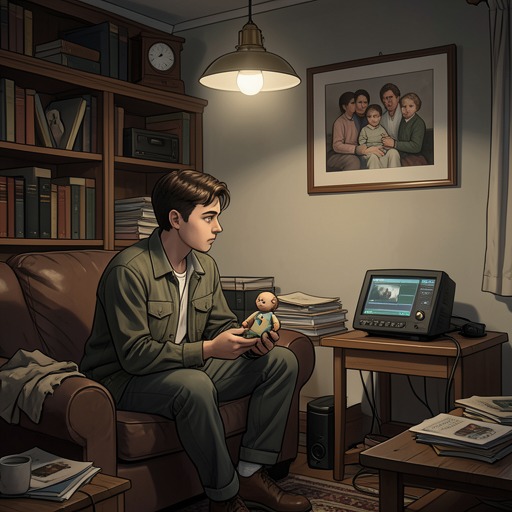
As the waiting car sounded its horn again, Rong Jinzhen remained seated, unable to move. Mrs Lillie stepped forward, rested her hands on his shoulders, and urged him to go, promising that she would wait for his letters. Her touch breaks his stillness. He rose, then turned back at the door, knelt, and acknowledged her as his mother before leaving. At five o’clock on 11 June 1956, he departed on a journey from which he never returned to the household. Before leaving, he asked to be called Rong Jinzhen, making the change of name part of the same separation that divided his family life from his new identity.
The Continuing Maternal Claim
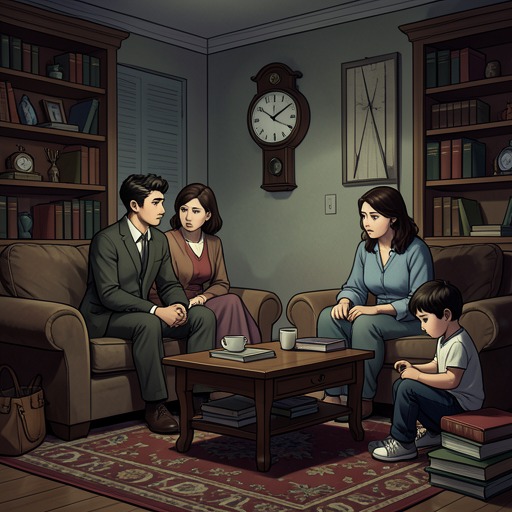
After Young Lillie died, the family debated whether to summon Rong Jinzhen back. They knew he was far away and attached to a powerful, secretive work unit, but Mrs Lillie decided to send a telegram asking him to return for the funeral. Her reasoning rested on the bond already established: he bore the family name, called her Mother, and therefore remained their son; with his father dead, the family ought to call him home.
Rong Jinzhen did not attend in person. A stranger arrived with a large wreath on his behalf and explained evasively that he could not discuss the circumstances. The family found the absence painful and puzzling, especially because they believed Rong Jinzhen would have come if he could. His later letters grew shorter and less frequent, and they never again saw him. The account does not resolve what prevented his return, but Mrs Lillie’s decision to call him home confirms that distance and secrecy did not cancel her claim on him. Her role is therefore not only to receive and protect him: she continues to name him as family even when the household can no longer reach him.