Di Li
DecodedDi Li is Rong Jinzhen’s wife, a security officer at Unit 701, and the custodian of most of the notebooks he filled during his years there. Their marriage is presented not as a conventional courtship but as a quiet decision made through a notebook: Rong Jinzhen invites her to read his private writing, she asks to be his wife, and he agrees. Her life thereafter is divided between a secretive workplace and a husband whose devotion to solitary work leaves little room for ordinary married life. The notebooks she safeguards preserve both the limits of their shared life and the unusual form their intimacy takes.
Background and Work
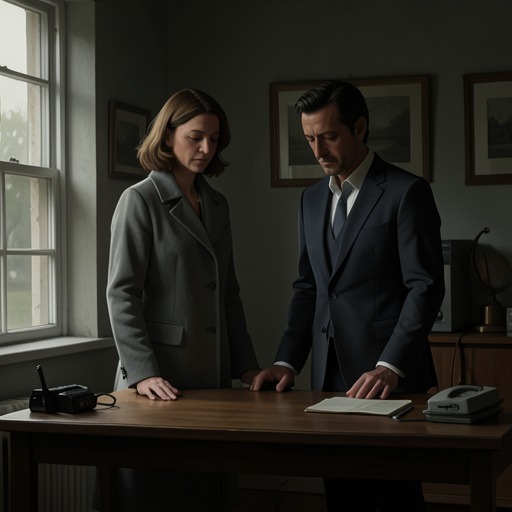
Di Li is described as an orphan who came to work at Unit 701 relatively early. She first worked as a telephone switchboard operator and, in 1964, transferred to the cryptography section as a security officer. She is a northerner, notably tall, with large eyes; she speaks proper Mandarin but says little, and when she does speak her voice is low. Her quietness suits a post built around guarding information, though the account does not reduce her to her occupation: she becomes an essential participant in Rong Jinzhen’s private life as well as in the unit’s security procedures.
The notebook entries offer a small, personal echo of her earlier work. One records a woman staying half an hour longer to read aloud about Pavel Korchagin, the central character in How the Steel Was Tempered. The reader says it is her favourite book and that she carries it wherever she goes, taking it out whenever she has free time. She also explains that she once worked as a telephone operator at Headquarters and had heard Rong Jinzhen’s voice over the phone years earlier. These details connect her former job to the later relationship: before she became his wife, his voice had reached her through the institution’s communications system.
The Marriage and Its Private Origins
Rong Jinzhen married Di Li on 1 August 1966, when he was thirty-four. Before then, marriage prospects had repeatedly arisen, but he had tended to close himself off from them and seemed uninterested in women and marriage. His eventual wedding to Di Li came with little fanfare. The retrospective account calls it oddly timed: after the wedding, BLACK drew him further into his work, making the brief opening represented by marriage seem especially precarious.
Di Li’s account of how they became husband and wife gives the marriage a more intimate origin. On the third day after Rong Jinzhen was discharged from hospital, he came to her office and handed in a notebook. As the security officer responsible for checking notebooks, she examined it to ensure that no pages were missing or left over. He told her that it contained no work-related secrets, only personal ones, and invited her to read it and reply if she wished. She read until after sunset, then returned to find him waiting outside her building. She told him she had finished the notebook and asked him to let her be his wife. He agreed; they married three days later. In her telling, the notebook is not merely an object passed between colleagues. It gives her access to a private self that his guarded habits otherwise conceal, and turns reading into the occasion for a direct request and answer.
When asked whether she loved him, Di Li answered that she loved him as she loved her country. Asked whether she regretted marrying him, she was surprised, opened her eyes wide, and insisted that regret was impossible; her eyes filled with tears as she spoke. Her words bind personal loyalty to a larger public allegiance, while her visible emotion makes clear that the answer is not simply an abstract declaration. The account does not explain away the tension between the two kinds of devotion.
Marriage Under the Shadow of Work
By another account, Rong Jinzhen was a difficult husband in practical terms. He would stay away for days and sometimes nearly two weeks, and when he returned he spoke little to Di Li. He might eat and leave, or eat, sleep, and leave when he woke. Their married life therefore meant living together while rarely seeing or speaking with one another. The distance was not described as a conflict between the couple so much as a consequence of the solitary habits he maintained and intensified through his work.
Rong Jinzhen also struggled with the administrative demands of being a section chief. He tended to appear at the office only during its final hour, spent the rest of his time in the cryptography room, and even unplugged the telephone to avoid interruption. He withdrew from the responsibilities of leadership and marriage alike, preserving a life of working alone and living alone. After BLACK entered the picture, this seclusion became more extreme. Di Li’s position as his wife thus brought her close to a man who repeatedly organized his life around denying others access to him; the marriage’s endurance is striking partly because ordinary companionship was so scarce.
Custodian of the Notebooks
Between 1956 and 1970, the years Rong Jinzhen worked for Unit 701, he filled twenty-five notebooks. Di Li held them in her custody. She used her position as his wife only once to take a single notebook into her personal possession; the other twenty-four were secured in a large iron cabinet with a double lock requiring two keys to turn at the same time. Di Li kept one key, while her section chief held the other. Although the notebooks were in her care, she was not free to read them or treat them as her own. Their custody made her responsibility intimate and restrictive at once: she protected a record closely connected to her husband while remaining barred from most of it.
The account of the notebook she did read reveals how that boundary could be crossed, briefly and by Rong Jinzhen’s invitation. His words distinguished personal secrets from work-related ones and asked her not only to read but to reply. That exchange gives a particular meaning to her custodial role. Di Li is not simply the official keeper of documents; she is the person he chooses to approach with the part of himself that cannot be filed as professional work. Yet the other notebooks remain governed by the unit’s security arrangements, and their contents are unavailable to her as well as to outsiders.
Later Life and Narrative Significance
Years later, an interviewer who spent ten days at Unit 701 found Di Li still working as a security officer. Time had diminished her formerly tall frame somewhat, though she remained taller than most people. She had no children and no parents; she considered Rong Jinzhen both to her. Because of the nature of her position, she could not resign from active duty at will. Once her resignation was accepted, she intended to go immediately to Lingshan County Nursing Home and sit beside him every day. Until then, she could use only her annual leave to visit, amounting to roughly one or two months in total each year.
The narrator describes her as detached and reticent, perhaps because of her long service as a security officer or her years spent alone. That impression is explicitly limited: the interviewer also acknowledges the difficulty of recovering Rong Jinzhen’s personal and emotional life from incomplete accounts. Di Li’s testimony and the notebook fragments consequently carry unusual weight. They show a woman who lives within the restrictions of Unit 701, protects writings she cannot ordinarily inspect, and remains committed to a husband whose working solitude has sharply curtailed their shared time. Her significance lies in holding together these opposed roles: guardian of secrecy and recipient of a private confession, an official responsible for records and the person who wants to spend her remaining time beside their author.