Rong Xiaolai
DecodedRong Xiaolai, better known as Young Lillie, is a mathematician and university leader whose practical decisions repeatedly shape who is admitted into the Rong family and what opportunities its youngest member receives. He protects a pregnant stranger by persuading his relatives to shelter her, later arranges for Jinzhen to join his own household, and resists both political pressure and premature academic advancement. His story links public principle to the less visible work of making a family: offering refuge, choosing a name, and deciding how a gifted but isolated boy should grow.
Identity and Background
Rong Xiaolai was born in 1883 and belonged to the eighth generation of the Rong family to live in Tongzhen. He was the twenty-first member of his generation. His personal name was Rong Xiaolai, his style name was Dongqian, and his sobriquet was Zeshi; people called him Young Lillie. His father founded N University, placing him within a family whose public standing was closely tied to education.
Young Lillie studied mathematics at N University, graduating in 1906. He went to the United States in 1912, earned a master’s degree from MIT, and returned in 1926 to teach at his alma mater. He remained there as a professor of mathematics and later served as vice-chancellor. These positions made him both a scholar and a visible representative of the Rong family, a combination that would draw political attention during wartime.
Refuge and Family Responsibility
Young Lillie’s readiness to act on behalf of outsiders appears early in the account of Jinzhen’s birth. After the Killer died, a woman from outside the province arrived at the Killer’s family’s home, claiming that she was carrying his child. The family rejected her. A bystander directed her to N University, where Young Lillie’s father took her in and instructed his son to bring her to Tongzhen. Young Lillie thus became responsible for turning a temporary act of refuge into a question of whether the Rong household would accept her.
He understood that the elderly heads of the household might refuse. The older Rong man had suffered a stroke and was confined to bed; his wife held the household’s effective authority. Young Lillie recalled her Buddhist devotion and presented the woman’s pregnancy as the result of a pilgrimage to Putuo Mountain: she had been unmarried, had prayed there, and discovered the pregnancy afterward. He used this account to ask whether the household would take her in, framing acceptance as an act of faith rather than an acknowledgment of the child’s disputed paternity.
The woman lived with the Rongs, but the eventual birth exposed the weakness of that explanation. She died after giving birth, and the baby’s resemblance to the Killer made his parentage plain to those present. Young Lillie’s persuasive story had secured shelter, but it could not shield the child from the family’s anger or uncertainty. The baby was not recognized as a family member, and the account says that his resemblance to his grandmother helped prevent the household from abandoning him. Young Lillie’s intervention therefore brought the child into the Rong mansion without immediately securing him a place in the family.
Jinzhen’s Place and Education
Young Lillie’s responsibility for Jinzhen continued beyond the crisis of his birth. Years later, he arranged for the boy to live at the home of Cheng, a primary-school headmaster, keeping his existence from his wife and daughter. After their daughter died at seventeen, Cheng’s visit of condolence revealed the secret to Young Lillie’s wife. Learning of Jinzhen’s hardships and intelligence, she urged her husband to bring him into their home. Jinzhen joined the family and called Young Lillie Professor, while addressing his wife as Mummy and their daughter as Sis. The household’s kinship took shape through care and everyday forms of address as much as through descent.
Young Lillie also regarded education as a matter of timing, not simply a contest to advance the most gifted pupil as quickly as possible. Although Jinzhen’s abilities might have justified going straight to university, Young Lillie opposed that course. He worried that a childhood spent apart from other people had left the boy needing ordinary social experience with children of his own age. He also noticed Jinzhen secretly trying to prove results already established by other mathematicians. In Young Lillie’s view, immense intelligence without worldly experience could be squandered on rediscovery; the boy needed to proceed step by step.
That caution did not mean denying Jinzhen’s exceptional ability. When high-school teachers found themselves unable to answer his increasingly difficult questions, Young Lillie allowed him to skip grades, one after another. Jinzhen eventually passed the university entrance examinations with full marks in mathematics and ranked seventh in the province, then entered the mathematics department at N University. The sequence reflects Young Lillie’s balance of restraint and recognition: he first sought to protect the boy’s development, then accepted acceleration when the ordinary classroom could no longer contain it.
Principle and Public Conflict
In 1944, amid the upheaval affecting C City and N University, the Nanjing puppet government offered Young Lillie the chancellorship. The authorities valued his reputation and hoped that the Rong family’s past grievances under the KMT government might make him receptive. Instead, he tore up the appointment document in public and declared that the Rongs would rather die than betray their country. His refusal won popular approval but closed off the prospect of an official position under the government.
Young Lillie had already considered leaving the university’s political infighting and going into hiding in Tongzhen. The offer and his rejection sharpened that decision. By then his father had been dead for many years, and the collapse of the family’s fortunes and the political climate had weakened his position at N University. His departure was not simply a retreat from public life: the record ties it to a refusal to accept political office on terms he judged disloyal, as well as to a letter from Mr Auslander that hastened his journey.
Naming, Mentorship, and Narrative Role
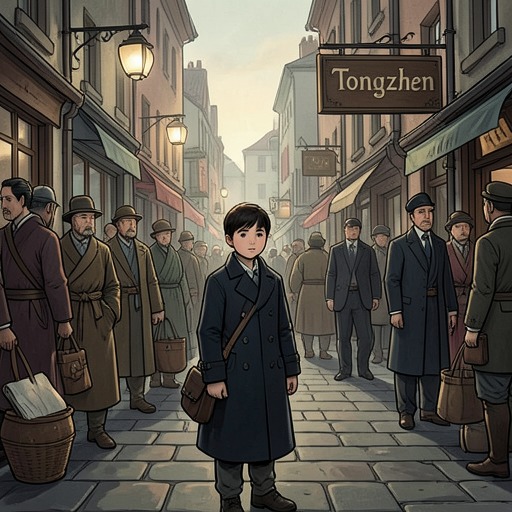
On his return journey to Tongzhen, Young Lillie worried over what to call the boy who had grown up there. He considered Jinzhen, meaning Golden Sincerity, and Tongzhen, meaning Childlike Sincerity, and left the choice to the boy, who showed little preference. The episode echoes the earlier difficulty Mr Auslander had faced when asked to name the child. Naming becomes a small but consequential form of care: Young Lillie offers the boy a considered identity without pretending that a name can settle the uncertainty surrounding his origins.
Young Lillie’s judgment also matters to Jinzhen’s academic future. After testing Jinzhen on questions from the Putnam Mathematical Competition, Liseiwicz told Young Lillie that the student was the best the university had ever had and could become the best at leading universities abroad. He urged Young Lillie to give him the opportunity to study overseas. Young Lillie listened in silence in the recorded exchange; the evidence establishes the importance of Liseiwicz’s appeal, but not Young Lillie’s immediate decision.
Across these episodes, Young Lillie is neither merely a guardian nor simply an institution-builder. He negotiates between inherited family boundaries and chosen responsibility, and between a child’s extraordinary intellectual promise and his need for an ordinary human upbringing. His interventions do not erase the costs of exclusion, political upheaval, or uncertain parentage. They do, however, repeatedly create the conditions in which another person can be sheltered, educated, or recognized as kin.