Rong Jinzhen
DecodedRong Jinzhen is a mathematical prodigy who becomes a cryptographer, but his story is marked as much by what remains unknown about him as by what he achieves. Born amid a family deception and raised first under the name Duckling, he is successively taken in, renamed, educated, recruited, and drawn into secret work. His achievements against PURPLE and BLACK bring recognition, while illness, a public collapse, and the disappearance of his notebook expose the vulnerability beneath his reputation. The surviving accounts can describe his talent and major turns in life more confidently than they can disclose his inner emotional world.
Birth, Naming, and Early Identity
Rong Jinzhen is born to a mysterious woman who dies after giving birth. Those present regard his survival as remarkable, but the birth also reveals that he looks strikingly like the Killer, including in the distinctive birthmark above his buttocks. The resemblance exposes Young Lillie’s deception and gives the child’s arrival an unsettling connection to the man whose appearance he shares. The narrative establishes this resemblance as part of the circumstances surrounding his identity, not as evidence that he has any relationship to the Killer.
Mr Auslander considers the child’s unusually large head and the hardship of growing up without parents or family support, then decides to call him Duckling. The name belongs to the period before Rong Jinzhen is taken into Young Lillie’s care. In one later scene, a child produces a parcel from beneath a bed and explains that Mr Auslander had left it for the person who came. The passage preserves a material trace of Mr Auslander’s care, even as the parcel’s contents are not specified in the available account.
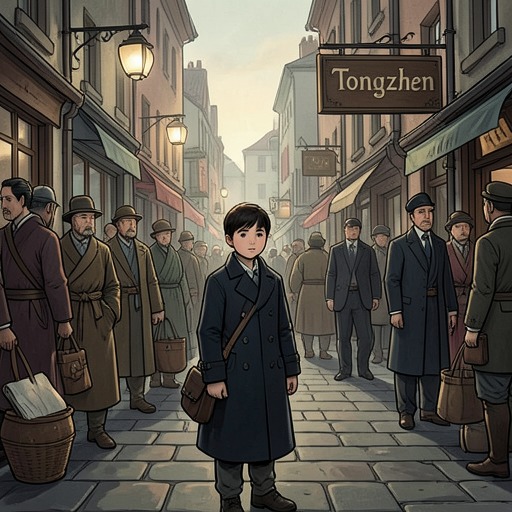
Young Lillie decides to take the child away after hearing him chant. The small room seems to retain an echo of the chanting, and Young Lillie experiences an unfamiliar uncertainty before concluding that the child is a genius and that leaving him behind would be a lifelong regret. The decision is made against a background of prolonged war and the danger that even well-intentioned actions might bring disaster to people close to Young Lillie. From then on, the child is no longer called Duckling: everyone calls him Jinzhen. His early identity is thus shaped by several acts of naming and care, each responding to a different aspect of his circumstances.
Unusual Talent and Education
At school, Jinzhen’s conduct leads people to think there is something wrong with him or that he is unintelligent. His academic results contradict that judgment: his grades are better than the rest of the class could achieve together. His classmates give him the nickname Idiot-savvy, a label that combines contempt with respect. It reflects the gap between how his behavior is read and what his work demonstrates, while also reducing a complicated person to the striking contrast others see.
His education is interrupted by a serious illness. As he prepares for what is meant to be his final summer at university before going to Stanford University, he becomes gravely sick; the illness determines that he will spend the rest of his life in China. While he is hospitalized, Jan Liseiwicz leaves the country. Jinzhen appears to be out of danger, but the hospital is concerned about accumulating medical bills and agrees to his request to recover at home. Master Rong and her mother come to collect him. A doctor mistakes one of them for his mother and, uncertain because one seems too old and the other too young, asks which is the patient’s mother.
The following spring, Jinzhen returns to the classroom. The family discusses whether he should resume his original studies or begin again as a freshman. Although he has spent only three weeks in class and has just recovered from a life-threatening illness, Jinzhen wants to rejoin his former classmates. He explains his sickness as having forced him away from science books, as though God were concerned that he might become their prisoner. The account presents this as his own interpretation of the interruption, not as an explanation that erases its medical seriousness.
Recruitment and Cryptographic Work
A decisive change in Jinzhen’s life begins after Young Lillie and Zheng the Gimp close the door to his study for a private conversation. That afternoon, Zheng the Gimp takes him away in a jeep for a couple of hours; Jinzhen returns in an ordinary car, with a secretive expression. His family’s questioning does not immediately produce an explanation. Young Lillie has to press him repeatedly before he speaks hesitantly, still addressing Young Lillie with his customary respect. The brief journey has already opened a distance between Jinzhen and his family: the narrative makes secrecy itself an observable change in his behavior, even before it explains the work involved.
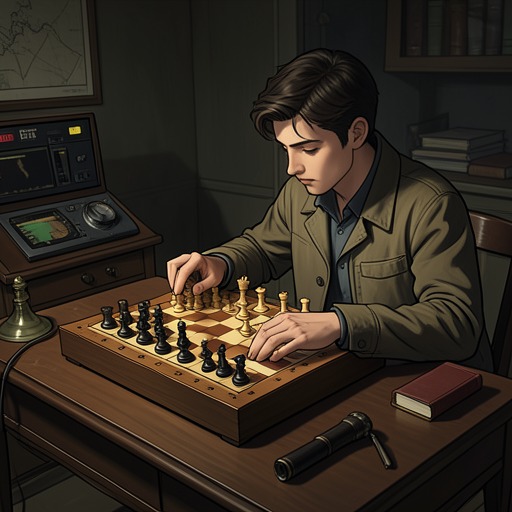
The account identifies Jinzhen as a cryptographer, and the clearest public measure of his ability is his cracking of PURPLE. A year after detractors have challenged him, that achievement serves as the decisive answer to them. The narrative later states the result plainly: PURPLE has been cracked. His accomplishment is not presented merely as a private intellectual triumph; it changes how others assess his capacity and helps explain the adversary’s later response.
Jinzhen’s work on BLACK brings a different ordeal. After a conference disappoints him, he recognizes that hoping someone else will supply the advice or correct path for deciphering it is futile. He repeats to himself that he should count on no one but himself. The scene shows both persistence and isolation: his resolve is a response to disappointment, but the repeated appeal to self-reliance also underscores how little guidance he believes he can expect. Later, another speaker corrects the credit for deciphering BLACK, saying that Jinzhen was the one who did it and that the speaker’s own fame is unwarranted.
An old man offers the strategic explanation for BLACK’s creation. According to his account, its makers had become dispirited after PURPLE was deciphered and saw their work at a dead end. Their confrontation with Jinzhen convinced them that his talent was formidable; they feared that continuing to challenge him would lead to their destruction. They responded by creating BLACK, a cipher with no key, despite the condemnation this would invite. This explanation enlarges the significance of Jinzhen’s success: the adversary’s design is described as a reaction to the danger they perceive in him.
Collapse and the Missing Notebook
Jinzhen’s public image of exceptional ability is sharply interrupted when he collapses on a platform. Those present see a brief change in his eyes, after which he goes rigid and falls. The scene offers no diagnosis or detailed account of what has happened; its force comes from the suddenness with which a person regarded through the lens of intellect becomes physically vulnerable in front of witnesses.
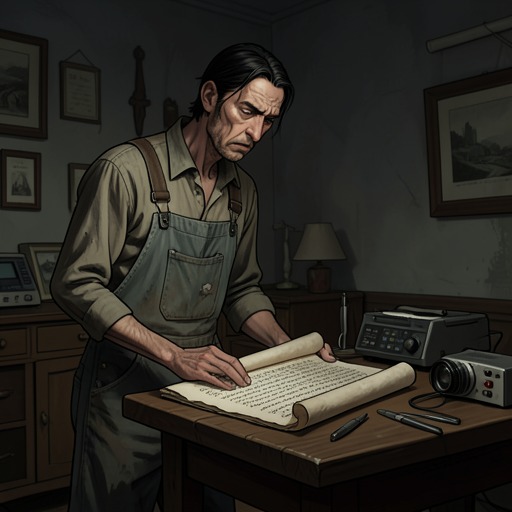
The disappearance of his briefcase becomes another crisis, closely tied to his attachment to his notebook. Vasili finds him on 3 January 1970, at four in the afternoon, the sixteenth day after the briefcase went missing. In a later encounter, Jinzhen initially does not notice the narrator watching him. After eating, he rises to leave, their eyes meet, and he approaches with difficulty, extending both hands. His repeated request for the notebook is the only thing he manages to say. The account makes the notebook’s importance palpable through this single, strained appeal, without reducing its contents to cryptographic work alone.
Marriage, Private Feeling, and Narrative Limits
The notebook also offers evidence of a private emotional life. Its contents are jumbled and at times obscure, but a later reader can trace Jinzhen’s growing love for Di Li, especially in its final sections. The narrator suspects that Di Li removed passages because they contained intimate feelings and may have been even more obscure than the rest. When asked whether Jinzhen had expressed his love plainly, Di Li says he had not, while allowing that some of his words may have carried that meaning. The surviving notebook therefore reveals a progression of feeling without yielding a straightforward declaration or a complete account of the relationship.
According to Di Li, on the third afternoon after leaving hospital Jinzhen came to her office and personally handed over the notebook. Her work as a security guard required her to inspect submitted notebooks for missing or extra pages. Jinzhen told her that it contained no work-related secrets, only his personal ones, and invited her to read it and reply if she was curious about him. The act joins the official procedure of inspection to an unusually personal invitation: the notebook is both a document subject to scrutiny and a means through which Jinzhen makes himself known.
Di Li recounts that she asked Jinzhen to let her be his wife, that he answered yes, and that they married three days later. Asked whether she loved him, she described her love as comparable to her love for her country. The narrator reports her manner as emotionally restrained, but admits that this does not reveal what she felt at the time or when she later told the story. He likewise acknowledges that he understands Jinzhen’s genius and cryptanalytic power better than his emotions, friendship, or intimate exchanges. That limitation is part of Jinzhen’s characterization: the record preserves concrete achievements and fragments of affection, while leaving the person behind them only partly visible.
Reputation and Significance
Jinzhen’s story repeatedly sets other people’s judgments against evidence they cannot comfortably contain. At school, classmates mistake difference for stupidity even as his grades surpass theirs; in cryptography, skeptics are answered by his success against PURPLE; in the account of BLACK, a speaker relinquishes fame in his favor. Yet accomplishment does not make him fully knowable. His illness changes the course of his education and keeps him in China, secrecy separates him from his family, and the lost notebook becomes a point of acute distress as well as a record of private feeling.
Looking back on Jinzhen’s past and present, the narrator expresses reverence for his mystery and genius alongside profound desolation. That double response gives the portrait its shape. Jinzhen can be named, tracked through decisions and consequences, and credited with extraordinary work; but the people telling his story cannot reconstruct all that he felt. The notebook seems to promise access, yet some of its pages are missing and others remain obscure. His legacy is therefore both a record of deciphering and an unresolved question about what even the closest observers were able to read.