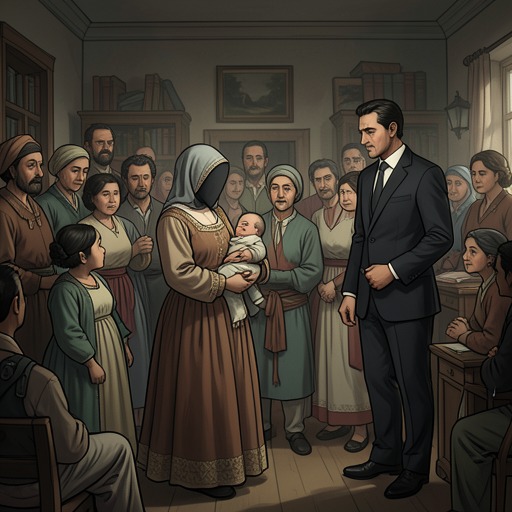
Mr Auslander
DecodedMr Auslander is a foreign dream interpreter who becomes the one person in the Rong household to treat Duckling as a child rather than a family scandal. His knowledge of the Rong genealogy allows him to understand the boy’s concealed origins; his daily care makes him a father in practice; and, facing death, he tries to secure Duckling’s future with a letter to Young Lillie. His story is marked by a striking contrast: the man once harmed for interpreting other people’s words gradually loses the power of speech, yet continues to communicate through writing, ritual, and care.
Identity and Work
Mr Auslander had been invited to the Rong household to interpret Grandmother Rong’s dreams. She adored him, but his work could provoke dangerous reactions. After he interpreted a dream for a tea merchant at the docks, the merchant’s anger led to a beating that broke both Mr Auslander’s arms and legs and destroyed one of his bright blue eyes. He crawled back to the Rong Family Mansion, where the family took him in as a kindness to Grandmother Rong. He remained there for the rest of his life.
He eventually found a role in the household that suited his knowledge and attentiveness: compiling the Rong genealogy. Over the years he learned the histories of its branches, including its legitimate and illegitimate descendants, their fortunes, and their movements. His notes made him unusually well informed about the family’s secrets. When the old servants caring for the newborn Duckling asked him to choose a name, Mr Auslander understood why the task was delicate: he knew the baby’s exact place in the family and the scandals surrounding his birth. He first considered the problem of the child’s surname, setting aside the available possibilities as unsuitable or liable to revive painful family history. Instead, he chose the affectionate name Duckling, which displaced the frightening label Grim Reaper that neighbors had used for the child.
A Father to Duckling
The baby had little standing in the family, and no one seemed to care whether he lived or died. Mr Auslander alone treated him as another human being. After his morning tasks and midday rest, he walked along the pebble path to the old servants’ rooms, sat beside the wooden crate where the baby played, and spoke aloud about his dreams. Though Duckling was too young to understand, Mr Auslander brought him rattles and small pottery toys. The child gradually grew attached to him.
The setting of their closeness was the Pear Garden, where Mr Auslander kept his office. Its old pear trees surrounded a wooden house associated with a servant’s death and stories of ghosts; people were afraid to go there. Yet it became Duckling’s familiar world. When he first managed to move around by himself, crawling rather than walking, he made his way to Mr Auslander’s office. The feared garden thus becomes, in the child’s experience, a place of attachment and refuge.
When Duckling was about three, he called Mr Auslander Daddy for the first time. The old man opened his eyes to find the child standing beside him, tugging at his jacket with tearful eyes. Duckling had thought his father dead; in crying out to him, he seemed to bring him back to life. Mr Auslander took him to live in the Pear Garden that same day. A few days later, at eighty, he climbed a pear tree to hang a swing for Duckling’s third birthday. The small act makes his fatherhood concrete: he does not merely claim the child but builds a home and makes a present for him.
The Letter and Duckling’s Future
Eight years later, as the pear blossoms began to fall, Mr Auslander composed a letter to Young Lillie, the son of Old Lillie. He wrote and revised its lines over several evenings, then left the letter in a drawer for more than a year because he feared making a mistake and wanted more time with Duckling. When he recognized that he had little time left, he asked Duckling to post it. Wartime movements delayed its arrival for months.
In the letter, Mr Auslander describes himself as nearing the end of a life that had lasted almost a century and asks Young Lillie to become Duckling’s guardian. He acknowledges that he has cared for the boy for many years, but insists that another person must take over. His appeal rests partly on the bravery and generosity of Young Lillie and his father, which had made Duckling’s birth possible. He also stresses that Duckling belongs to the Rong family and that the child’s grandmother was the person Old Lillie loved and admired most. The genealogy that once let Mr Auslander navigate family secrets now helps him argue for the boy’s place in that family and for his future beyond it.
Illness, Pear Blossoms, and Death
The disease that eventually killed Mr Auslander first appeared in his throat. The story links this illness to the life he had led: his elegant speech had brought him success as an interpreter, while other people’s anger at his words had also brought him harm. By the time he was preparing his final letter, he had nearly lost the ability to speak. His approaching death therefore makes written communication essential, and his last requests to Duckling arrive on paper.
During his silent illness, Duckling brought him water steeped with pear blossoms each morning. The pale flowers opened in the warm liquid as the old man watched. Pear blossoms had become inseparable from their life together: Duckling grew up among them, and Mr Auslander associated their return with joy and a sense of recovered health. He had also made a yearly practice of collecting the falling flowers and asking Duckling to count them, recording totals on the wall and sometimes having him count again. These ordinary repetitions gave the child practical experience with addition and subtraction without formal lessons.
As death approached, Mr Auslander’s written instructions grew more exact. First he asked for pear flowers in his coffin, then for eighty-nine blossoms to match his age, and finally for Duckling to calculate how many days were contained in eighty-nine years and have that number of flowers buried with him. Duckling had never been formally taught mathematics, but his yearly counting had prepared him for the task. Asked why he had made the calculation, he explained that he was working out how many days Daddy had lived. Mr Auslander’s final request thus joins the two inheritances he leaves the child: the pear blossoms of their shared home and the habit of attending closely to number. His death ends their life together, but the care and simple lessons through which he raised Duckling continue beyond him.