Yan Shi
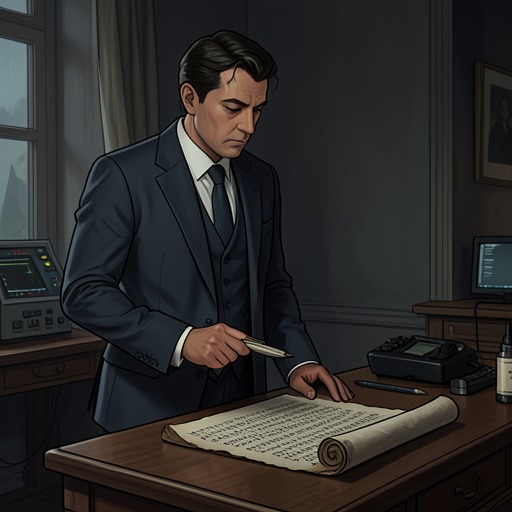
DecodedYan Shi is the Unit 701 cryptanalyst credited with deciphering BLACK, but his own account overturns the simple story of a lone codebreaker’s triumph: the decisive clue came from Rong Jinzhen’s notebook, and Yan ultimately insisted that Rong had done the essential work. His character emerges through this tension between ambition, isolation, and belated acknowledgment, while the cipher’s key—zero—turns an apparently formidable barrier into a false façade.
Position in Unit 701
Yan served as Rong Jinzhen’s immediate subordinate when Rong was section chief. He recalls the department at its height, with a much larger section than the diminished one he later knew. The winter when Rong lost his mind, which Yan dates uncertainly to 1969 or 1970, marks the point from which his own account of the BLACK breakthrough looks backward. Director Zheng was another section chief at the time; he had discovered Rong, and the two men had studied mathematics at N University.
Yan’s place in this hierarchy was not merely administrative. He had worked close to Rong before Rong’s mental collapse, and later claimed that the notebook left by his former chief enabled him to see what Rong’s attack on BLACK had not revealed. Their professional relationship thus became the ground for both Yan’s accomplishment and the dispute over who deserved its credit.
Reputation and estrangement
When the narrator first hears that BLACK has been deciphered, Director Zheng identifies Yan as the man responsible and says he is still alive. Zheng later voices the prevailing resentment: many at Unit 701 believed Yan had gained too much from an achievement made possible by Rong’s notebook and the work Rong had already done. The narrator reports that Yan had acknowledged this dependence in their interview, though Zheng is surprised to hear it. The disagreement establishes a gap between the unit’s suspicion of Yan and Yan’s later, more candid account.
The narrator also allows for an unflattering interpretation of Yan’s earlier conduct. He may initially have tried to push Rong aside and deliberately made himself estranged from the rest of Unit 701. The evidence does not explain his motives, and that uncertainty matters: Yan’s later recognition of Rong does not erase the account of his earlier distancing. Instead, the two aspects remain together—a subordinate accused of maneuvering for distinction, and an old man who eventually gives away the distinction attached to his greatest success.
After retiring, Yan left the confines of Unit 701 and lived with his daughter in the capital of G Province. The narrator travels from Unit 701 to visit him, reaching the city in three hours by expressway and finding the daughter’s home without difficulty. Yan is already well over seventy, nearer eighty, with thick-lensed spectacles and silver hair. During the visit, he sits at a Go table alone, moving meditation balls in one hand and holding a white Go stone in the other. His fifteen-year-old granddaughter says he is hard to draw away from the game. The solitary match gives the interview a fitting frame: Yan is described as a man who had set himself apart, now facing himself across the board.
The confession about BLACK
In the interview, Yan first says that Rong helped him decipher BLACK, then corrects himself: Rong, he says, was the one who deciphered it, while Yan’s reputation was undeserved. The admission does not deny that Yan completed the act of cracking the cipher. Rather, it revises what that act means. Rong had worked on BLACK for years without finding an error in it; Yan says he saw the hidden secret only in the midst of Rong’s ruin, with the notebook carrying the earlier work forward.
Yan remembers the discovery as an episode of mounting excitement and uncertainty. He could not recall exactly when it happened, but places it in the early hours of the morning, around three. He describes pacing in a silent office, trying to restrain himself while listening to his own excitement. At last he took out the calculator gifted to Rong by Headquarters, capable of more than 40,000 calculations, and tested his unusual assumption. The offices were then underground in a mountain cave. Once BLACK was deciphered, Yan rushed out, fell to the ground, and wept and worshipped heaven and earth while it was still dark, just before dawn.
The key he found was zero. Yan describes it as a cipher that had no real lock: what appeared securely closed was only a façade, and a push was enough to open it. He also says that the key was in a leather attaché case. The simplicity of the answer helps explain why it had been difficult to trust; even after the door had opened and its contents were visible, he struggled to believe that the solution was real. His breakthrough was therefore not simply the discovery of an obscure technical trick. It was a recognition that the apparent demand for a key concealed its absence.
Credit, chance, and the cost of success
Yan does not present his success as proof that he surpassed Rong. He attributes his access to the solution to Rong’s notebook and argues that deciphering depends on a mixture of ingenuity and good fortune. In his telling, luck was not a decorative addition to hard work: the door looked locked, but the lock was not there. Had it truly required a key, he says, he would never have been able to open it. The unusual solution remained so counterintuitive that even seeing what lay beyond it did not immediately make it believable.
His account also makes the notebook more than a record of prior calculations. It is the material link between Rong’s unfinished effort and Yan’s eventual discovery. Yan says that Rong’s collapse was the setting in which he saw BLACK’s secret, but he refuses the heroic version in which that discovery belongs to him alone. In retrospect, his fame is presented as an inheritance from a colleague whose work survived him in written form.
Near eighty, Yan tells the narrator that these disclosures are personal secrets he has never shared. He explains that he no longer needs to live with the undeserved glory and that death may come at any time. The interview thus changes the apparent meaning of the original report that Yan deciphered BLACK: the code was indeed opened by him, but the credit, in his final account, belongs chiefly to Rong Jinzhen. That correction is not a footnote to the achievement; it is the revelation that makes Yan’s story consequential.