Rong Yinyi
DecodedRong Yinyi is the eldest daughter of Young Lillie and a senior figure at N University, where she was known as Master Rong. She never married, not because she had never loved, but because her love for a young man from the university’s physics department had been profound and painful. Her account of that attachment and her memories of Rong Jinzhen make her more than a source of family background: she is a witness whose private losses help frame the costs of waiting, loyalty, and belonging.
Family and Position at N University
Rong Yinyi appears in the family photograph taken in the summer of 1936, when she was in her twenties. Her parents, Young Lillie and his wife, sit in the front row; Rong Yinyi stands behind them with a shoulder-length bob, beside her younger brother, who was preparing to study abroad, and her younger sister, then about seven or eight. The photograph commemorated the brother’s departure. The war delayed his return until 1945, and the family’s composition changed in the intervening years: her younger sister died during an epidemic, while Rong Jinzhen joined the household that same summer.
Years later, Rong Yinyi had retired as head of N University’s Department of Mathematics. Her position gave her a view of both the university’s public life and its intimate reputations. She remembered the talk surrounding Jan Liseiwicz, whose decision to lend books to Jinzhen alone drew speculation about his motives. In another recollection, she described collecting Jan Liseiwicz at the docks after he returned from Europe in the first winter after the Second World War. The wooden packing case he had brought back was so large that it would not fit in the university’s Ford; she had to arrange a cart and four men to transport it to the department. Her memories preserve academic life not as an abstract institution but as a world of books, favors, gossip, and practical errands.
A Love Interrupted by War
When Rong Yinyi was young, she fell in love with a gifted physics student at N University who specialized in wireless technology. He was known for his ability to assemble a triple-waveband radio from scratch in a few hours. After the War of Resistance began, he left his studies to join the army, like many patriotic students at the university. For the first few years, he and Rong Yinyi kept in touch; then their correspondence gradually stopped.
His last letter to her came from Changsha in the spring of 1941. He explained that he had entered top-secret military research and would have to cut off contact with family and friends for a time. He repeatedly affirmed his love and asked her to wait. The letter promised that their wedding would take place once the Japanese were defeated. Rong Yinyi waited through the end of the war and then through the Liberation, but he did not return, and for years she had no news even confirming whether he was alive.
In 1953, someone arriving from Hong Kong brought the explanation: her former lover had gone to Taiwan years earlier, married, and had children. He told her to find someone else. Rong Yinyi’s long devotion ended not with reunion or certainty about his wartime fate, but with a message that closed off the future she had expected. The account says she never really recovered from the shock. Her story stands beside Jinzhen’s as another history shaped by attachment, although hers is a wait for a lost partner rather than a child’s search for a secure place in a family.
Rong Jinzhen’s Place in the Household
Rong Yinyi and her mother did not know Jinzhen existed until after her younger sister had died. Young Lillie had concealed the boy at the home of Cheng, a nearby primary-school headmaster, and had not told his wife or daughter. The secret came out when Cheng visited to offer condolences. After Young Lillie explained Jinzhen’s misfortunes, exceptional intelligence, and the request made by Mr Auslander, Rong Yinyi’s mother was moved to tears. With one daughter gone and a bereaved boy in need of a family, she urged Young Lillie to bring him home.
That decision made Jinzhen Rong Yinyi’s younger brother in everyday life, though family titles did not follow the family tree neatly. She and her mother called him Zhendi, while Young Lillie called him Jinzhen. Jinzhen called his mother Mummy, his father Professor, and Rong Yinyi Sis; by formal generational reckoning, she would have been his aunt. The mismatch between genealogy and household speech captures how his place was made through care and daily practice, not simply through a settled name or conventional kinship role.
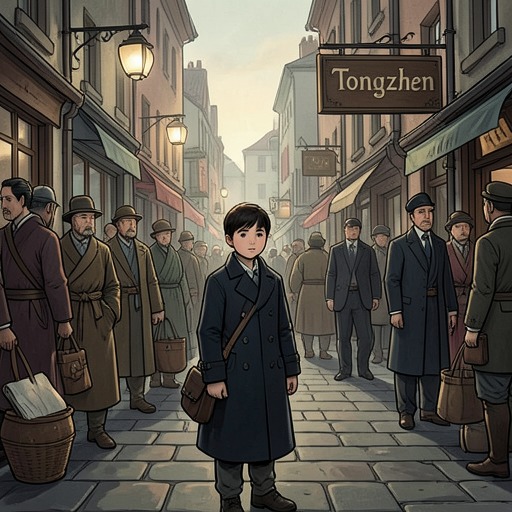
Rong Yinyi did not immediately welcome him. She recalled that he arrived without smiling or speaking, moved silently through the house, belched while eating, and left his shoes by the stairs without washing his feet. The shoes’ odor in the dining room and corridor, she said, could put her off her meal. Her first response was irritation and aversion, not instant affection. The family’s decision to keep him nonetheless became lasting: after he joined them that summer, he stayed until he obtained his first job. When his independent mathematical ability became apparent, Young Lillie enrolled him in the middle school attached to N University and decided that he should continue living with the family rather than board nearby.
Witness to Jinzhen’s Temperament
Rong Yinyi’s testimony joins affection to close observation. When Young Lillie later explained how Mr Auslander had asked Jinzhen to calculate his age, she understood the boy’s distress over an error as evidence of his attachment to the old man. Mr Auslander had died aged eighty-nine and lived through twenty-two leap years; accounting for those days brought Jinzhen’s calculation within the stated margin of error. Young Lillie had first scolded and then coaxed him until he calmed down. For Rong Yinyi, the episode revealed both his love for Mr Auslander and his difficulty forgiving himself for a mistake.
She described a temperament that could seem quiet and self-contained, and that could endure what others would find intolerable, but could also become stubborn and fiery when something touched a particularly vulnerable part of him. His loss of control, she observed, could take the form of an extreme act. As an example, she recalled the secret message he wrote in his own blood, declaring that Young Lillie was dead and that he would devote the rest of his life to caring for his mother. The episode expresses Jinzhen’s fierce attachment in a form that unsettled the household: his love was not merely a feeling but an absolute obligation he imposed upon himself.
His unusual habits had already marked him out at school. Other pupils called him Big-head because of his large head; they also noticed his absorption in counting ants, his dog-fur-trimmed scarf, his lack of restraint in class, and his practice of writing homework twice, once in Chinese and once in English. Rong Yinyi’s memories of his habits at home and the wider account of his school years together show how easily difference became a public nickname, even as the family learned to recognize the intelligence and attachment beneath it.
Narrative Role
Rong Yinyi’s account is retrospective and specific: a family photograph, a concealed child, an awkward set of kinship titles, a pair of discarded shoes, a letter that never led to a reunion. These details make her a crucial witness to the distinction between being related and being accepted. Her mother’s decision gave Jinzhen a home; Rong Yinyi’s later recollections show that belonging did not erase the discomfort of his arrival, but grew alongside it.
Her own history complicates that testimony. She spent decades waiting for a man who had asked her to wait, only to learn that he had made a life elsewhere. Jinzhen, meanwhile, formed attachments that could become consuming, and whose force she saw in his distress, his private message, and his devotion to those he considered family. Through Rong Yinyi, the novel places these different forms of fidelity beside one another without making them equivalent: her memories record both the cost of a promise that went unfulfilled and the household choices through which an excluded child was taken in.