Killer
DecodedKiller is the son of Rong Youying whose short, violent life consumes much of the Lin family’s wealth and whose posthumous legacy threatens the child born to a mysterious woman. First named for the size of his head and the circumstances of his birth, he becomes known simply as Killer. His story turns inheritance into a cruel repetition: after his death, a baby bearing his unmistakable resemblance is born into another family’s crisis and is initially treated as the continuation of his violence.
Birth and Identity
Killer’s life begins in the aftermath of Rong Youying’s catastrophic labour. A doctor asks whether he should save the mother or the baby, and Old Lillie insists that the adult should be saved. The attempt to deliver the child ends in organ failure for Rong Youying; an emergency Caesarean section saves the baby, but not his mother. The narration connects the size of his head with the danger of the birth, while also recalling that Rong Youying was nearing forty and was carrying her first child. The child’s survival therefore comes at the cost of the woman whose ingenuity had once sent a couple of tons of metal into the sky.
The Lin family gives the baby an assortment of names, but none displaces the name imposed by the circumstances of his arrival. People call him Killer Head because of his unusually large head and the terrible account of his birth. The name sticks among his friends and, eventually, everyone else. It begins as a label attached to a physical trait and a family tragedy, then seems retrospectively to fit the adult’s conduct. The movement from Killer Head to Killer gives the name a grim double meaning: it recalls both the newborn’s appearance and the harm he later causes.
Violence and the Lin Family’s Decline
The account says Killer entered criminal activity at twelve and died at twenty-two. In that decade, he took part in a dozen or more murders and seduced and abandoned many women. His gambling debts and other troubles repeatedly forced his family to spend money to get him out of difficulty. The narration presents his conduct not as one isolated scandal but as a sustained pattern that reaches from criminal activity into intimate relationships and the family’s finances.
The Lin family had been the richest in the provincial capital. Its shops lined both sides of a major boulevard for two kilometres, a visible measure of its commercial strength. As Killer grew up, that property and wealth rapidly diminished under the costs of his debts and entanglements. The account says that, had he not been killed by a woman, the family might have lost its house as well as its other holdings. His death consequently brings the family relief, but it does not undo the damage or end the consequences of his behaviour.
The Child Who Repeats His Image
After Killer dies, a pregnant woman from outside the province comes to the Lin family and says that her child is Killer’s. The family doubts her claim. Given the number of women he had been involved with, they regard her as one among many, and her arrival from another province deepens their suspicion. They turn her away. She then seeks help at N University, where Old John Lillie, moved by the injustice she has suffered, takes her in. The next day, he orders his son, Young Lillie, to take her to Tongzhen.
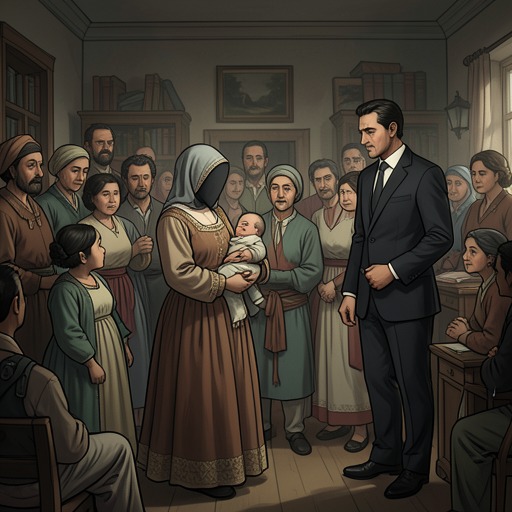
Months later, the woman gives birth in the Rong Family Mansion and dies after a haemorrhage. The newborn’s appearance makes the family’s doubts newly charged: he has Killer’s thick dark hair and large head, and even the same Mongolian spot. These resemblances expose Young Lillie’s earlier deception and make the child appear to the family as the illegitimate son of a murderer imposed upon them. Killer is absent from this episode, yet the story makes his likeness an active force in it: the baby is judged through the dead man’s reputation before he can have any identity of his own.
The infant is at first called the Grim Reaper, a name that makes his presence seem like a threat to the elderly servants assigned to care for him. The family does not recognize him as one of its own, and the possibility of abandoning him is seriously considered. His resemblance to Grandmother Rong, however, changes the outcome. That family connection saves the baby from being abandoned and ensures that he is raised in the Rong Family Mansion. Killer’s legacy thus produces both rejection and, through an unexpected resemblance to another ancestor, the condition of the child’s survival.
Narrative Role and Legacy
Killer’s characterization is delivered through consequences: the fortune he dissipates, the violence associated with his name, and the child whose appearance revives his memory. The contrast with Rong Youying is central. Her extraordinary ability and agonizing death in childbirth are followed by the account of a son whose conduct devastates the family; the narration makes that reversal part of the story’s meditation on the unpredictability of fate, not an explanation of his behaviour.
His role also extends beyond the limits of his lifespan. The family’s relief at his death is immediately complicated by the woman who arrives with his alleged child, and the baby’s resemblance turns a disputed claim into a more unsettling inheritance. Yet the resemblance does not determine the child’s fate completely: the connection to Grandmother Rong offers a counterweight to the name Grim Reaper and the family’s fear. Killer therefore remains consequential in the narrative chiefly as a destructive legacy—one that threatens to define the next generation, even as another strand of kinship interrupts that repetition.