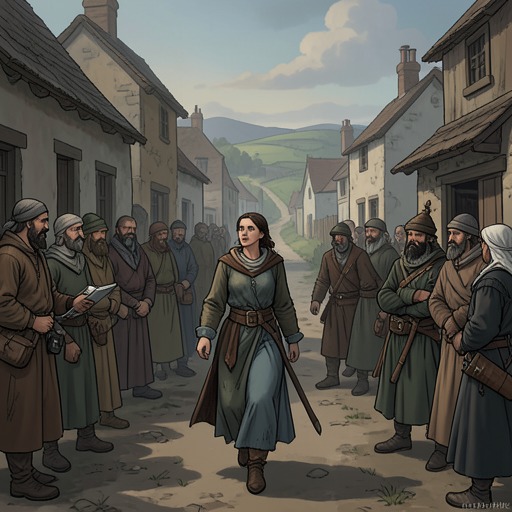
Selvagia
DianaSelvagia is a shepherdess whose misfortunes make her both a participant in the pastoral world of The Seven Books of Diana and one of its sharpest interpreters of love. Her story moves from an unexplained removal from her home and the loss of Alanio to a magically altered attachment to Silvano. Along the way, she challenges the men who blame women for love’s changes, insisting that time, place, and mutual forgetfulness shape affection on both sides.
Identity and Introduction
Selvagia enters the narrative as a singer coming from among the trees beside the river. Sireno, who has been away from the valley, asks Silvano who she is. Silvano describes her as a beautiful shepherdess who has recently been tending her flock in those meadows and is deeply troubled by love. He also reports conflicting opinions about her history: some say she has good reason for her complaint, while others suggest that she has long been at odds with disillusionment. He identifies her as a close friend of Diana and praises her grace and discretion.
Her first appearance is shaped by song before biography. The text identifies her performance as a sonnet, whose movement recalls former happiness while dwelling on the instability of present fortune. Its closing image imagines hope becoming trustworthy only after events have been subdued and the wheel of fortune secured. The image gives formal shape to the uncertainty that her story will describe: in this pastoral world, neither a beloved’s promises nor an apparently settled condition can make the future still.
Love, Loss, and Displacement
When Selvagia joins Sireno and Silvano, their conversation turns to the men’s complaints about women. Silvano argues that women forget those they once loved, especially after an absence. Selvagia answers that women are forgotten by men too, and that what love makes and unmakes may be moved or silenced by changing times and places. She rejects the claim that women’s understanding is at fault. Her broader complaint is that men judge women by incompatible standards: speech can be taken as proof of desire, silence as pride, reserve as hypocrisy, and frankness as excess. Whether a woman is praised or condemned, she argues, depends too readily on whether she conforms to a man’s inclination.
Selvagia presents her own experience as the ground for this answer, calling herself perhaps the most mistreated by love’s erratic effects. In her account, she had lived in a village by the Douro River, near the Temple of Minerva. The region’s quiet pastoral routine was periodically interrupted by the festival, when shepherds and shepherdesses gathered for songs, hymns, and contests. This setting places her private history within a communal world of ritual and performance, but it does not protect her from the consequences of love or family decisions.
After she sings, Ismenia is among those moved to tears. The next day, without explaining why, Selvagia’s father takes her from their village and brings her to the home of her aunt Albania in the village where the other shepherds live. Selvagia says she remains there for several days without knowing the reason for her removal. She later learns that Montano has married Ismenia and that Alanio intends to marry another of Ismenia’s sisters, Silvia. Although she has been separated from the life she knew and speaks of her own bad fortune, she wishes Alanio happiness with his new wife. Her expressed love for him is thus joined to a generous wish for his contentment, even as the news confirms that her hopes have not been fulfilled.
Silvano and the Change of Affection
Selvagia’s relationship with Silvano emerges through the story’s wider argument about constancy and change. At first, Silvano is devoted to Diana, while Selvagia’s account concerns her attachment to Alanio. Later, Felicia’s magic changes the shepherds’ affections. When Selvagia wakes, she immediately asks where her Silvano is. Felicia tells her that Alanio is at the door with his father’s permission to marry her; Selvagia replies that such permission is useless without the consent of her own thoughts and asks again for Silvano. Hearing her, Silvano comes into the room. The two look at one another with love and confirm an attachment that, the narrator says, only death could end.
The scene makes the change legible through Selvagia’s choice as well as through the magic that has altered her feelings. The proposed return to Alanio does not draw her back: she refuses to treat paternal permission as a substitute for her own will, and her attention is fixed on Silvano. Felicia tells the shepherds that her favor will remain available and that their love should end in marriage to the person each desires. The promise gives their newly formed bond a prospective social conclusion, though the episode does not narrate their eventual wedding.
Mutual Love and Narrative Significance
On the journey back to their flocks, Selvagia and Silvano appear as lovers reunited after a long absence. Sireno, by contrast, neither loves nor cares whether he is loved, a condition he associates with his altered state. Silvano remarks on the change in his friend, while Selvagia observes that the harm fortune might bring cannot equal the good of being so well matched. She also says that Felicia caused her to love someone she had never ceased seeing before. Her exchanges with Silvano turn their new relationship into an answering bond: each speaks of owing the other, and each treats the other’s life as inseparable from their own.
Selvagia’s part in the pastoral narrative therefore links its recurring concern with fickle love to a critique of who is blamed for it. She has known separation, unexplained family intervention, and the news of Alanio’s intended marriage; later, magic redirects her affection toward Silvano, and she embraces the new bond rather than the marriage proposed for her with Alanio. Her account does not make love’s reversals simple or entirely voluntary, but her defense of women insists that change cannot be explained by female inconstancy alone. Through song, debate, and the contrasting outcomes of her attachments, Selvagia gives the pastoral world a voice that is at once wounded by fortune and alert to the unequal judgments through which lovers describe one another.