Gretchen Hanley
ErasureGretchen Hanley enters the novel at the point where a family history becomes a present encounter. Thelonious Ellison finds her after learning that she may be his half-sister, identifies Benjamin Ellison as his father, and brings her a letter Benjamin wrote before he died. The meeting offers a concrete connection between them, but it does not settle what Gretchen knew, what she feels about the discovery, or whether she accepts what Thelonious brings.
Identity and Background
Gretchen is the daughter of Benjamin Ellison and, consequently, Thelonious Ellison’s half-sister. That relationship is presented as a recent discovery for Thelonious: he tells another person that Gretchen appears to be his half-sister, then seeks her out and explains that Benjamin was his father. The scene establishes the kinship from Thelonious’s side of the encounter; it does not say whether Gretchen already knew about Benjamin or about her connection to Thelonious.
The distinction matters because the family link is not introduced through a shared memory or an established relationship. It arrives through identification and evidence: Thelonious finds Gretchen’s name on a box, presses the bell, and later places Benjamin’s letter before her. The reader encounters her within that process of verification, as a person connected to the family past whom Thelonious has only now located. The narrative supplies her name and parentage, but little independent background beyond the circumstances of this meeting.
The Search and First Encounter
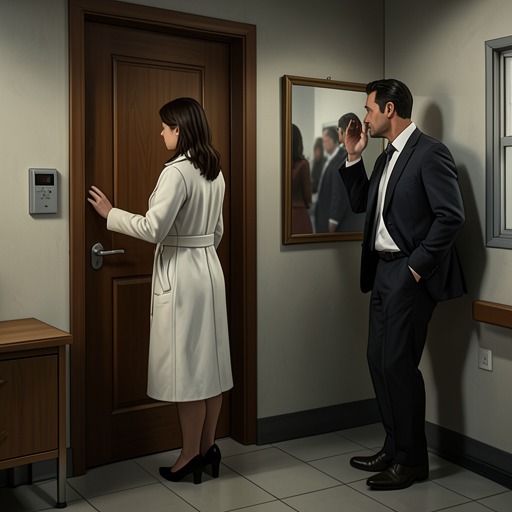
Thelonious goes directly to find Gretchen. At the building, he sees her name on a box and presses the bell. This detail makes the search specific and practical: he has come to a particular address, and the name he finds confirms that he has reached the person he is looking for. The evidence does not describe the length of the search or explain how he obtained the address, so the encounter begins at the moment of contact rather than recounting the steps that led there.
The conversation is direct. Thelonious identifies Benjamin as his father and says that Gretchen appears to be his half-sister. He does not soften the fact or allow the relationship to remain an implication. His decision to come to the point gives the meeting a plain, almost procedural shape: first he establishes who he is and why he has come; then he presents the letter and raises the matter of money. Gretchen’s own account of the family, however, is not included in the available scene, and the directness of Thelonious’s approach does not tell the reader how she understands the disclosure.
Thelonious says that he does not like Gretchen, while also recognizing that her bitterness should not surprise him. The remark establishes an immediate strain in the encounter without explaining its history. The scene does not identify what prompted her bitterness, whether it is directed at Thelonious, Benjamin, or the situation as a whole, or whether it changes over the course of their conversation. Her characterization is therefore sharply but narrowly drawn: she meets the revelation in a context Thelonious perceives as bitter, while the reasons remain unstated.
Benjamin’s Letter and the Money
The letter supplies a second form of connection between Gretchen and Benjamin. Thelonious tells her that Benjamin wrote it before he died, that he has only recently found it, and that finding it led him to track her down. He puts the letter on the table in front of her. The gesture makes the family history an object physically present between them, but the letter’s contents are not disclosed in this evidence. It is possible to establish its origin, its timing, and the role it plays in bringing Thelonious to Gretchen; its message cannot be reconstructed from the encounter alone.
Thelonious also tells Gretchen that Benjamin wanted her to have money. He takes out his checkbook and pen, indicating an intention to provide it, but the scene does not confirm that he writes or gives her a check. Nor does it establish the amount or whether Gretchen accepts the offer. Her subsequent question—“This is real?”—registers uncertainty at the close of the exchange. Because it follows both the presentation of the letter and the offer of money, its precise referent is not made explicit; the question should not be treated as proof of acceptance or as a settled response to either item.
The sequence links Benjamin’s posthumous intentions to Thelonious’s actions in the present. The letter explains why he has sought Gretchen, while the offer of money gives his visit a material consequence beyond announcing their kinship. Yet the exchange stops short of resolution: Benjamin’s wishes are reported by Thelonious, and the scene does not show the transfer completed or Gretchen’s final decision. Her question leaves open whether the evidence, the offer, or the reality of the connection itself is what she is trying to verify.
Narrative Role and Limits of the Encounter
Gretchen’s introduction changes Thelonious’s understanding of his family by revealing a half-sister he has not previously known he had. The discovery is tied to Benjamin’s past and reaches Thelonious through a letter found after Benjamin’s death. In this way, Gretchen is not merely a new name in the family account: locating her turns the father’s concealed or previously unknown connection into a meeting that demands action from his son.
The scene’s restraint is important to how that change is presented. Thelonious can state the relationship, produce the letter, and offer the money, but those acts do not automatically create trust or settle the past. Gretchen’s bitterness and final question keep the encounter open at its ending. The evidence does not establish whether she welcomes Thelonious, accepts the money, reads the letter, or forms a continuing relationship with him. Her significance here lies in the revelation she embodies and in the unresolved response that follows it: Benjamin’s family history has reached her door, but the scene does not tell the reader what she will make of it.