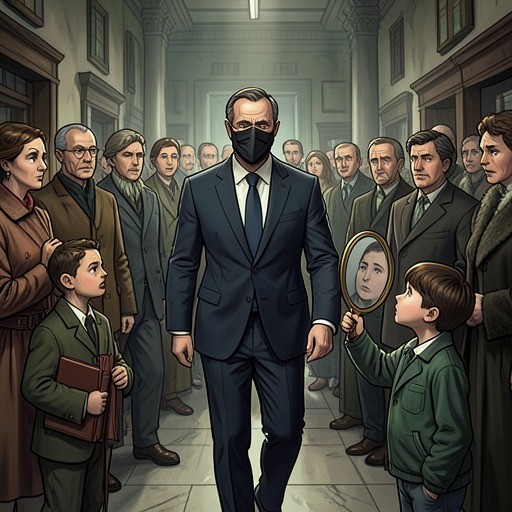
Wiley Morgenstein
ErasureWiley Morgenstein is a Hollywood producer whose interest in My Pafology joins commercial instinct to an expressed desire for artistic and professional recognition. First seen considering the book’s market value, he later flies to Washington to meet its author, Stagg R. Leigh. Their lunch makes his dual approach visible: Morgenstein praises the novel’s humor, sadness, and apparent realism while treating its dialogue as material that could move directly onto the screen.
Position and First Assessment
Somewhere in Hollywood, Morgenstein smokes a cigar beside a pool with a large New Jersey man he had attended Passaic Junior College with for two years, thirty years earlier. The scene places his calculation of My Pafology’s potential inside an easy, private setting, but the terms of his attention are distinctly commercial. He smiles, relights his cigar, and says, “They go to the movies now, these people. There’s an itch and I plan to scratch it.” The remark casts an audience as a demand to be answered and the novel as a possible means of doing so.
Morgenstein’s interest is not presented as a matter of marketability alone. He calls the book good and says, “This one will get me taken seriously.” The comment links his judgment of the novel to his own standing: the project might be commercially valuable and confer professional legitimacy on the person who backs it. The scene thus gives his enthusiasm two measures, audience appetite and the seriousness he hopes the work will bring him. His brief exchange about shuffleboard sits beside these larger calculations, keeping the conversation informal while the book’s prospects remain its underlying subject.
He also wants access to the person behind the manuscript. Morgenstein says, “I’ve gotta meet the writer though. I want to know the hand that wrote this book. You know what I mean?” The phrasing makes authorship itself part of what interests him: the book has a “hand” behind it, and he wants to encounter that maker rather than deal only with the work at a distance. This impulse does not displace his commercial reasoning; it accompanies it. The novel’s potential, its ability to bolster his reputation, and his curiosity about its author all converge in his decision to arrange a meeting.
The Meeting in Washington
When Morgenstein flies to Washington to meet Stagg R. Leigh, the author prepares with visible nervousness. Stagg practices a frown in the mirror, shaves off his mustache, tests a hat and rejects it, then chooses brown weejuns, khakis, and a white shirt with blue stripes. He puts on his dark glasses and arrives late at the restaurant on the roof of the Hotel Washington. These details establish the meeting as a performance for Stagg before Morgenstein has said anything: the writer is trying out how to appear to the man who wants to meet him.
Morgenstein, by contrast, has selected a booth inside the dimly lit main room rather than a table on the balcony overlooking the White House’s east lawn. He rises with Cynthia, the young woman seated with him, when Stagg arrives. His introduction is courteous and familiar: “Pleased to meet you, Stagg,” he says. “This is my girl Friday, Cynthia.” Cynthia responds with an exaggerated compliment about the privilege of meeting an author of Stagg’s “notable station,” and the narration notes her high-pitched giggle. Stagg does not reciprocate in the same manner. The arrival therefore places Morgenstein between his guest and his companion, managing the introduction while the author’s reserve contrasts with Cynthia’s performance of admiration.
Praise, Adaptation, and the Offer
Cynthia tells Morgenstein, “You’re not all that fat, Wiley,” and he ignores the comment. Instead, he turns to the business of the meeting, telling Stagg that his editor was shocked Morgenstein had secured an audience and thanking him for coming. He asks what Stagg would like to drink and summons the waiter. The quick return to the novel and the appointment makes his priorities clear without requiring a formal presentation: he has come to discuss the book, and he wants to make his enthusiasm understood.
His praise is emphatic but also points toward adaptation. Morgenstein says, “Hey, I love that damn novel. I laughed my ass out. Oh, it’s sad too, don’t get me wrong. And real as hell. We can just lift the dialogue right out of the book.” He names comic effect, sadness, and realism as parts of his response, then immediately describes dialogue that can be transferred from page to screen. The movement from emotional appraisal to practical use captures the character’s defining combination: he speaks as an engaged reader while evaluating how the novel might function in another medium. Stagg orders a Gibson as Morgenstein continues.
Morgenstein further insists that his interest preceded the face-to-face meeting: “You know I would have paid for the damn novel even if you refused to meet with me. I just decided to see what would happen. Three mil talks, don’t it?” The statement makes money both the leverage that brought the author to the table and evidence of the scale of Morgenstein’s commitment. Yet the scene records his claim and the offer’s persuasive force, not a completed acquisition or a finished screen production. His importance lies in the threshold he represents: My Pafology has attracted a Hollywood producer who sees it as a property with commercial reach, while the novel’s author remains, for Morgenstein, an essential person to meet as well as the source of usable dialogue.